
Why Everyone Is Watching Universal Insurance Holdings (UVE) Now
Universal Insurance Holdings (UVE) is back on investor radar after a fresh look at its value metrics and earnings profile, which highlight a low P/E, supportive cash flow ratios, and steady investment income.
Recent trading has supported that value thesis, with the share price up 25.75% over 90 days and 48.47% year to date. A 60.89% 1-year total shareholder return indicates momentum that has developed gradually rather than appearing in a single spike.
Scan for other insurance names that show similar value, earnings support, and price momentum to Universal Insurance Holdings with our curated list of 32 high quality undervalued stocks
After a run like this, risk and reward start to feel more finely balanced for Universal Insurance Holdings. The valuation work now decides whether you still treat this as a buy-the-strength setup or a wait-for-the-pullback story.
Most Popular Narrative: 7% Overvalued
The most followed valuation view pegs Universal Insurance Holdings at a fair value of $44, a touch below the last close at $47.08, which frames the current share price as slightly ahead of that model.
Recent strong premium growth outside Florida (+25.4% year-over-year) alongside higher overall policies in force demonstrate the company's success diversifying geographically, which reduces concentration risk and may help stabilize and support future revenue and earnings.
The company is capturing higher premiums due to increases in property values and inflation adjustments, which aligns with broader rising reconstruction and replacement costs. This is cited as a factor that could support top-line revenue and total income.
See why 6 investors see Universal Insurance Holdings as 7% overvalued.
The most popular narrative uses a 7.11% discount rate and still lands on that $44 figure, even though the model assumes revenue drifting lower and profit margins compressing over time. Analysts behind this framework are effectively arguing that the quality of earnings, balance sheet resilience and capital returns can offset those headwinds enough to justify a richer multiple on future earnings than the stock has today.
Analyst expectations inside this approach are conservative on the income statement. Forecasts call for annual revenue to ease by about 1.8% and net profit margins to move from double digits to just above 5%, with earnings modeled at $78.0 million by around mid 2029 compared with $195.8 million today. To reconcile that lower earnings base with a $44 value, the narrative leans on a future P/E of around 18x, materially higher than both Universal Insurance Holdings' current single digit multiple and the wider US insurance peer group cited at 10.9x in the same framework.
Capital allocation choices are central to this story. Ongoing buybacks reduce the share count, which can help support earnings per share even if absolute profits soften, and are interpreted as a signal that management views the equity as attractive around recent trading levels. At the same time, the narrative flags familiar pressure points for a Florida focused insurer, including competition in its core market, reinsurance cost uncertainty and the impact of higher loss and expense ratios on underwriting profitability. These factors sit behind the decision to keep fair value steady at $44.
Result: Fair Value of $44 (OVERVALUED)
Still, higher loss and expense ratios, along with competition and reinsurance cost uncertainty in Florida, could quickly test how durable this Universal Insurance Holdings thesis really is.
Find out about the key risks to this Universal Insurance Holdings narrative.
Another View: Multiples Point To Undervaluation
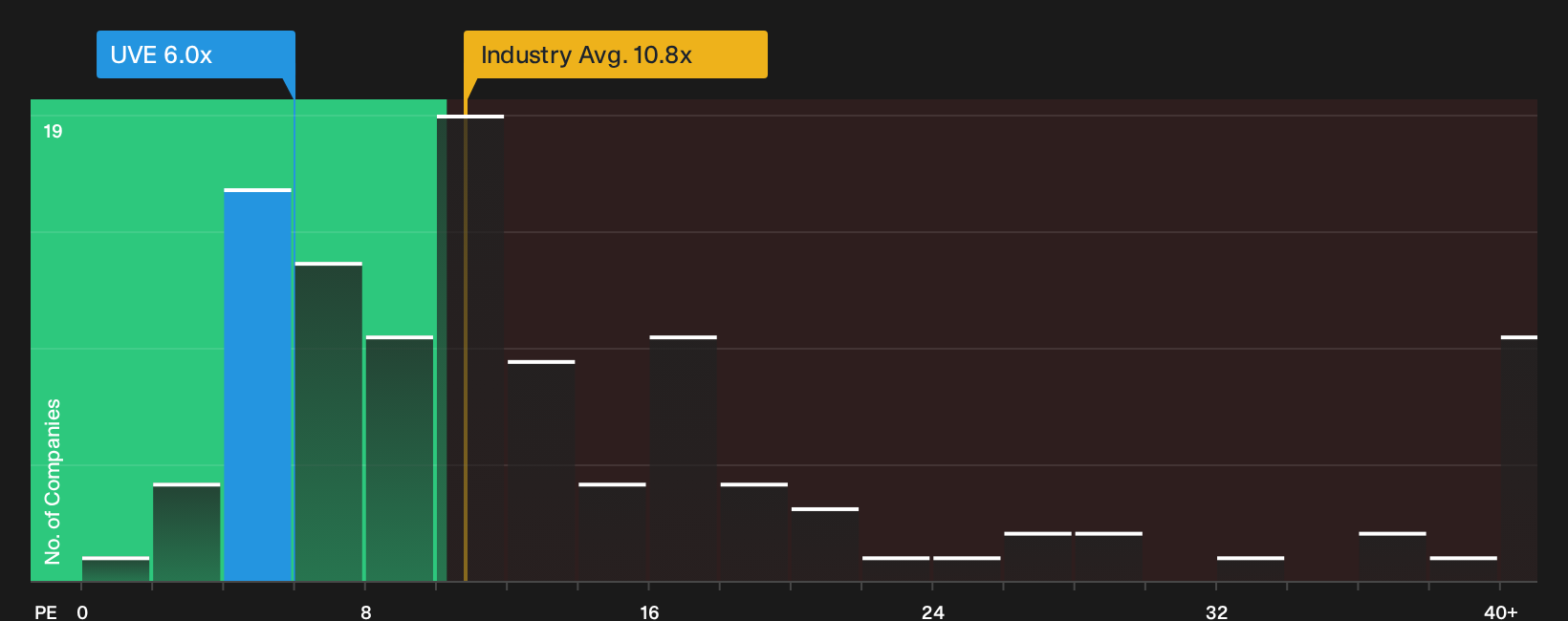
The narrative that Universal Insurance Holdings is 7% overvalued at $47.08 leans heavily on a forward P/E of about 18x in 2029. Today's reality is very different. The stock trades on a P/E of 6x, compared with a fair ratio of 6.9x, the US insurance group at 11x and peers at 19.2x, which signals the current market is attaching a clear discount rather than stretching on optimism.
For investors, that gap cuts both ways. It can reflect genuine concern about forecast revenue and earnings declines, or it can mark out a pocket of potential value if the pessimism proves too harsh. The key question is whether you think this discount closes, or the premium case in the consensus narrative gives way.
See what the numbers say about this price — find out in our valuation breakdown.
Next Steps
Mixed signals around Universal Insurance Holdings can cut both ways, so if you want to move with conviction, weigh the 4 key rewards and 2 important warning signs.
Looking for more investment ideas beyond Universal Insurance Holdings?
If you stop at Universal Insurance Holdings, you risk missing other opportunities that fit your goals just as well, or possibly even better.
- Target potential mispriced opportunities by scanning our value focused universe with 32 high quality undervalued stocks to see which companies share similar traits.
- Strengthen your search for stability by reviewing a list of solid balance sheet and fundamentals (25 results) that can help you focus on financial resilience first.
- Hunt for income-focused opportunities by checking a curated mix of 8 dividend fortresses that may complement a holdings list anchored by Universal Insurance Holdings.
This article by Simply Wall St is general in nature. We provide commentary based on historical data and analyst forecasts only using an unbiased methodology and our articles are not intended to be financial advice. It does not constitute a recommendation to buy or sell any stock, and does not take account of your objectives, or your financial situation. We aim to bring you long-term focused analysis driven by fundamental data. Note that our analysis may not factor in the latest price-sensitive company announcements or qualitative material. Simply Wall St has no position in any stocks mentioned.
Have feedback on this article? Concerned about the content? Get in touch with us directly. Alternatively, email editorial-team@simplywallst.com