
Stellantis Is Betting on New, Affordable EVs. How to Play STLA Stock Here.
Stellantis (STLA), the multinational automaker formed after the 2021 merger of Fiat Chrysler Automobiles and France's Groupe PSA, has unveiled six new concept cars ahead of the Paris Motor Show that will run from Oct. 12 to 18. Stellantis, which is known worldwide for its wide range of popular cars such as Jeep, Peugeot, Citroen, and Alfa Romeo, is looking to gain market share in Europe with these launches amid brutal competition from Chinese players.
However, the irony is that China remains a crucial component of Stellantis's strategy, as the company will have to work closely with its Chinese partners. In fact, two models from its Chinese partner, Leapmotor, will also form part of the aforementioned lineup.
Deliberating on the wider vision behind these cars, Gilles Vidal, Head of Design, Enlarged Europe, said, "With these six concept cars, we are expressing a shared conviction: the future of automotive design must be both bold and meaningful. Each concept explores new ways to enhance everyday experiences while reinforcing the unique identity of its brand. Together, they demonstrate how creativity, innovation and emotion can come together to make people fall in love with cars again."
About Stellantis
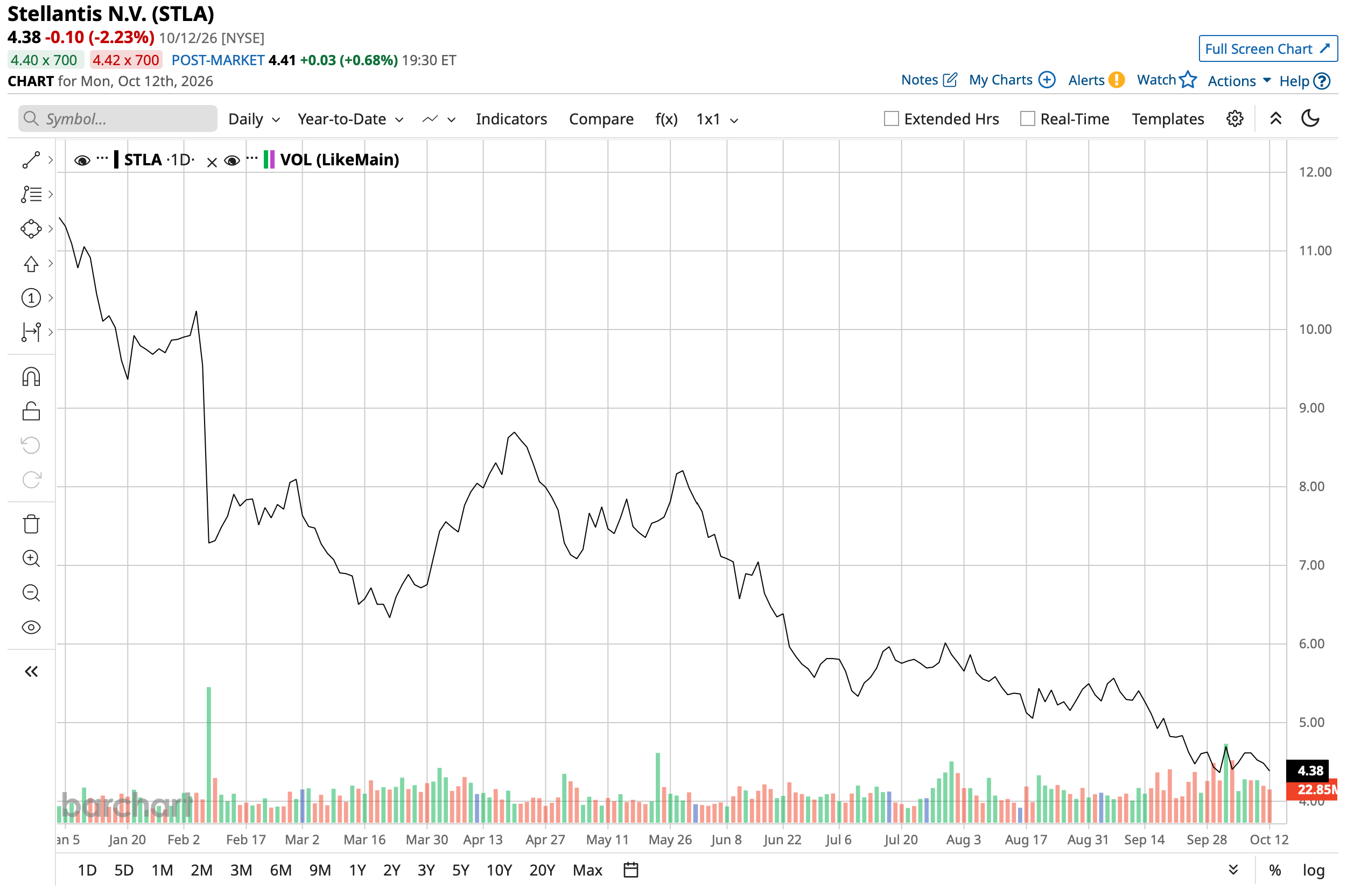
Founded in 2021, Stellantis designs, engineers, manufactures and sells vehicles across passenger-car, SUV, pickup, light-commercial-vehicle and luxury segments. It serves customers in more than 130 markets and operates manufacturing facilities across Europe, North America, South America, and Africa. Valued at a market cap of $16.9 billion, STLA stock is down 59.8% on a YTD basis.
Thus, the stock remains under pressure. Can these new cars and the company's FaSTLAne 2030 strategy have enough heft in them to arrest this decline and lead to a turnaround for it? Let's find out.
In The Fastlane (With Bumps?)
Spreading yourself too thin is not desirable, especially in a capital-intensive industry such as autos. This is where Stellantis hopes FaSTLAne 2030 will be a game-changer for the company. With a planned investment of 60 billion euros over five years, some of the key elements of the strategy include more than 60 new vehicle launches and 50 significant refreshes through 2030.
It also includes a planned mix of 29 battery-electric vehicles, 15 plug-in hybrid or range-extended electric vehicles, 24 conventional hybrids, and 39 internal-combustion or mild-hybrid vehicles, with Jeep, Ram, Peugeot, and Fiat identified as the four brands it will focus on most. Finally, more than 24 billion euros will be earmarked for global platforms, powertrains, and technology.
Now, this is an ambitious ask for a company that reported a 2% revenue decline, an operating loss of 842 million euros, a net loss of 22.3 billion euros (albeit this includes about 25.4 billion euros of unusual charges), and negative free cash flow last year.
Moreover, Stellantis is not the first (and certainly will not be the last) to announce a strategic overhaul. There have been many over the years, with varying degrees of success. While Ford's (F) Ford+ strategy may have improved operating performance, the company remains mired in losses for the EV division and significant restructuring costs. On the other hand, Renault's Renaulution program has had a longer run, and the company claims that its operating margin rose from 3.6% in 2021 to 6.3% in 2025, while automotive free cash flow increased from 1.3 billion euros to 1.5 billion euros.
Thus, the man leading this transformation and his expertise will be of prime importance for Stellantis. For a company veteran like Antonio Filosa, the job could not have been more arduous. Filosa has played a stellar role in South America for Stellantis, where Fiat became the market leader, while Peugeot, Citroen, Ram, and Jeep expanded their positions. He was also involved in establishing the Pernambuco manufacturing hub in Brazil, which helped launch Jeep locally and turned Brazil into Jeep's largest market outside the United States.
Moreover, Filosa, as COO of the high-value American business, worked on reducing excessive dealer inventories, reorganizing leadership, introducing new products and powertrains, and improving relations with dealers, unions, and suppliers. Those were important first steps because Stellantis had suffered from weak U.S. sales and strained dealer relationships. This was reflected in the company's showing in the region for Q2, where revenue rose 13% YoY.
Considering this, devising a turnaround for the whole company is a different ballgame altogether, and the company's Q3 results on October 28 should provide us with an even better picture of whether Filosa is on the correct road.
Gradual Improvements In Q2
Although results are not big yet, Stellantis certainly displayed improvements in the second quarter.
Net revenues increased by 13.1% from the previous year to 43.5 billion euros, while losses turned to profits. From a loss of 0.65 euros per share, Q2 2026 saw the company report an EPS of 0.07 euros. Net revenues in America rose the fastest at 31.5% in the same period while also being the company's largest revenue segment at 18.2 billion euros.
Consolidated shipments rose by just 1.1%, however, to 1.597 million vehicles, with the company gaining market share in North America (7.4% vs 7%) and Africa and the Middle East (12.2% vs 12%), while showing declines in the same in Europe (15.2% vs 15.9%), South America (19.1% vs 23.3%) and Asia (0.2% vs 0.3%).
Coming to cash flows, net cash outflows from operating activities remained identical at 2.9 billion euros for the first six months of 2026, as it was in 2025. Yet, a reduction in negative industrial free cash flow to 921 million euros from a substantial 3 billion euros in 2025 was a positive development. Operating margins improved too, from 0.6% in the year-ago period to 1.8%, but they continue to remain under 2%.
Overall, STLA stock trades at undervalued levels with forward P/E, P/S, and P/CF of 5.89, 0.07, and 4.55, respectively, all below the sector medians of 14.78, 0.85, and 9.69, respectively.
Analyst Opinion On STLA Stock
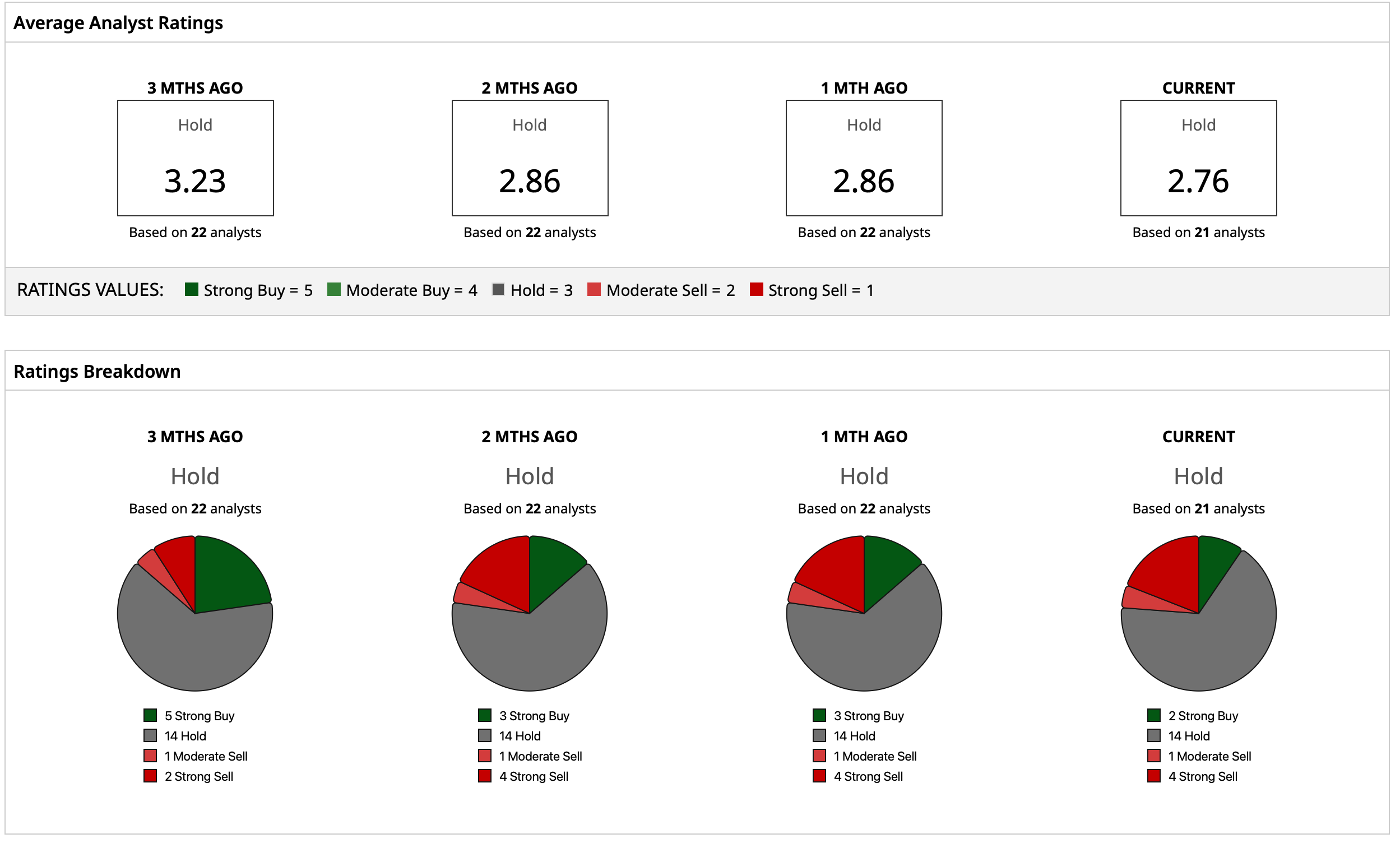
Considering this, analysts have deemed STLA stock to be a “Hold,” with a mean target price of $6.51 that indicates a potential upside of 49% from current levels. Out of 21 analysts covering the stock, two have a “Strong Buy” rating, 14 have a “Hold” rating, one has a “Moderate Sell” rating, and 14 have a “Strong Sell” rating.
On the date of publication, Pathikrit Bose did not have (either directly or indirectly) positions in any of the securities mentioned in this article. All information and data in this article is solely for informational purposes. For more information please view the Barchart Disclosure Policy here.