
Advanced Micro Devices Just Unveiled Its Helion Blueprint for Agentic AI. What That Means for AMD Stock.
Chip behemoth Advanced Micro Devices (AMD) recently unveiled its Helion agentic artificial intelligence (AI) rack, which is powered by AMD Compute and built on an Open Compute Project (OCP) spec design. The platform's highlight is that, unlike Helios (built for frontier AI training), it comes in two configurations.
The first configuration is that of a CPU-only rack that is built on its sixth-generation EPYC silicon, which is capable of scaling to 32,768 CPU cores. This can be used by hyperscalers seeking dedicated capacity to run AI agents, separate from the infrastructure used for model inference. The second configuration is an all-in-one rack that combines AMD EPYC CPU nodes with AMD Instinct MI350P GPU nodes. This version targets enterprise agentic AI deployments.
As the Helion blueprint is built on OCP standards, it gives AMD’s partners a way to build AMD-based systems, which could heighten adoption. Agentic AI has immense potential to become a major enterprise workload, which could mean that Helion can drive higher EPYC demand. Basically, the Helion blueprint indicates that AMD is trying to turn its strength in CPUs into an AI infrastructure platform that benefits from the next phase of the AI boom, i.e., through agentic AI.
Let's take a closer look at AMD now.
About AMD Stock
Advanced Micro Devices, based in Santa Clara, California, is a major semiconductor maker that develops processors and graphics chips for PCs, gaming systems, data centers, and AI workloads.
With a market value of $970.08 billion, the company has become an increasingly important challenger to Nvidia (NVDA) among hyperscale cloud providers. While Nvidia still leads the AI chip market, AMD is expanding its presence with its Instinct accelerators and Helios rack-scale AI platform, positioning itself against Nvidia’s Grace Blackwell and Vera Rubin offerings.
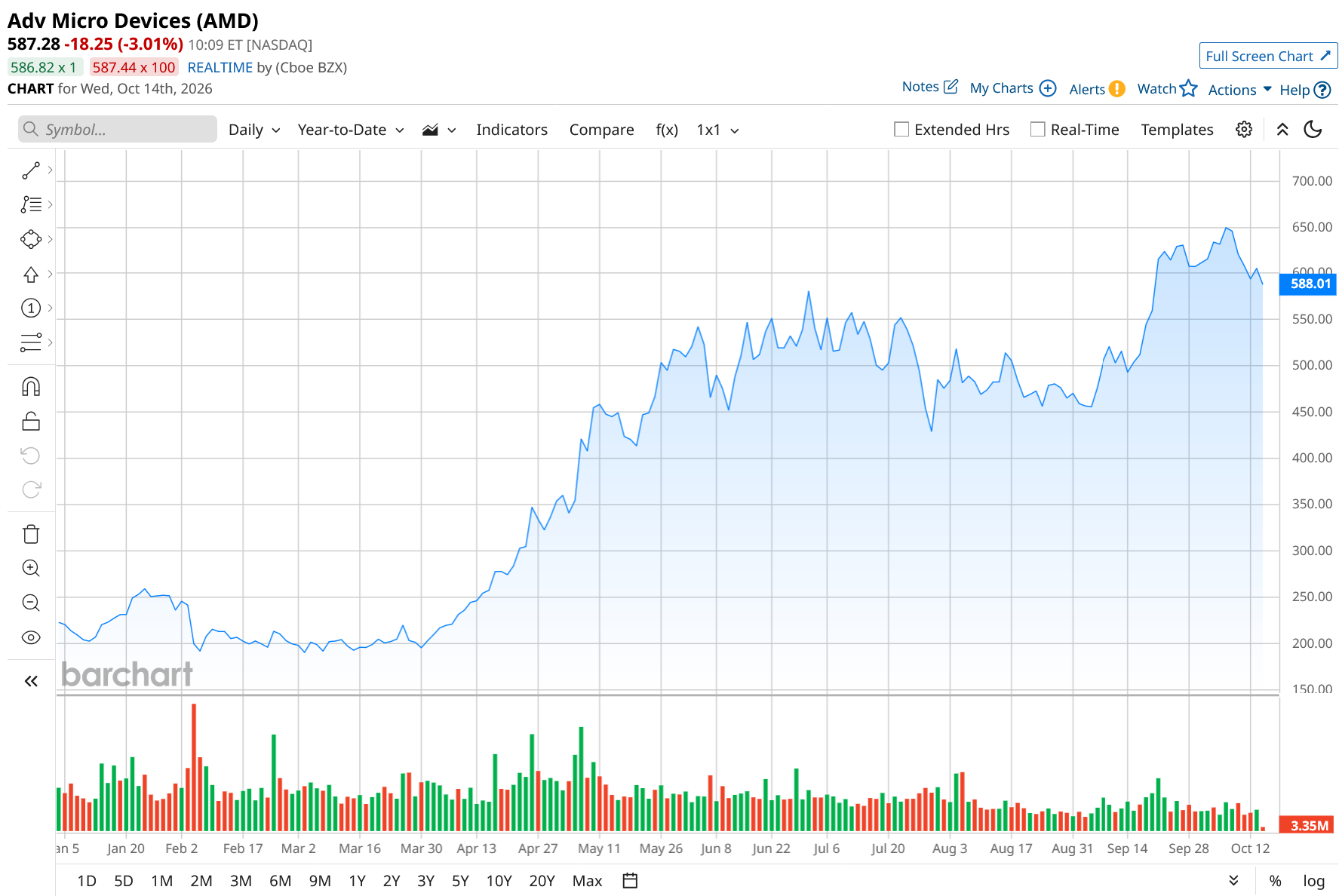
AMD stock is up about 170% over the past 52 weeks as investors now see it as a serious challenger to Nvidia in AI chips. Large orders from OpenAI, Meta (META), and Anthropic, booming data center sales, rapid profit growth, and tight chip supply have lifted its prospects. Over the past six months, the stock has gained 130%. It reached a 52-week high of $658.52 on Oct. 6, but is down 11% from that level.
On a forward-adjusted basis, AMD’s price-to-earnings (non-GAAP) ratio of 78.33x is considerably stretched compared to the industry average of 22.87x.
Q2 Results: Data Center Growth Powers Strong Revenue and Earnings Beat
In the second quarter, the company’s data center revenue rose 107% year-over-year (YoY) to $6.70 billion, as its AMD EPYC processors and AMD Instinct GPUs continued to see strong demand.
AMD’s total revenue rose 50% YoY to $11.54 billion, above the $11.28 billion Wall Street analysts (as polled by LSEG) expected. AMD also highlighted that data center operations account for 58% of its topline. Hence, while the client and gaming segment grew modestly, the data center segment more than made up for it.
Its non-GAAP operating income climbed by 245% YoY to $3.09 billion. Its non-GAAP EPS also rose 246% from its year-ago value to $1.66, surpassing the $1.62 that Street analysts had expected. AMD expects about $13 billion in third-quarter revenue, plus or minus $300 million.
Wall Street analysts are robustly optimistic about AMD’s future earnings. They expect the company’s EPS to climb by 71.1% YoY to $1.66 for the third quarter (to be reported on Nov. 3, after the market closes). For fiscal 2026, EPS is projected to surge 97.3% annually to $6.45, followed by a 114.4% growth to $13.83 in fiscal 2027.
Here’s What Analysts Think About AMD Stock
This month, Citigroup analysts raised the price target on AMD stock from $575 to $800, as the firm views agentic AI as a potentially larger driver of computing demand than traditional chatbots. According to Citigroup analysts, AMD will be the biggest beneficiary of a rebound in CPU demand, as agentic AI emerges as a new application for CPUs.
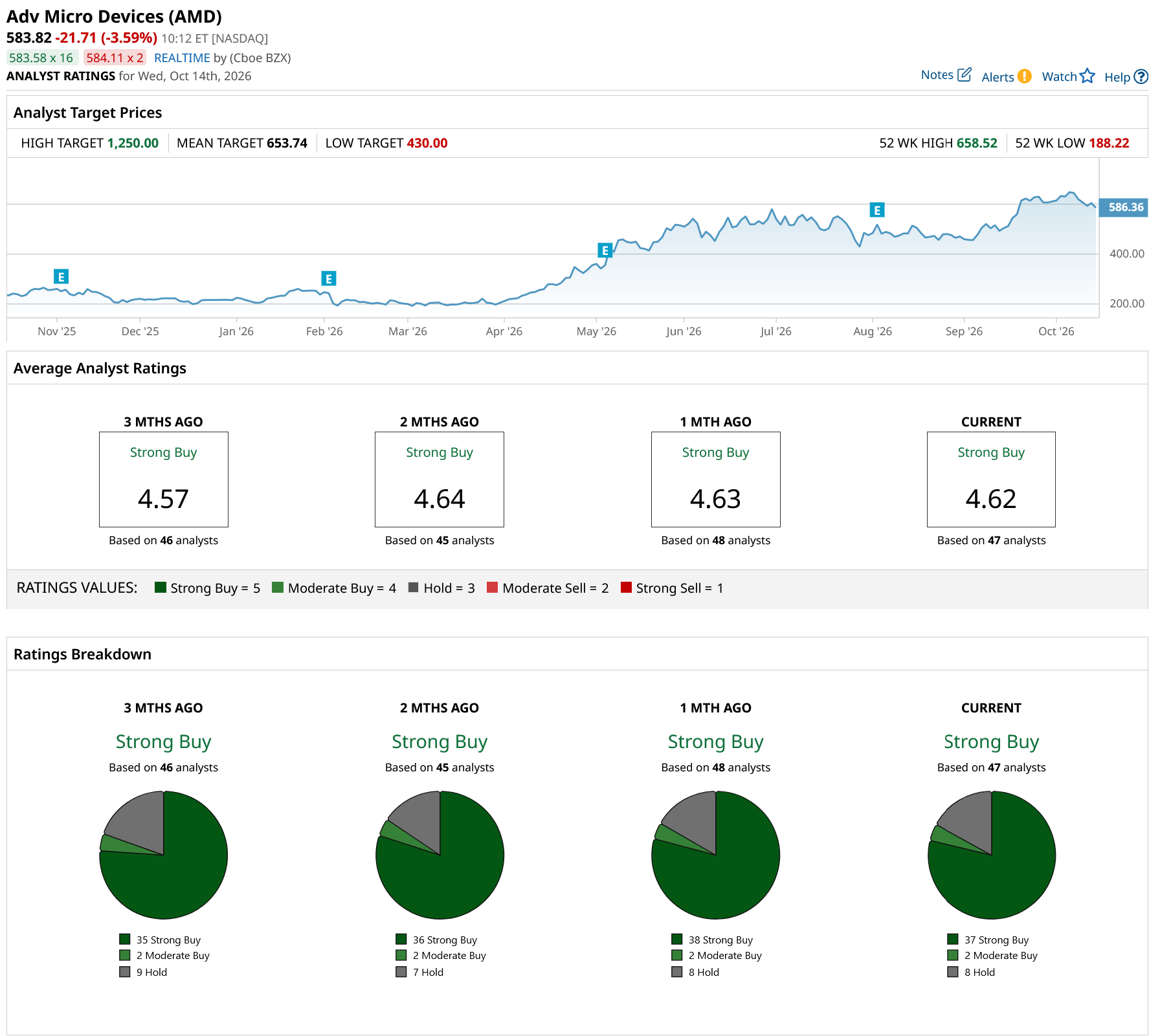
Chip giant AMD is a widely followed name on Wall Street, with analysts awarding it a consensus “Strong Buy” rating. Of the 47 analysts rating the stock, a majority of 37 analysts have given it a “Strong Buy” rating, two analysts rated it “Moderate Buy,” and eight analysts are taking the middle-of-the-road approach with a “Hold” rating. The consensus price target of $653.74 represents a 12% upside from current levels. Moreover, the Street-high price target of $1,250 reflects a 114% upside.
On the date of publication, Anushka Dutta did not have (either directly or indirectly) positions in any of the securities mentioned in this article. All information and data in this article is solely for informational purposes. For more information please view the Barchart Disclosure Policy here.