
Caught Out By Star Cement's Fall? Here's What Bears Saw
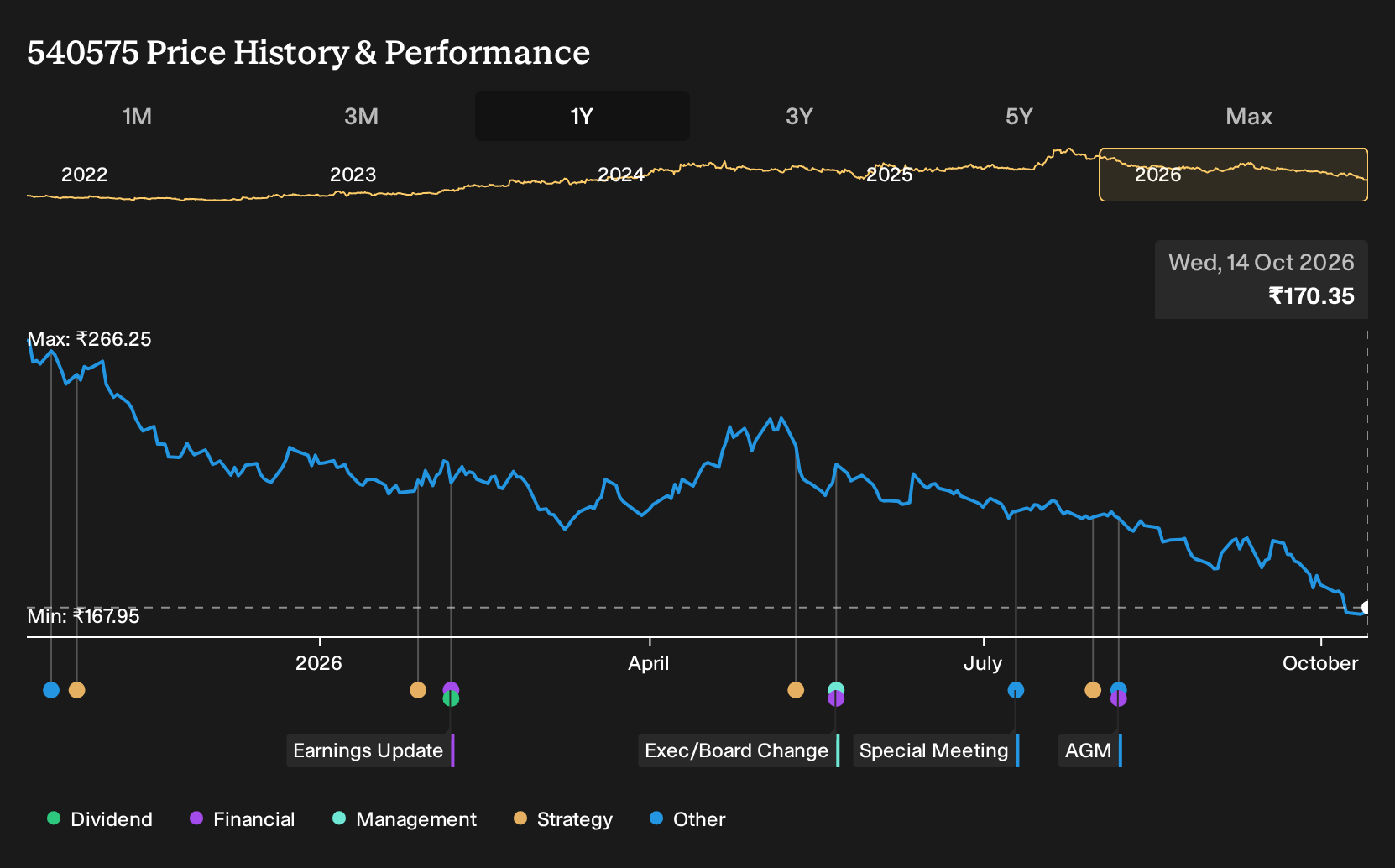
If you only glanced at Star Cement’s latest quarterly update, the headline might have seemed mixed. Revenue moved one way while net profit and margins went the other. For Star Cement shareholders, the loss over the past year was 33.9%, including dividends. If you had been weighing an investment a year ago, how much of that setback was already hinted at in the earnings mix and regional risk on record at the start?
A Narrative on Simply Wall St is one investor's written case for a company, with its growth, margin and multiple assumptions spelled out. Those assumptions imply an estimated Fair Value.
The easy part of this move is behind Star Cement. Zero in on 184 high quality undervalued stocks for companies trading below our estimates.
The Two Star Cement Stories Investors Had To Weigh
The shares cost ₹266 at the start of the period, and anyone looking at Star Cement then had to decide which story felt more realistic.
On the optimistic side, the Narrative set Fair Value at ₹286, about 7% above the start price, built on assumptions of 14.3% revenue growth, a 12.1% profit margin and a future P/E of 26.9x over a 3 year horizon.
The more cautious view pinned Fair Value at ₹125 and focused on heavy Northeast exposure and reliance on government incentives as key risks to future margins.
What The Results Changed For The Star Cement Story
The clearest fresh fact for Star Cement was the Q1 2027 scorecard. Revenue was ₹9,428.889m versus ₹9,119.925m a year earlier, while net income slipped to ₹747.166m from ₹984.549m and net margin moved from 10.8% to 7.9%. That tilt toward weaker profitability challenged the optimistic case that leaned on higher future margins.
The main takeaway is simple. When a thesis leans on margin expansion, you should watch the reported net margin line first and only then decide how much weight to give any growth story at another company.
What Star Cement’s Current Price Already Assumes
Star Cement now trades at ₹170, down 33.9% over the past year, while the selected Narrative’s Fair Value sits above that level rather than beneath it. The gap rests on a view that North India capacity, subsidy shifts and building solutions together reshape how earnings are spread across regions and products.
For you as a potential buyer, the key assumption to test is whether Star Cement can commission and ramp the Rajasthan and Haryana projects broadly on schedule while holding EBITDA per tonne near current guidance despite lower subsidies and higher costs.
"Some analysts expect Star Cement to use the planned North India capacity additions, higher efficiency projects, and fuel mix shifts to extend the EBITDA per tonne levels seen in FY26 into a broader, more diversified footprint over time. A key requirement is that Star Cement commissions and ramps up the Rajasthan and Haryana projects broadly in line with the planned timelines and capex, while managing lower subsidy income and higher fuel and packing costs without a sustained hit to EBITDA per tonne."
That disagreement has a full argument behind it. → Uncover the higher Fair Value this Narrative argues for
Go Straight To The Source
The next headline does not have to be where your research begins. Go straight to the companies and see whether a contrarian opportunity could be taking shape.
- Company 1 - 49% below our estimate - uses long term public works and modular building methods to smooth project earnings.
- Company 2 - 42% below our estimate - turns complex AI, regulatory and safety problems into high value expert consulting assignments.
- Company 3 - 43% below our estimate - secures large data center and smart building contracts that reshape its project pipeline.
Those are three of them. See the full list of 203 financially solid companies →
This article by Simply Wall St is general in nature. We provide commentary based on historical data and analyst forecasts only using an unbiased methodology and our articles are not intended to be financial advice. It does not constitute a recommendation to buy or sell any stock, and does not take account of your objectives, or your financial situation. We aim to bring you long-term focused analysis driven by fundamental data. Note that our analysis may not factor in the latest price-sensitive company announcements or qualitative material. Simply Wall St has no position in any stocks mentioned.
Have feedback on this article? Concerned about the content? Get in touch with us directly. Alternatively, email editorial-team@simplywallst.com