
AT&T Stock Got Crushed by SpaceX News. This Is a Buy-the-Dip Opportunity.
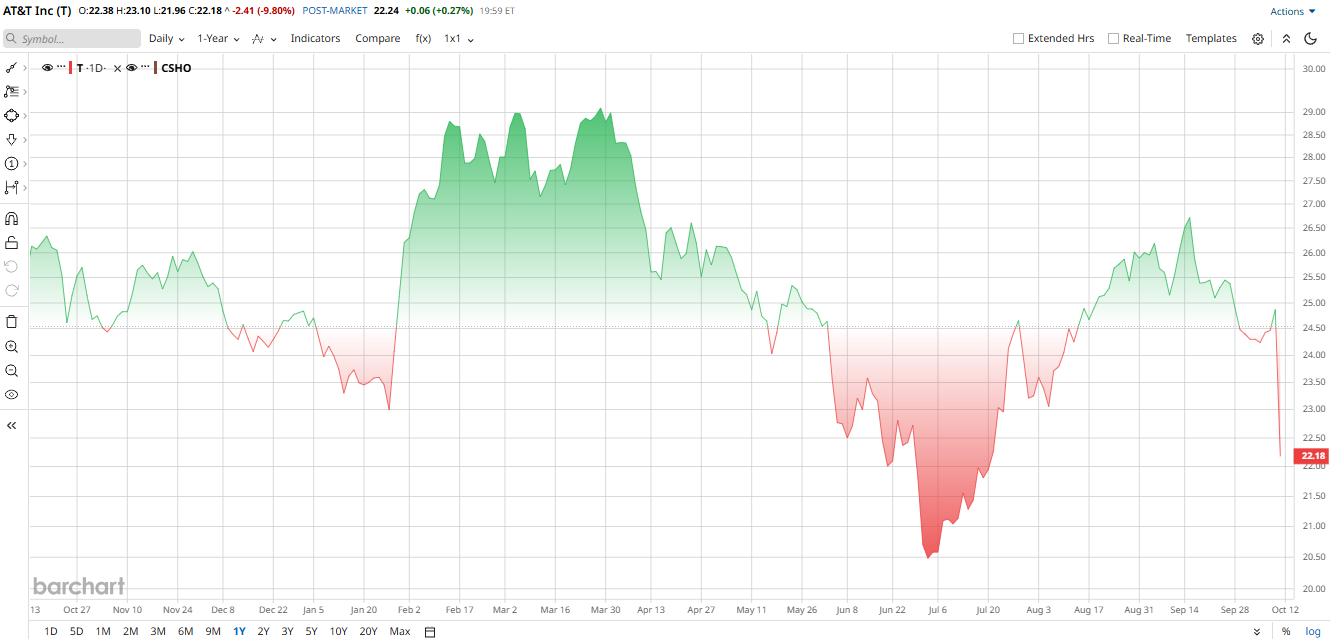
A harsh reality check just fell on AT&T (T) stock. On Oct. 9, shares dropped 11% amid a selloff of telecom stocks after SpaceX (SPCX) unveiled plans for a spectrum acquisition that will help it enter direct wireless service with Starlink Mobile.
The threat to AT&T is real. But the company's free cash flow, fiber and wireless expansion, and valuation still leave room for growth. The problem, though, is the division of SpaceX's long-term goals from AT&T's today. But has one day of panic created an opportunity in T stock? Let's take a closer look.
SpaceX Is Moving Beyond Satellite Dead Zones
SpaceX's spectrum acquisition is aimed at filling a technical deficit in Starlink Mobile's network in the 800 megahertz band. Specifically, SpaceX reached an agreement with Grain Management to purchase an equal amount of paired spectrum in that same band. Up to 14 MHz of paired spectrum was agreed to be purchased from Grain in the 800 MHz band. “This prime low-band spectrum addresses one of the key remaining technical gaps that will pave the way for Starlink Mobile to become a major mobile carrier in the US,” SpaceX noted in an update.
The deal is estimated to be worth about $8 billion, pending final Federal Communications Commission (FCC) approval. Higher frequencies fail to reach the same distance and pass through as well as low-band, meaning the deal could provide SpaceX with a better platform for providing its own mobile broadband.
SpaceX said that the spectrum will help its signal reach customers even when in buildings. CEO Elon Musk described the acquisition as the “last critical piece” the company needs to provide complete phone coverage in the United States.
All of this thrusts AT&T's network services into SpaceX's crosshairs. However, a nationwide carrier is not instituted by spectrum alone. SpaceX still needs to invest in ground equipment, develop follower support and distribution, achieve regulatory approval, and convince people to make the switch. The potential competition cannot be ignored, but AT&T has time to act.
AT&T's Cash Flow Gives Investors a Cushion
AT&T’s second-quarter 2026 results provide a counterweight to the SpaceX headlines. In Q2, revenue rose 2.3% year-over-year (YOY) to $31.6 billion, while adjusted EPS climbed to $0.65 from $0.54 in the year-ago period. Free cash flow reached $4.7 billion, up from $4.4 billion a year earlier.
CEO John Stankey was pleased with the results. “Earlier this year, we provided an outlook for accelerated growth and execution of our strategy,” the CEO said on the Q2 earnings call in July. "That's exactly what we delivered in the second quarter."
The company added more than 1 million Advanced Connectivity customers across fiber, fixed wireless, and postpaid phones. That included 432,000 postpaid phone net additions. Fiber net additions hit their best second quarter ever.
AT&T also raised its 2026 share repurchase target to about $10 billion. That's a big vote of confidence from management.
Looking ahead, the company reiterated its full-year guidance. AT&T expects consolidated service revenue growth in the low single digits, adjusted EBITDA growth of 3% to 4%, adjusted EPS of $2.25 to $2.35, and more than $18 billion in full-year free cash flow.
T Stock Looks Cheaper After the Selloff
At roughly $23 per share, T stock trades at 10 times expected 2026 earnings of about $2.30 per share at the midpoint, which is lower than the sector median of 12 times. Meanwhile, the annual dividend of $1.11 equates to a yield of 4.94%, offering income while investors wait for growth and competition risks to become clearer. A low earnings multiple, recurring cash flow, and share repurchases make AT&T stock more interesting after the recent decline.
Of course, cheap does not mean risk-free. SpaceX could pressure pricing or increase customer-acquisition costs over time, while AT&T’s infrastructure spending and debt limit its flexibility. Investors should view T stock as a potential income-and-recovery play, not a guaranteed rebound.
What Does Wall Street Think of AT&T Stock?
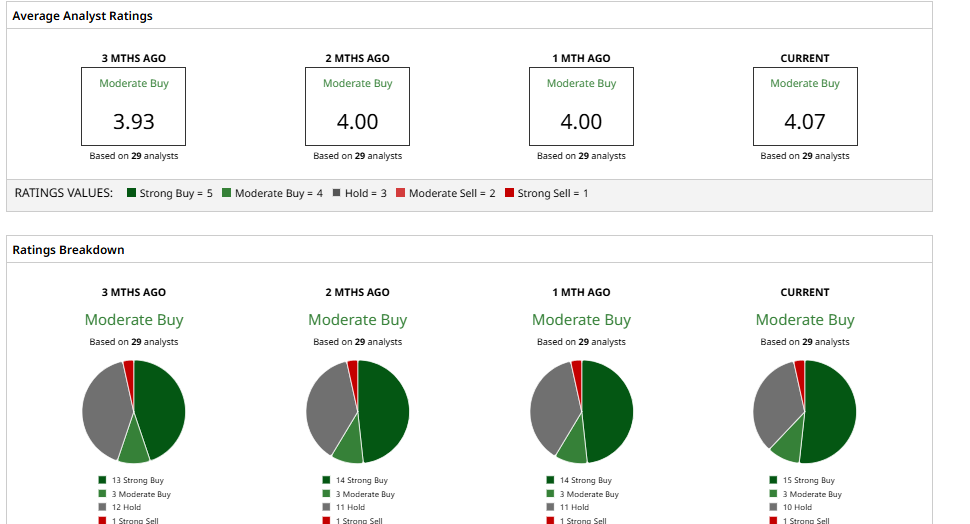
Analysts are mostly bullish on AT&T stock, even after the SpaceX news.
Morgan Stanley raised its price target to $28 from $27 in late September, keeping an “Overweight” rating on the stock. BNP Paribas also upgraded T stock to “Outperform” in September, bumping its price target to $30 from $26, while Wolfe Research upgraded shares to an “Outperform” rating back in July with a $29 price target. Meanwhile, Citi analyst Michael Rollins has called the selloff a potential buy-the-dip opportunity, arguing that meaningful disruption from SpaceX may not arrive until 2029.
Not everyone is a believer. Wells Fargo has a “Sell” rating on T stock with a $20 target. But the bulls clearly outnumber the bears.
Overall, AT&T has a consensus “Moderate Buy” rating on Wall Street. The mean price target of $28.80 suggests about 25% potential upside from recent prices, while the Street-high target of $36 implies potential upside of nearly 57% from here.
On the date of publication, Nauman Khan did not have (either directly or indirectly) positions in any of the securities mentioned in this article. All information and data in this article is solely for informational purposes. For more information please view the Barchart Disclosure Policy here.