
Berkshire Hathaway Just Gave Bending Spoons Stock a Big Boost
Bending Spoons (BSP) shares ripped higher on Wednesday morning after Berkshire Hathaway (BRK.A) (BRK.B) agreed to invest another $330 million in the Italian technology group. The conglomerate had invested about $600 million in BSP’s initial public offering (IPO); its total stake in the Nasdaq-listed firm now sits at about 4%.
Following today’s surge, Bending Spoons stock is up nearly 63% versus the start of this year.
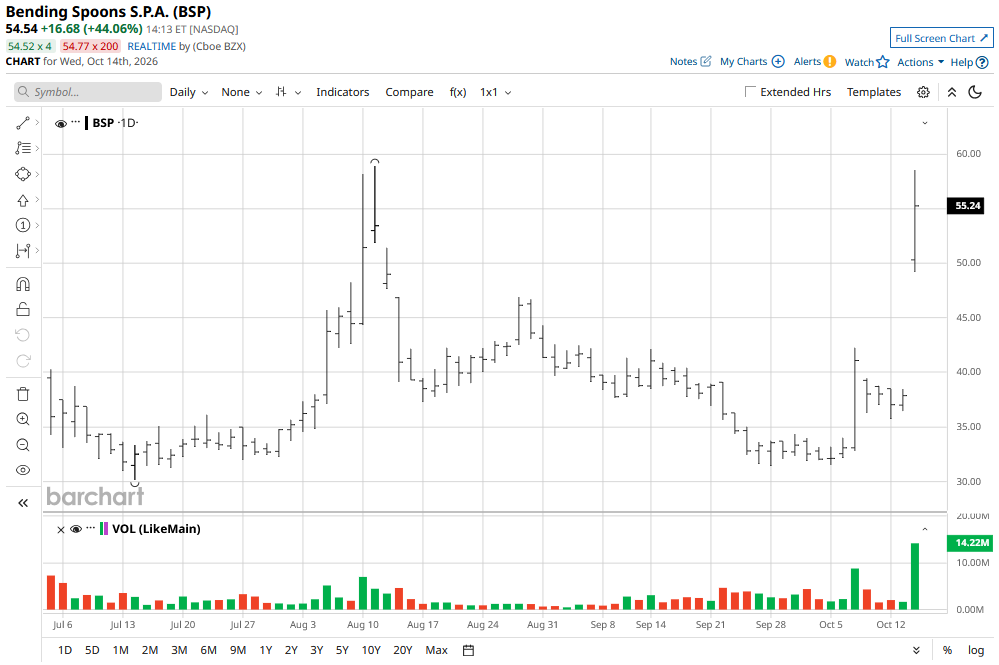
Why Bending Spoons Stock Rallied on Wednesday
Berkshire will purchase 10 million newly issued ordinary BSP shares at $33 each through a private placement, subject to customary closing conditions.
The announcement is positive as it strengthens the company’s capacity to finance acquisitions. In fact, co-founder Francesco Patarnello said the deal pipeline remains strong, giving this fresh capital a clear strategic purpose.
Importantly, Berkshire’s investment after already baking the IPO reinforces confidence in Bending Spoons’s acquisition model. All in all, it adds financial flexibility without creating another interest obligation.
Adding to the momentum on Oct. 14 was a technical breakout, as BSP ripped through its 50-day moving average (MA), indicating that bulls have taken back control of the near term.
Why BSP Shares Aren’t Worth Buying Today
Caution is still warranted in playing Bending Spoons shares because the Berkshire announcement signals significant dilution ahead for the company’s existing investors.
Crucially, the conglomerate’s negotiated buying price sits well below Wednesday’s trading levels. So the endorsement supports the business case without establishing that today’s price is a bargain.
BSP’s valuation also makes it somewhat less attractive for risk-averse investors. At the time of writing, it’s trading at a forward price-to-earnings (P/E) ratio of about 27x, which makes it just as expensive to own as the best-of-breed AI stocks, even including Nvidia (NVDA).
What’s the Consensus Rating on Bending Spoons?
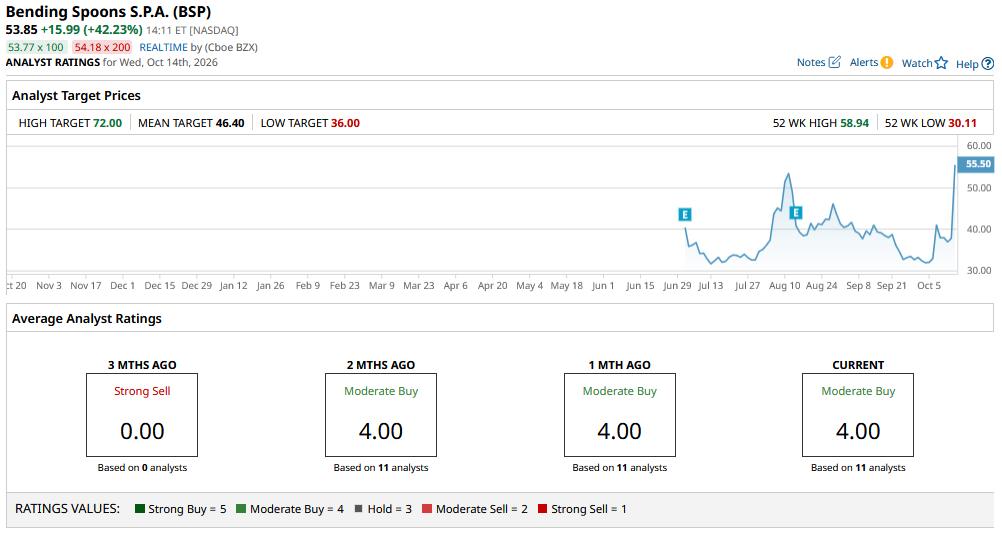
Wall Street analysts also seem to believe the recent rally in BSP stock has gone a bit too far.
According to Barchart, while the consensus rating on Bending Spoons remains at “Moderate Buy,” the mean price target of about $46 signals potential downside from current levels.
On the date of publication, Wajeeh Khan did not have (either directly or indirectly) positions in any of the securities mentioned in this article. All information and data in this article is solely for informational purposes. For more information please view the Barchart Disclosure Policy here.