
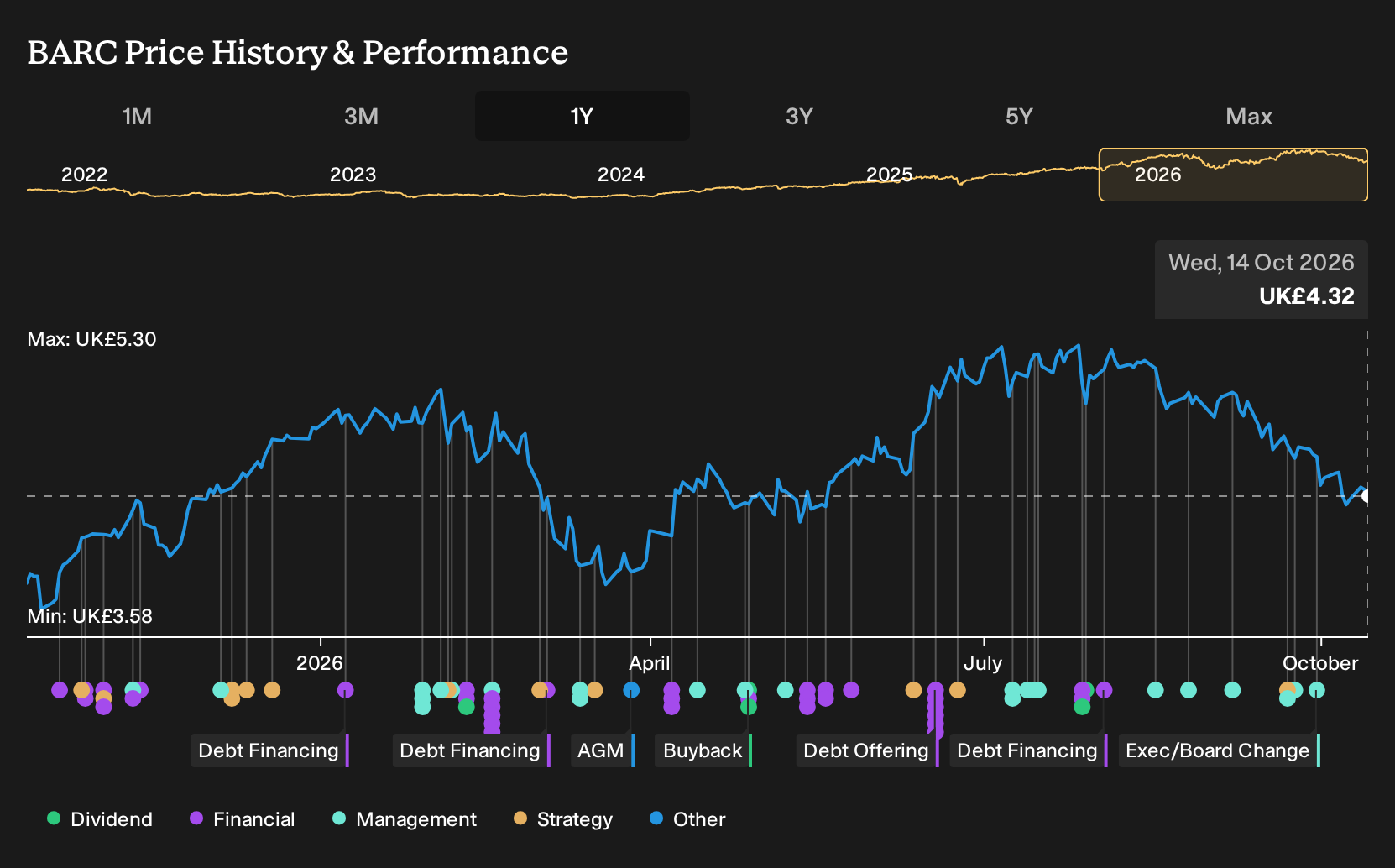
IPO Underwriting Return Could Alter The Investment Case For Barclays (LSE:BARC)?
- Barclays has moved to restart its equity capital markets business in India, planning to resume IPO underwriting there after almost a decade, as part of its wholesale banking services.
- The return to Indian IPO underwriting marks a shift back toward fee based capital markets work that could influence how Barclays balances its global debt and equity advisory efforts.
- This raises questions about how Barclays' investment narrative could be affected by its renewed push into Indian equity capital markets.
Scan how Barclays' renewed push into Indian equity capital markets compares with other banks pursuing similar opportunities by reviewing the hand picked list of list of solid balance sheet and fundamentals (9 results).
Barclays Investment Narrative Recap
To own Barclays, you need to be comfortable with a large, complex bank that is trying to squeeze more earnings from technology, mix shift and fee income while keeping risk events under control. The India equity capital markets move fits into that story but does not look like a key near term catalyst alongside digital projects, structural hedge income and a shift toward higher return UK and US franchises.
The bigger swing factors right now remain execution on fraud controls and impairments, legal and reputational issues, and cost discipline given higher office and wage pressures. High bad loans at 2%, a low 72% allowance and heavier use of higher risk funding keep credit quality and funding costs firmly in focus for the next leg of the Barclays investment case.
There are no specific fresh company announcements tied directly to the India ECM restart, so the most relevant reference point is management’s broader plan to lean into fee and financing activities in the Investment Bank while keeping risk weighted assets stable. That framework is intended to build a more capital efficient revenue mix that depends less on balance sheet expansion.
For you as a shareholder, the key question is how well this pivot fits with other levers such as US Consumer growth, structural hedge income and technology driven efficiency gains. Progress in those areas can help absorb fraud related charges, higher compliance costs and any wage or office related pressure, while setbacks would make new ventures in equity capital markets feel more like incremental complexity rather than a clear earnings catalyst.
What The Barclays Forecasts Assume
Barclays' narrative projects £34.6 billion revenue and £9.2 billion earnings by 2029. This lines up with analysts' expectations for 7.1% yearly revenue growth and an earnings increase of about £2.4 billion from £6.8 billion today.
Uncover why Barclays' fair value indicates a 33% potential upside to its current price that may not last much longer.
Exploring Other Perspectives
The alternate, more optimistic take on Barclays leans heavily on cost control. Those analysts were already pencilling in revenue of about £36.5b and earnings near £10.8b by 2029, assuming a cost-income ratio in the low 50s. If India ECM expansion reshapes that earnings mix, both the upbeat and baseline stories may shift.
Explore 6 other Barclays fair value estimates, including one that suggests as much as 112% potential upside from the current price!
Decide For Yourself
Disagree with existing narratives? Extraordinary investment returns rarely come from following the herd, so go with your instincts.
- A great starting point for your Barclays research is our analysis highlighting 5 key rewards and 4 important warning signs that could impact your investment decision.
- See our latest analysis for Barclays. The report includes a comprehensive fundamental analysis summarized in a single visual, the Snowflake, making it easy to evaluate Barclays' overall financial health at a glance.
Looking For More Ideas Beyond Barclays?
If the Barclays story has you thinking about portfolio upgrades, it can help to line it up against other opportunities that match your risk appetite and income goals. The Simply Wall St Screener gives you a quick way to shortlist companies that fit different styles before you commit time to deeper research.
- If you want potential upside with strict quality filters, start by reviewing 5 high quality undiscovered gems that pair strong fundamentals with less crowded investor attention.
- For steadier profiles, focus on resilience and capital protection by checking out 4 resilient stocks with low risk scores. These score well on financial strength and volatility metrics.
- If income is a priority, look across 2 dividend fortresses that combine higher yields with balance sheets that can support ongoing payouts.
This article by Simply Wall St is general in nature. We provide commentary based on historical data and analyst forecasts only using an unbiased methodology and our articles are not intended to be financial advice. It does not constitute a recommendation to buy or sell any stock, and does not take account of your objectives, or your financial situation. We aim to bring you long-term focused analysis driven by fundamental data. Note that our analysis may not factor in the latest price-sensitive company announcements or qualitative material. Simply Wall St has no position in any stocks mentioned.
Have feedback on this article? Concerned about the content? Get in touch with us directly. Alternatively, email editorial-team@simplywallst.com