
Why There Might Be a Mathematical Incentive to Bet on AST SpaceMobile Stock’s 227% Options Spread
Debit-side options spreads are similar to at-bats in baseball. You’re not expected to generate a high success rate but your team is counting on you to be smart with your decision-making processes, leveraging game conditions and circumstances to your advantage. And that brings us to AST SpaceMobile (ASTS).
Generally speaking, it’s a good idea to avoid names that have attracted the ignominy of Barchart’s Technical Opinion indicator, as ASTS stock has with its 100% Strong Sell rating. At the same time, you don’t necessarily want a blanket rule as you just might miss out on a potential opportunity. With AST, the company’s space-based cellular broadband network arguably presents a strong, fundamental argument for contrarianism.
Another factor to consider is implied volatility and the volatility skew. For the November monthly chain (expiring Nov. 20), the IV reading for ASTS stock stands at 91.46%, which by itself indicates the potential to move. Therefore, if the ticker happens to tumble out of the gates, there’s enough “fuel” for the security to recover more quickly and march higher.
Additionally, the November monthly skew suggests that smart money traders are anticipating an upside recovery rather than prioritizing downside protection. That may be significant, considering that AST SpaceMobil stock has lost nearly 30% in the last 30 days.
To be fair, the smart money isn’t always right. It’s also possible that the interpretation of what the smart money is doing could be wrong. But for the time being, the market seems to be anticipating a reversion to the mean.
Finally, the second-lowest November monthly strike tethered to multi-leg options strategies that offer a favorably asymmetric risk-reward profile is the $50 level; specifically, the 45/50 bull call spread expiring Nov. 20.
The question is, does AST SpaceMobil stock have a legitimate shot at $50 over the next five-and-a-half weeks?
A 227% Payout for ASTS Stock is Tempting But is it Realistic?
Based on how the November strike selections are structured, there’s a massive gap in maximum payouts between the lowest and second-lowest strikes. For obvious reasons, the 40/45 bull spread (expiring Nov. 20) appears more probabilistically palatable, as AST SpaceMobile stock must only rise through the $45 strike on expiration, which is about 6.8% above the current spot price.
However, the maximum payout for that debit spread is only 75.44% at time of writing. That’s unfavorably asymmetric since you would be betting a higher amount ($285) for the chance to profit a lower amount ($215). Yes, the probability of profit (breakeven) is relatively high at 47.7% but the probability of full profitability would drop to 33.68% (based on the implied probability of how options are priced using a random walk model).
Under these parameters, the 40/45 bull spread would suffer an expected value (EV) of $116.60 below parity, which would then translate to an expected return on capital (ROC) of -40.98%. That’s not good — and that’s also where attention mathematically turns to the higher 45/50 bull spread.
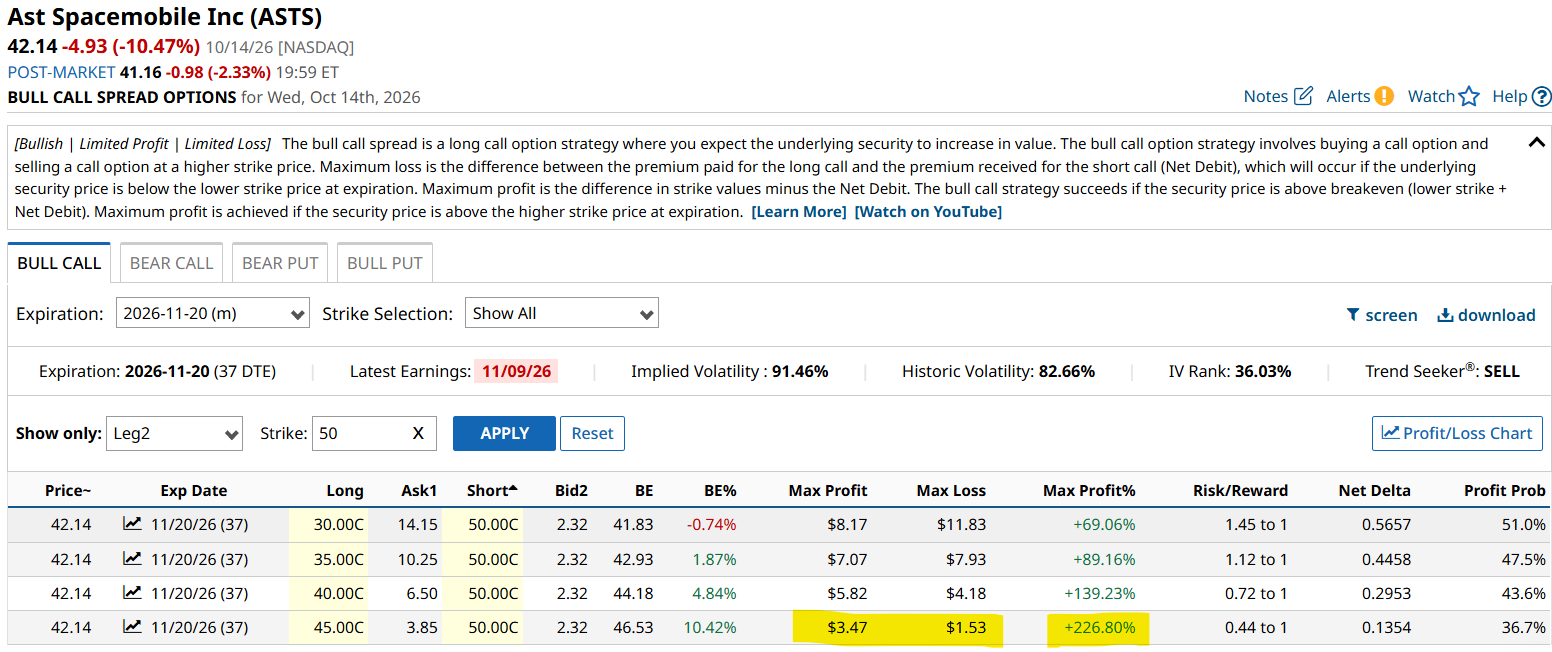
Here, the parameters involve a net debit of $153 for the chance to maximally profit $347, a payout of 226.8%. Of course, for this trade to fully pan out, ASTS stock must rise through and trigger the $50 strike on expiration, which is 18.65% up from the current spot price. Adding to the challenge, the probability of ASTS hitting the second-leg strike on Nov. 20 is only 21.56%.
Plugging these parameters into an EV calculator, we get a reading of $45.20 below parity. This figure translates into an expected ROC of -29.54%. That’s superior to the more conservative 40/45 bull spread, which then presents to us a mathematical conundrum.
When we consider efficiency of risk capital, there’s an argument that the more aggressive trade within the pair is actually the more rational one. It’s just that we don’t want to deliberately swing on a bad-looking pitch — which is where the opportunity may lie.
Changing the Probability of AST SpaceMobile Stock
Unless something dramatic happens to the ASTS stock price, the payout is likely going to stay within an established ratio or relationship to risk. In other words, retail traders shouldn’t expect the market to hand out a free bump in payout to make the 45/50 bull spread enjoy a positive EV. So, if there is something that’s going to change, it must come from the probability of success.
Now, changing the probability of a trade sounds like an absurd idea but the hiccup comes from the fact that there is no such thing as a universally neutral probabilistic model. Every such model depends on an initial framework or assumption to carry the argument forward. As such, while the underlying mathematical architecture may be objective and universal, the application of such frameworks is philosophical.
With Wall Street’s implied probability frameworks, the underlying assumption is the random walk. Without getting overly complicated, if we assume that AST SpaceMobile stock will undergo a random walk between now and the expiration date, then the aforementioned probabilities would be fully relevant — they would simply stem from the math of randomness.
But the meta question in all of this is whether this assumption is justified for the specific security and specific circumstances at hand. I’m making an argument that ASTS stock is instead more likely to undergo a nonrandom walk.
Over the course of the last two months, AST SpaceMobile stock printed 10 weekly candlesticks in the technical chart — only three of these sessions saw net positive price action (from the opening hour to the closing price). That’s going to change the immediate perception of ASTS and, by historical inference, change its likely forward trajectory.
State-to-State Transitions Point to Contrarian Optimism
Right now, we can make an argument that ASTS stock is structured in a heavily bearish state. The question, then, is not whether it is currently bearish or not. Everybody acknowledges that it is. Rather, the question is the odds of transition: will AST stay in its current state or will it evolve to a higher state?
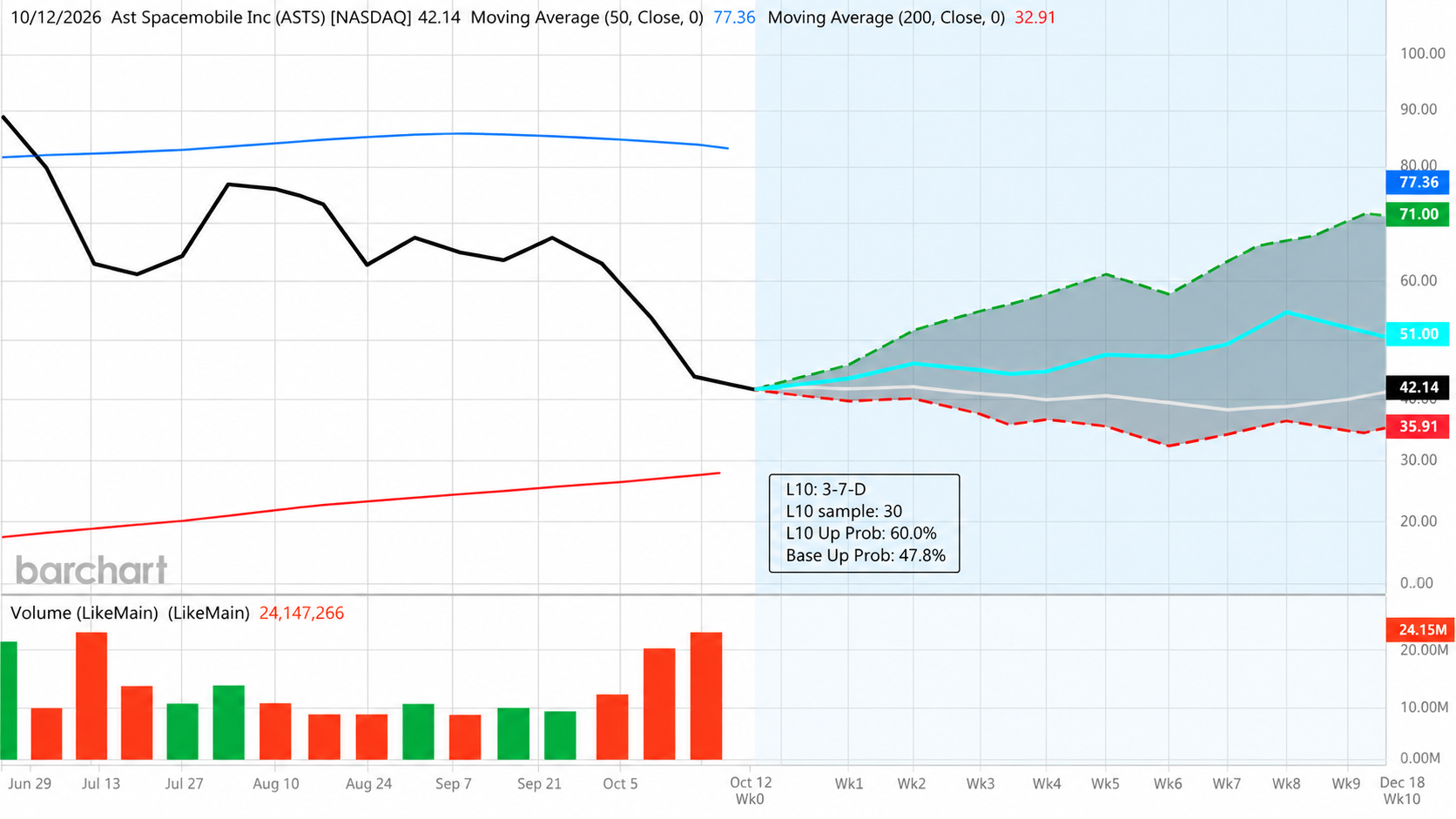
Of course, there’s always going to be guesswork involved when dealing with the wild equities market. But we also know through historical data that, in the trailing five years, the aforementioned specific bearish state — the one where ASTS stock only managed to print three up weeks in a 10-week period — has materialized 30 times on a rolling basis.
What’s fascinating is that over the next several weeks, AST SpaceMobile stock as a median response tends to swing higher — enough so that the probability of ASTS hitting $50 on Nov. 20 may improve to a range between 33.3% and 46.7%. While these stats aren’t great by themselves, they would clear the 30.6% minimum for the 45/50 bull spread to be considered zero expectancy or a “fair bet.”
At 33.3%, the spread would have an EV of +13.50 or an ROC of 8.82%. At 46.7%, the spread would have an EV of +80.50 or an ROC of 52.61%.
Obviously, there’s still heavy risks involved. Nevertheless, if you want to take a rational approach to speculation, ASTS stock deserves a closer look.
On the date of publication, Josh Enomoto did not have (either directly or indirectly) positions in any of the securities mentioned in this article. All information and data in this article is solely for informational purposes. For more information please view the Barchart Disclosure Policy here.