
Walmart (WMT) Could Be 25% Undervalued After Deutsche Bank Upgrade
Deutsche Bank’s upgrade of Walmart (WMT) and the stock’s 2.6% move higher put fresh attention on the retailer, just as new healthcare benefits and paid parental leave reshape its employee offering.
The Deutsche Bank call adds to a steady run in the ticker, with a 7.4% seven-day share price return and a 6.5% 30-day gain indicating building momentum. At the same time, the 7.4% one-year total shareholder return and very large three- and five-year total shareholder returns show Walmart has already rewarded long-term holders.
Scan how other large retailers with resilient cash flows and scale are trading right now by reviewing the 32 high quality undervalued stocks alongside Walmart after Deutsche Bank's upgrade.
Walmart’s advantages in scale, pricing and digital reach are clear after the latest upgrade and sharp move in the share price. The open question now is whether that strength is already fully reflected in today’s valuation.
Most Popular Narrative: 24.9% Undervalued
The most followed narrative on Walmart currently points to a fair value of $154.58, well above the recent $116.16 close. This places the Deutsche Bank upgrade against a backdrop of a much larger valuation gap according to that thesis.
Walmart’s “Other” SBU is described as being positioned for continued success, leveraging innovation and agility to capture new market share. While risks exist, the segment’s performance and strategic initiatives are cited as supporting a positive outlook. Investors and stakeholders may wish to monitor developments in digital integration and specialty category expansion as potential drivers of future growth.
See why 60 investors see Walmart as 25% undervalued.
Result: Fair Value of $154.58 (UNDERVALUED)
Still, this thesis could crack if Walmart’s “Other” unit experiences weaker digital engagement, or if rivals crowd into those specialty categories faster than expected.
Find out about the key risks to this Walmart narrative.
Another View on Walmart’s Valuation
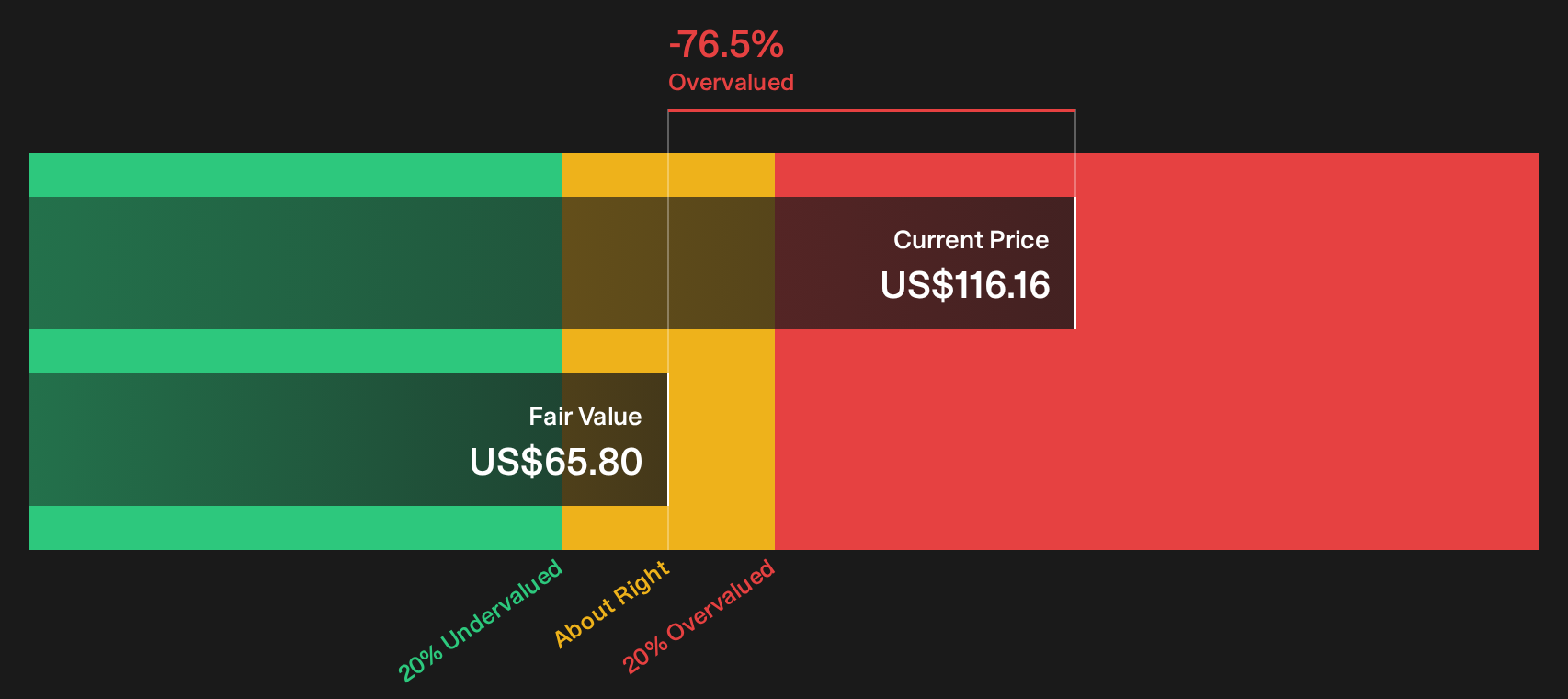
The popular Walmart narrative points to a $154.58 fair value and a 24.9% discount, yet our DCF model paints a much cooler picture. On that framework, the recent $116.16 price sits well above an estimated future cash flow value of $65.80, which screens as overvalued instead.
Two models, two very different answers. It raises a simple question for investors: Are you more comfortable leaning on sentiment around growth stories, or on the cash flows that the SWS DCF model is actually pricing in for Walmart?
Look into how the SWS DCF model arrives at its fair value.
Next Steps
Strong opinions run through this Walmart story already. Move quickly, check the key facts for yourself and then decide how they stack up against the 2 key rewards.
Looking for more investment ideas beyond Walmart?
If Walmart has sharpened your focus, do not stop there. Use powerful screeners to spot other opportunities that fit the kind of portfolio you want to build.
- Target income first by reviewing companies in the 7 dividend fortresses that may help anchor your returns with regular cash payouts.
- Strengthen your downside protection by filtering for businesses in the 32 resilient stocks with low risk scores that pair resilience with measured risk profiles.
- Get ahead of the crowd by scanning the 20 high quality undiscovered gems before other investors start paying attention.
This article by Simply Wall St is general in nature. We provide commentary based on historical data and analyst forecasts only using an unbiased methodology and our articles are not intended to be financial advice. It does not constitute a recommendation to buy or sell any stock, and does not take account of your objectives, or your financial situation. We aim to bring you long-term focused analysis driven by fundamental data. Note that our analysis may not factor in the latest price-sensitive company announcements or qualitative material. Simply Wall St has no position in any stocks mentioned.
Have feedback on this article? Concerned about the content? Get in touch with us directly. Alternatively, email editorial-team@simplywallst.com