
How to Play Meta Stock After Hunterbrook’s Short Report on Slowing Muse Growth
Meta Platforms (META) has staged an impressive comeback in recent weeks, fueled by renewed investor confidence in CEO Mark Zuckerberg’s artificial intelligence (AI) strategy. The September launch of Muse, the company’s new personal AI agent, helped reignite enthusiasm for Meta’s AI ambitions and sent its shares sharply higher from their August lows. However, just as the rally was gaining momentum, a new bearish report threatened to cast a shadow over one of the company’s most closely watched growth initiatives.
Hunterbrook Capital recently disclosed a short position in Meta alongside a report from its affiliated investigative outlet, Hunterbrook Media, questioning the sustainability of Muse’s early momentum. The report brought renewed scrutiny to the AI agent and prompted debate over whether investors had become overly optimistic about its prospects. Still, while Hunterbrook’s findings may appear concerning at first glance, assessing their implications for Meta’s longer-term outlook requires a closer examination.
That leaves investors facing an important decision: Should they take Hunterbrook’s warning seriously enough to reconsider their exposure to META stock, or is the bearish case less convincing than it initially appears? More importantly, how should existing shareholders and prospective buyers approach the stock following the report? Let’s take a closer look.
About Meta Platforms Stock
Meta Platforms, formerly known as Facebook, is a global technology company that owns and operates some of the world’s largest social media and messaging platforms, including Facebook, Instagram, WhatsApp, and Messenger. The company generates the vast majority of its revenue from digital advertising, leveraging its massive user base and AI-powered recommendation and targeting systems to help businesses reach consumers. Beyond its core advertising business, Meta is investing heavily in AI, augmented and virtual reality, and wearable devices. It has a market cap of $1.94 trillion.
Shares of the Facebook parent have climbed 11% on a year-to-date (YTD) basis. The stock has staged a strong rebound from its August lows, driven by the September launch of Muse, which helped restore investor confidence in CEO Mark Zuckerberg’s AI strategy.
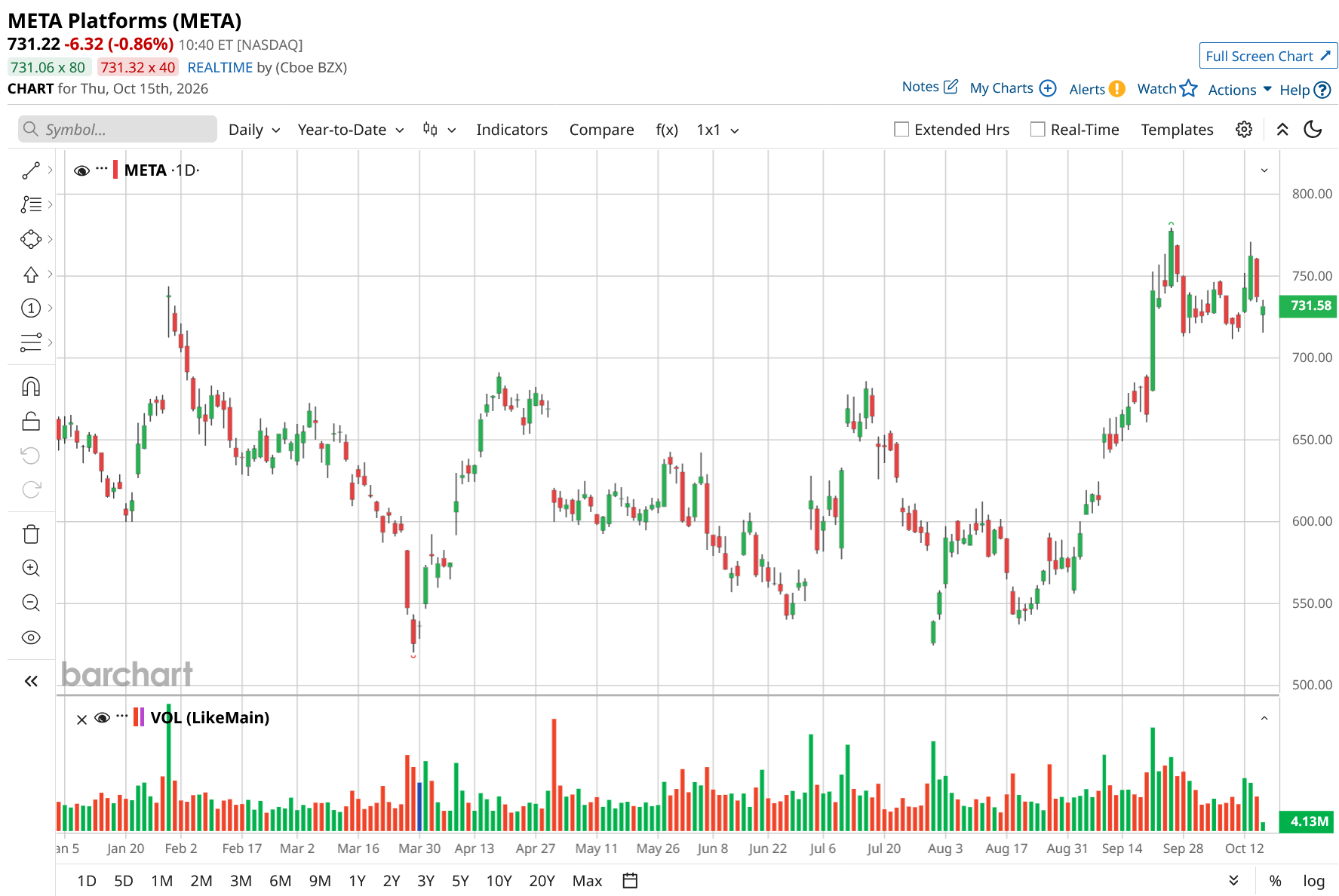
Muse Growth Is Moderating, but Hunterbrook’s Bear Case Has Gaps
Last Friday, Hunterbrook Capital revealed a short position in Meta Platforms, betting that the initial enthusiasm surrounding the company’s Muse AI agent had outpaced actual usage trends. The disclosure came alongside a report from Hunterbrook Media, which analyzed tracking data from alternative-data firm TickerTrends. The figures suggested that Muse’s initial launch momentum was fading.
Before diving into the specific metrics cited in the report, I think it’s worth explaining why Hunterbrook relied on TickerTrends and, more importantly, what gave it enough confidence in the alternative-data firm’s findings to back its thesis with a short position. Well, many investors will recall how chipmakers took a hit last Thursday after the Financial Times reported that OpenAI’s annualized revenue was $20 billion below previously signaled levels. And perhaps most interestingly, the revelation was hardly news to TickerTrends users. A day before Axios reported that OpenAI’s annualized revenue was approaching $70 billion, TickerTrends data had put the figure at $50.44 billion, closely matching the number later reported by the FT.
At this point, let’s turn back to Meta’s Muse. Hunterbrook’s report highlighted three key metrics: Muse’s downloads, app-review volume, and daily active users (DAUs). The firm calculated that average daily downloads in the seven days through Oct. 6 were 8.1% lower than in the preceding week. App-review volume declined 11.6% in the seven days through Oct. 7 compared with the previous week. Meanwhile, DAUs continued to rise, although their growth rate slowed by more than half in the first week of October compared with late September.
While Hunterbrook’s report highlighted that Meta’s Muse was losing some of its initial momentum, the data presented would not be enough to convince me to take a short position. First, it’s natural for downloads, reviews, and user growth to normalize after the initial excitement surrounding a major product launch. Moreover, the available download data does not capture the Oct. 7 launch of Muse’s iPad app, making it difficult to gauge the impact of its latest expansion to a new platform. Muse is also currently available only in the U.S. and Canada, and a rollout in additional markets could significantly change the trajectory of downloads and DAUs, potentially undermining Hunterbrook’s bearish thesis.
Meta’s Muse Monetization Potential Matters More Than Short-Term Growth Trends
Rather than focusing primarily on downloads and DAUs, important as those metrics are, I would place greater emphasis on Muse’s monetization potential. Meta currently charges partners modest transaction fees, while Muse offers a free basic tier and paid subscriptions priced at $20 and $100 per month for heavier usage.
With most casual Muse users likely to remain on the free tier, the most obvious path to monetization would be for Meta to follow its familiar playbook: scale the product first, then introduce advertising. The challenge, however, is that Muse promises a high degree of privacy and security, with user interactions remaining inaccessible to anyone apart from the user, including Meta itself. That would prevent Meta from collecting the kind of interaction data it relies on for ad targeting across Facebook and Instagram. How Meta plans to balance those privacy commitments with an advertising-based business model remains to be seen.
Meanwhile, Wall Street analysts remain optimistic about Muse’s monetization prospects. Deutsche Bank analyst Benjamin Black estimates that Muse could account for as much as 8% of Meta’s total revenue by 2030, generating roughly $36 billion in annual sales. At the lower end of his projections, Black sees Muse generating $2.4 billion in revenue by 2030. Separately, Truist analyst Youssef Squali projects that Muse could contribute an additional $28.5 billion in annual revenue to Meta by 2030.
How to Play META Stock After Hunterbrook’s Short Report
Putting it all together, I would avoid shorting META based solely on Hunterbrook’s report. The data highlighted in the report pointed to a normalization in Muse’s growth rather than signs of a struggling product. It also remains unclear how subsequent developments, such as the launch of Muse’s iPad app, have impacted the key metrics underpinning Hunterbrook’s thesis. For existing shareholders, continuing to hold META stock appears to be the most prudent course of action. Investors looking to initiate a position could consider waiting for a pullback rather than chasing the post-Muse rally. Meta also has a key near-term catalyst—its Q3 earnings report on Oct. 21. With that, investors may be better off holding steady until the company provides further updates.
On the date of publication, Oleksandr Pylypenko had a position in: META . All information and data in this article is solely for informational purposes. For more information please view the Barchart Disclosure Policy here.