
Dear Micron Stock Fans, Mark Your Calendars for December 9
Investors in the shares of memory chip major Micron (MU) have been having a jolly good time in 2026. Now, with shares up more than 200% so far this year, they have another reason to rejoice. In its latest annual report filed on Oct. 9, the company announced it will increase its share buyback program to $35.16 billion.
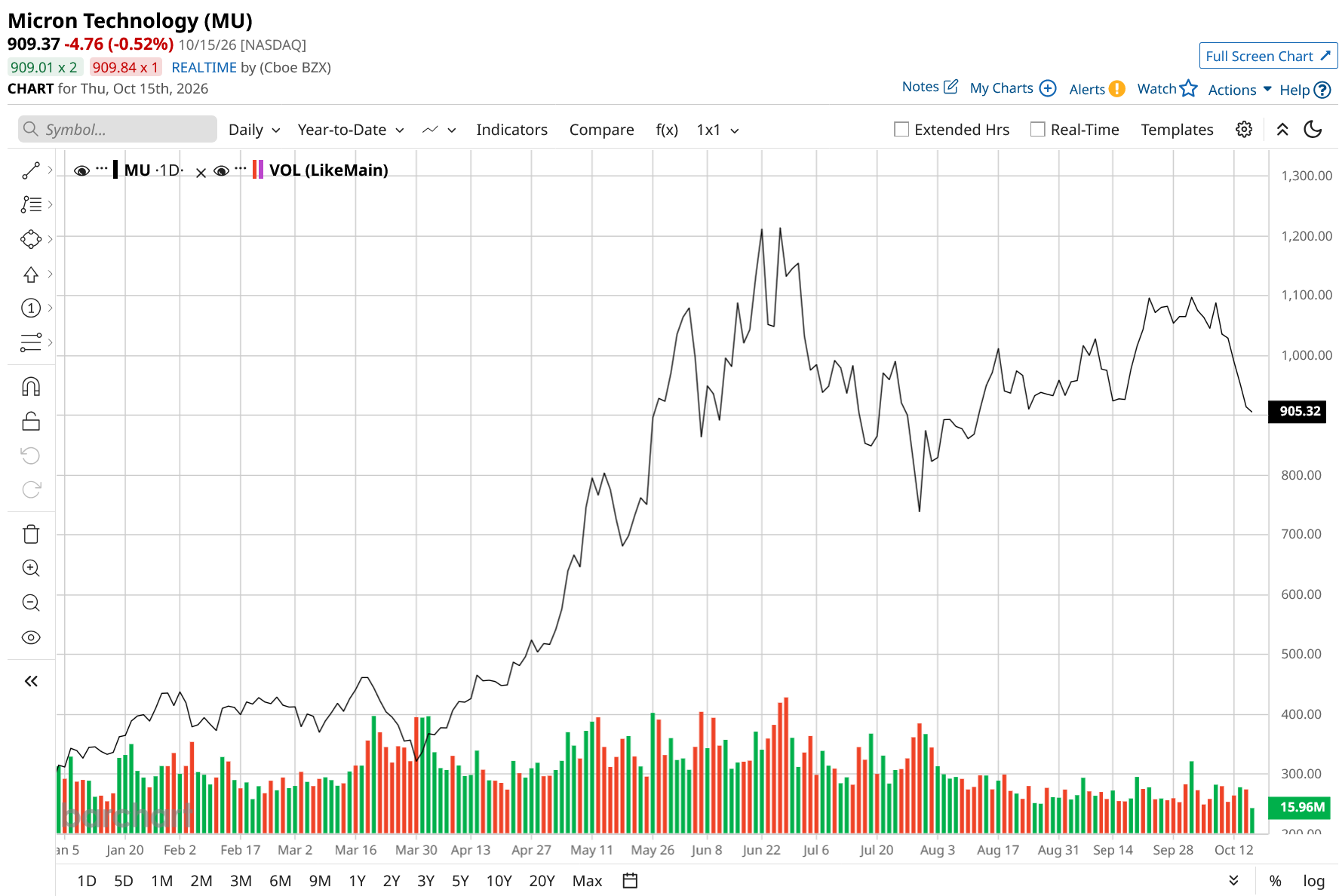
Although the shares have fallen about 15% in the past five trading days primarily due to Chinese memory chipmaker CXMT's new “4F square” DRAM architecture and wider market concerns, this should not be a major cause of concern for long-term investors in the counter.
Micron's Buy, Buy, Buy
The $35.16 billion figure may seem big for the old Micron, but not so for the new AI-powered version of the Boise, Idaho company. Moreover, of the $35.16 billion, $2.16 billion remains from the earlier authorization of a $10 billion buyback in 2019. Notably, Micron decided upon the $35.16 billion number after calculating its adjusted free cash flow, which came in at $33.2 billion for the quarter ended Sept. 3, 2026.
The company calculates adjusted free cash flow by subtracting net capital expenditures from cash flow from operations, while also accounting for proceeds from asset sales and government incentives. After deducting dividends paid and applying the relevant CHIPS Act grant adjustment, Micron arrived at $33.025 billion as the basis for increasing its authorization, which also included the $2.16 billion remaining under its previous program.
However, some important caveats must be kept in mind. The $35.16 billion is the ceiling for the share repurchase program; it is not an obligation for Micron. Conversely, what Micron is obligated to adhere to is the CHIPS Act, under which the buybacks can only begin on Dec. 9. This is because Micron has received funding under CHIPS Act agreements, which were subject to some conditions.
For instance, during the first two years of the five years following the Dec. 9, 2024, award date, repurchases are permitted within specified limits to offset dilution from employee stock compensation or as otherwise allowed by the U.S. Department of Commerce. Moreover, during the final three years, repurchases are subject to additional financial conditions, including limits tied to free cash flow after specified adjustments for CHIPS Act grant incentives and dividends.
Yet, amid all this, the quantum of the purchase must be put into context relative to where Micron was. Just under a decade ago, in 2017, Micron's entire market cap was less than the buyback program value it has authorized now. In July 2017, the company's market cap was $31.3 billion. Further, since the beginning of the last $10 billion program, the largest repurchase ever in a year was $2.66 billion, while for the full fiscal year of 2026, Micron had made repurchases worth only $650 million and none in FY 2025.
Q4: A Source of Strength
Micron's numbers for the most recent quarter certainly gave its latest buyback increase a thrust.
In the fourth quarter of 2026, Micron reported revenue of $54.3 billion, representing growth of 379.3% from the year-earlier period. The data center segment emerged as the largest contributor, overtaking cloud memory. Data center revenue expanded more than elevenfold year-over-year (YoY) to $18 billion, while cloud segment revenue increased 3.6 times to $16.3 billion.
Rising revenue was accompanied by exceptionally strong margins. The cloud segment delivered gross margins of 83%, up from 59% in the prior-year period, and the data center unit achieved gross margins of 90%, compared with 41% a year earlier. Company-wide gross margins reached 84.9%, versus 45.7% in the previous year.
This performance carried through to profitability, as Micron recorded earnings of $33.42 per share for the quarter, compared with $3.03 per share in the year-ago period. Earnings also surpassed the Street estimate of $31.77 per share, marking the tenth consecutive quarter of beating profit forecasts.
For the first quarter of 2027, Micron guided for revenue between $60 billion and $63 billion and earnings per share in the range of $37.15 to $39.15. Both figures stand above current consensus estimates of $57.02 billion in revenue and $35.40 per share in earnings.
Although capital expenditures rose sharply from $1.38 billion to $27.4 billion, operating cash flows more than offset the increase. For the fiscal year ended Sept. 3, 2026, net cash from operating activities totaled $89.7 billion, up from $17.5 billion in fiscal 2025. Free cash flow likewise advanced to $62.3 billion from $3.7 billion in the prior year. Micron closed the fiscal year with $38.4 billion in cash and only $491 million in short-term debt. This strongly suggests that the new $35.16 billion share buyback program will not put any pressure on the company's balance sheet.
Despite the substantial share price appreciation, Micron continues to trade at attractive valuation levels. While the forward P/E and P/CF of 5.41 and 5.38 are below the sector medians of 22.79 and 20.64, respectively, the forward P/S of 3.92 is slightly above the sector median of 3.41.
Notably, Micron currently commands a market cap of $1.1 trillion, while its shares are up 210% on a year-to-date (YTD) basis.
Analyst Opinion on MU Stock
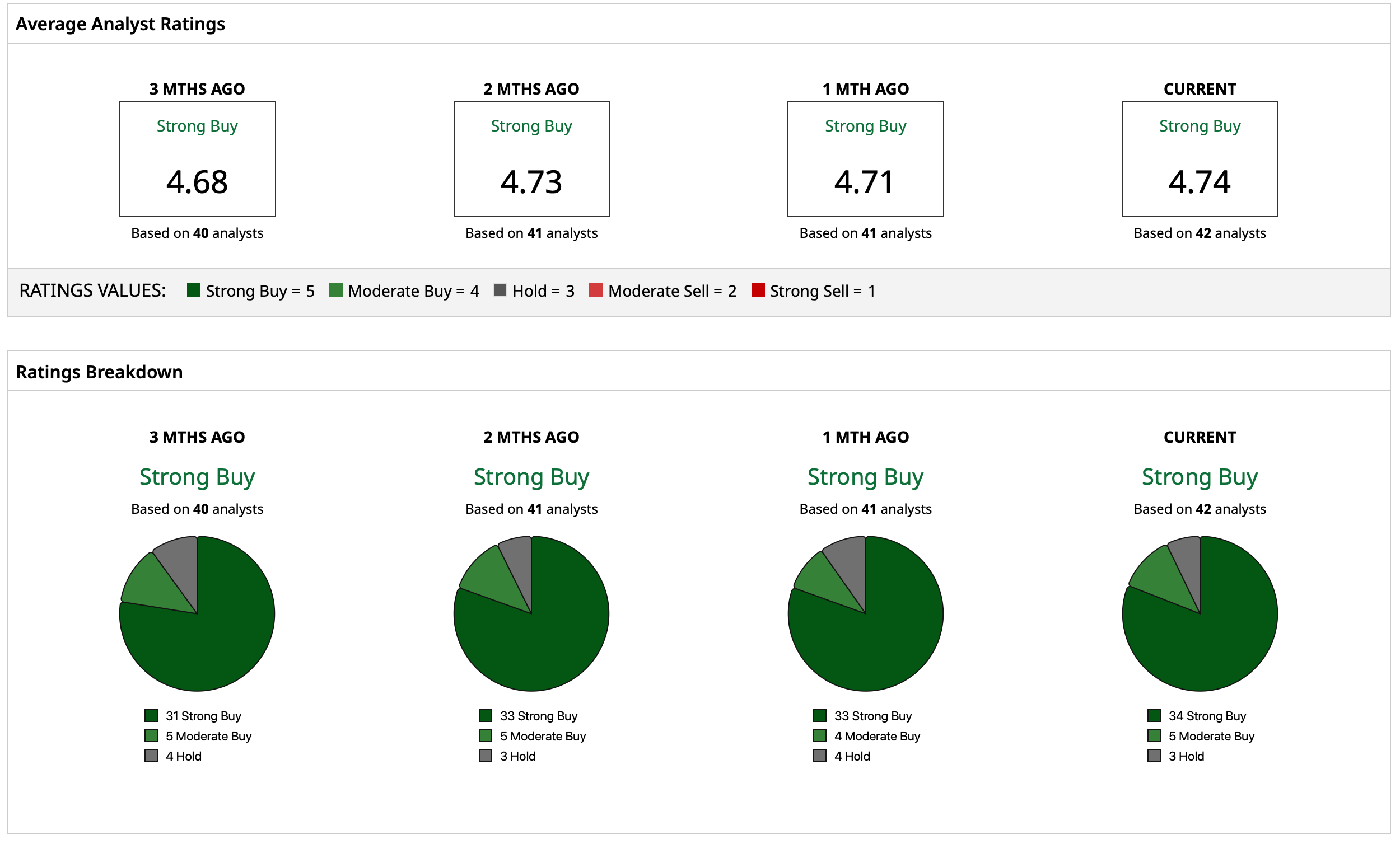
Overall, analysts remain bullish about Micron, earmarking for it a consensus rating of “Strong Buy” and a mean target price of $1,563.22. This implies a potential upside of 73% from current levels. Out of 42 analysts covering the stock, 34 have a “Strong Buy” rating, five have a “Moderate Buy” rating, and three have a “Hold” rating.
On the date of publication, Pathikrit Bose did not have (either directly or indirectly) positions in any of the securities mentioned in this article. All information and data in this article is solely for informational purposes. For more information please view the Barchart Disclosure Policy here.