
NFLX Stock Alert: Why Some Experts Are Worried That Netflix Has a Churn Problem
Streaming giant Netflix (NFLX) is facing mounting pressure on Wall Street as competition from rival streaming platforms and YouTube intensifies. The company’s once-dominant position in the streaming market is being tested as it struggles to keep viewers engaged and investors confident in its growth prospects. On Wednesday, Netflix announced plans to cut 6% of its workforce, or approximately 1,000 jobs, marking its largest round of layoffs since 2022. The move comes as the streaming leader contends with a weakening audience and a battered stock price.
As per the latest data, Viewers are spending less time on the platform, and more subscribers are calling it quits. On Wednesday, Apptopia director Adam Blacker pointed out that Netflix’s subscriber retention problem is deepening, with its U.S. churn rate jumping sharply in the third quarter. Churn measures the percentage of subscribers who cancel their subscriptions over a given period, making it a critical indicator of a streaming platform’s ability to hold on to its audience.
With more viewers heading for the exit and engagement showing signs of weakness, Netflix faces a growing challenge in an increasingly crowded streaming market. So, given the backdrop, can the company turn the tide, and what should investors make of the warning signs? Let’s take a closer look at the challenges facing Netflix and the outlook for NFLX stock.
About Netflix Stock
Founded in 1997, Netflix is a leading global entertainment company headquartered in Los Gatos, California. Initially launched as a DVD rental service, the company transformed the entertainment industry by introducing online streaming in 2007, allowing viewers to watch content on demand. Today, Netflix operates across more than 190 countries, offering a broad library of entertainment to audiences worldwide.
Netflix’s offerings span original and licensed television series, feature films, documentaries, anime, stand-up comedy, and games, alongside an expanding slate of live programming and podcasts. Its content portfolio covers multiple genres and languages, catering to diverse audiences across international markets. The company generates most of its revenue through paid memberships, with subscription plans varying by market and, in some countries, including ad-supported options.
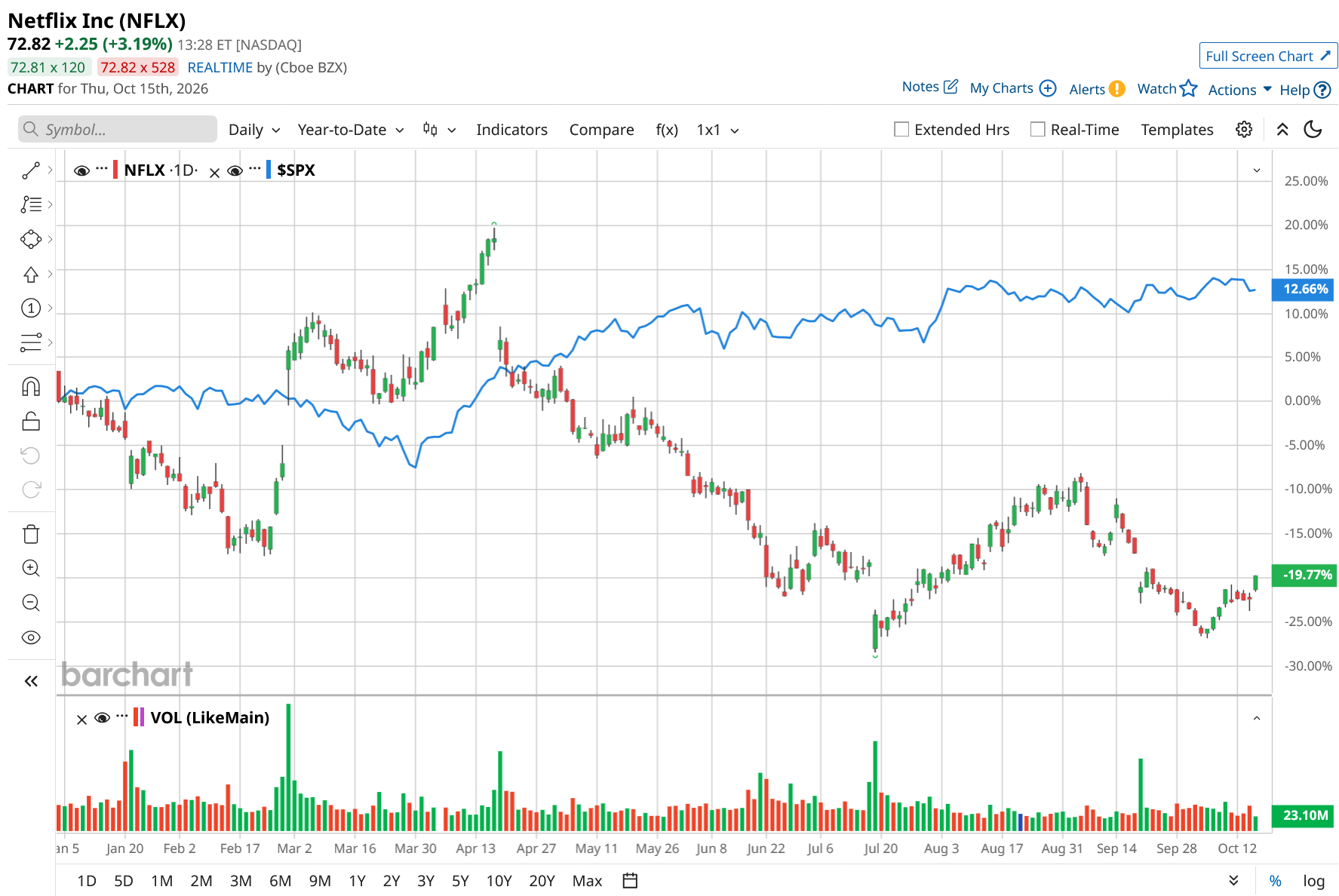
However, Netflix’s dominance in the streaming industry has done little to shield its stock from Wall Street’s selloff. Valued at approximately $293.85 billion, NFLX shares have plunged nearly 40% over the past year and 22% in 2026, sharply underperforming the broader S&P 500 Index ($SPX), which has gained 15.3% over the past year and 12.3% year-to-date (YTD).
The stock has also tumbled roughly 42% from its 52-week high of $124.86, reached in October 2025. With intensifying competition and growing concerns about subscriber retention weighing on sentiment, Netflix’s once-formidable market position is facing a tougher test.
Q2 Earnings Snapshot
Netflix delivered a mixed financial performance in its fiscal 2026 second-quarter earnings report on July 16, with solid profit growth offset by a slight revenue miss and lower free cash flow. Revenue climbed 13.4% year-over-year (YoY) to $12.56 billion, narrowly missing Wall Street’s estimate of $12.58 billion. Operating income reached a robust $4.19 billion, translating into a healthy operating margin of 33.4%. However, the margin slipped from 34.1% in the year-ago quarter, pointing to some pressure on profitability despite continued top-line growth.
Geographically, Netflix maintained its growth momentum, recording double-digit revenue growth across all regions. Quarterly revenue surpassed $4 billion in Europe, the Middle East, and Africa (EMEA), while both Latin America (LATAM) and Asia-Pacific (APAC) crossed the $1.5 billion mark. In the United States and Canada (UCAN), revenue grew 10% YoY, reflecting only the partial-quarter impact of the company’s recent price increase, which management said had performed well and was in line with expectations.
Viewer engagement also showed improvement, with total viewing hours growing 2% in the first half of 2026, accelerating from 1.5% growth in 2025. This improvement came despite competitive pressure from major sporting events, including the Winter Olympics and the FIFA World Cup, during the year.
On the bottom line, Netflix reported net income of $3.40 billion, up 8.8% from the prior-year period. Earnings per share (EPS) rose 11.1% YoY to $0.80, edging past Wall Street’s estimate of $0.79. However, free cash flow (FCF) fell to $1.53 billion from $2.27 billion a year earlier, partly reflecting higher cash tax payments, including those related to the Warner Bros. termination fee.
Netflix also stepped up its capital-return efforts, repurchasing $4.7 billion worth of shares during the quarter, its largest quarterly share repurchase to date. The company still has $27.1 billion available under its remaining share repurchase authorizations. Its balance sheet ended the quarter with $14.4 billion in gross debt and $9.1 billion in cash and cash equivalents. Netflix also has $1 billion of debt maturing later in 2026, which it plans to refinance.
Looking ahead, Netflix narrowed its full-year 2026 revenue forecast to a range of $51 billion to $51.4 billion, while maintaining its operating margin guidance of 31.5%, both consistent with its previous outlook. The company also reiterated its expectation of generating approximately $12.5 billion in free cash flow for the full year.
Netflix Faces Rising Churn as Viewers Tune Out
Netflix’s subscriber retention woes appear to be intensifying. According to Apptopia, the streaming giant’s U.S. churn rate surged 16.6% in the third quarter, following three consecutive quarters in which churn had been running approximately 8% above year-ago levels. More concerningly, U.S. churn has increased for seven consecutive quarters, although the first six increases were all below 5%.
The latest spike suggests that Netflix may be facing a sharper challenge in keeping subscribers from walking away. Viewer engagement is also showing signs of weakness. Average daily time spent per U.S. daily active user (DAU) fell to 73.2 minutes in the third quarter, down from 77 minutes in the first quarter, marking a second consecutive quarterly decline. Although viewing time remained above the 70.2 minutes recorded a year earlier, the sequential drop raises concerns.
Typically, rising churn can lift average viewing time as less-engaged users cancel their subscriptions, leaving a more active audience behind. However, Netflix’s average viewing time declined anyway, suggesting that engagement may be weakening even among those who continue using the platform, according to Apptopia director Adam Blacker. Younger viewers are emerging as a particular concern.
Apptopia data showed that U.S. users aged 17 to 25 spent an average of just 59.7 minutes per day on Netflix in the third quarter, the lowest of any age group. That figure also marked a steep decline from 68.7 minutes a day in the same quarter last year. With younger audiences spending less time on the platform, Netflix faces another hurdle in keeping viewers engaged and maintaining its appeal in an increasingly competitive streaming market.
How Do Analysts View NFLX Stock?
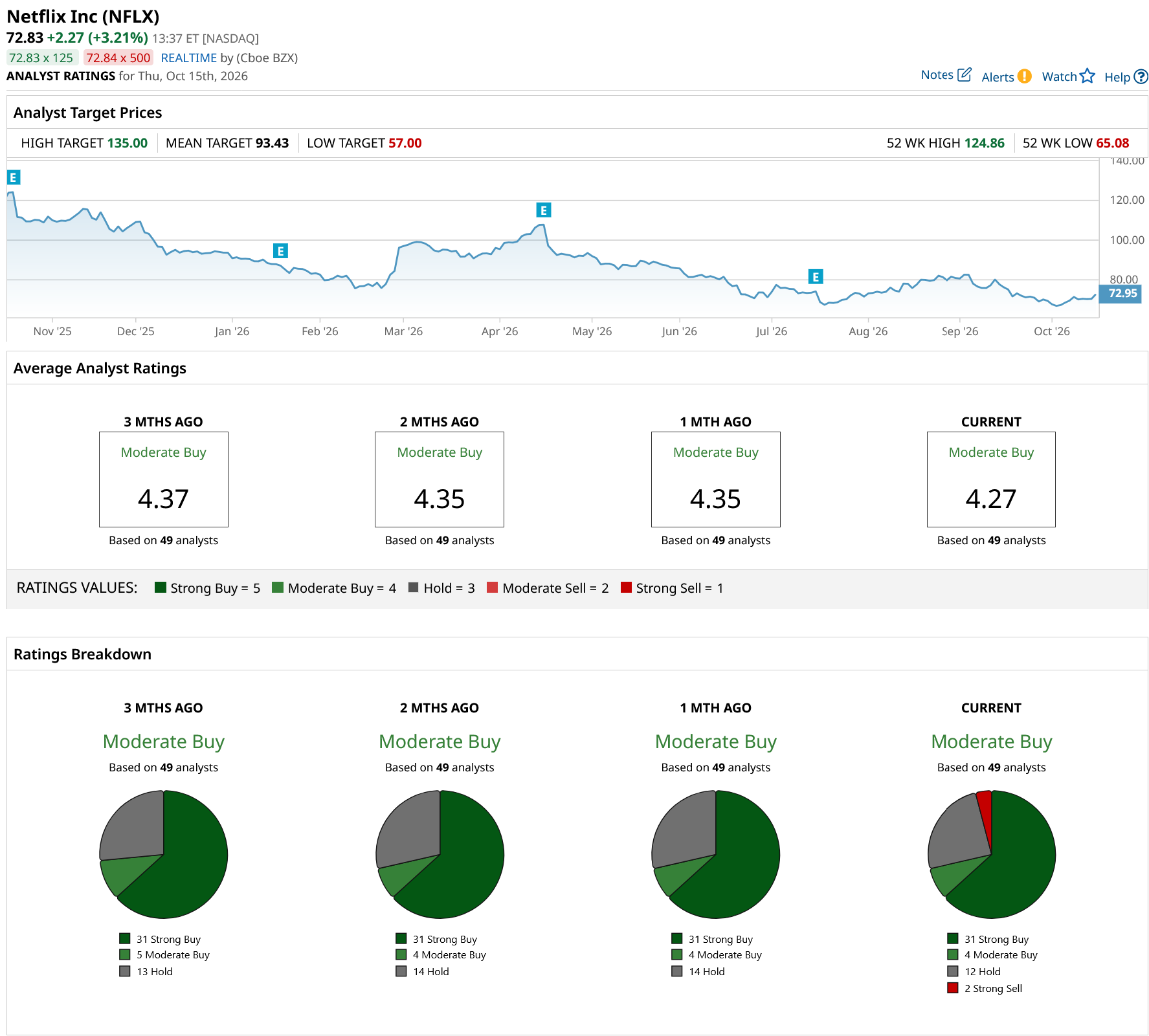
Despite the steep selloff, Wall Street hasn’t given up on Netflix just yet. The stock retains a consensus “Moderate Buy” rating, signaling that analysts see room for a potential recovery. Of the 49 analysts covering NFLX, 31 recommend a “Strong Buy,” four rate it a “Moderate Buy,” 12 assign a “Hold,” and just two issue a “Strong Sell.”
The optimism is reflected in the price targets, too. The average target of $93.43 points to an upside of approximately 29%, while the Street-high target of $135 implies a potential rally of roughly 86% from current levels.
On the date of publication, Anushka Mukherji did not have (either directly or indirectly) positions in any of the securities mentioned in this article. All information and data in this article is solely for informational purposes. For more information please view the Barchart Disclosure Policy here.