
McDonald’s Stock Offers Up a Juicy Dividend Yield Above 3%, But I Don’t See Many Other Reasons to Buy It
Things have been tough for restaurant stocks this year. High inflation — particularly the sharp rise in gas prices — is pinching lower- and middle-income families and negatively impacting their spending on other goods. To make things worse, restaurants are grappling with higher input costs as prices of raw materials like beef have spiked this year.
While restaurants might have wanted to pass on higher input costs to customers, the macro slowdown, reflected in sluggish same-store sales growth, has reduced room to raise prices. On the contrary, companies have been racing to offer affordable options to lure more customers to ordering.
Restaurant Stocks Have Taken a Beating in 2026
There is also the challenge from weight-loss drugs, which increase satiety and lower the calorie needs of people consuming them. KFF Health Tracking Poll, published last November, revealed that one in every eight U.S. adults were consuming a GLP-1 drug. The poll showed high cost of these drugs as a concern. Prices have fallen this year, which, coupled with the launch of pills, can boost their adoption.
Amid the restaurant industry woes, Meritage Hospitality Group (MHGUQ), which is among the biggest franchisees for Wendy’s in the U.S., operating 314 restaurants across 15 states, filed for bankruptcy last month, blaming record-high beef prices and profitability issues.
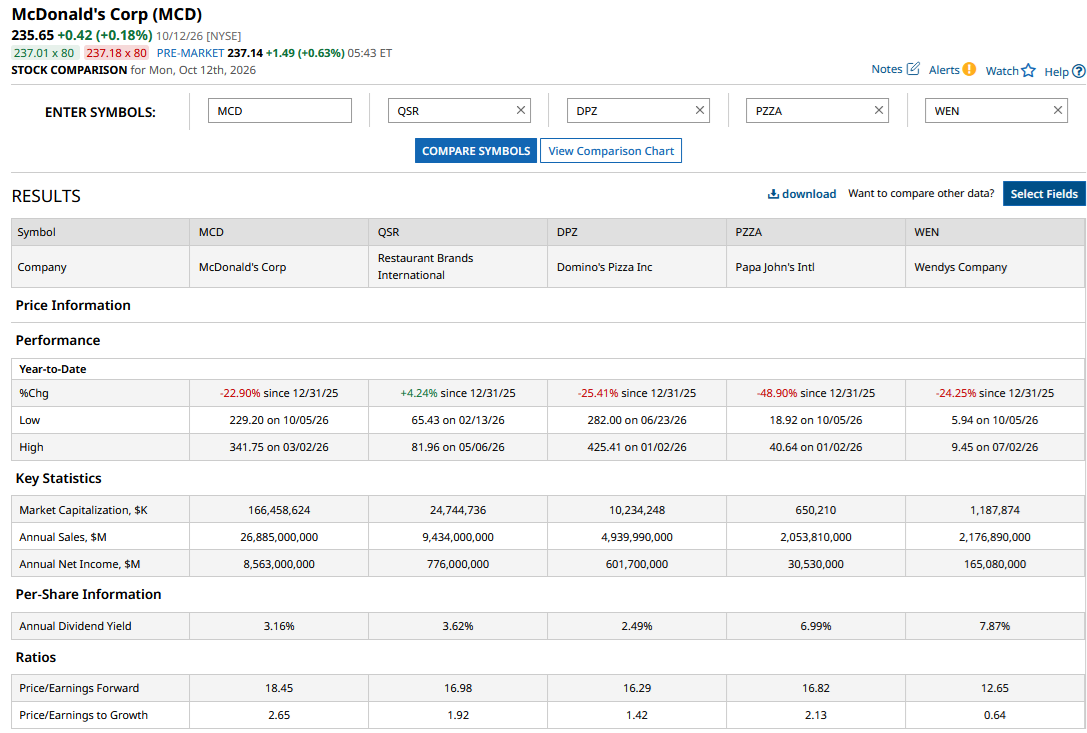
It's not alone, as restaurant stocks have also borne the brunt of these headwinds, and McDonald’s (MCD), Domino’s Pizza (DPZ), and Wendy’s (WEN) are all down 20% this year. Papa John’s International (PZZA) has been among the worst performers, losing nearly half of its market cap. Yet, Burger King owner Restaurant Brands International (QSR) — which counts Bill Ackman’s Pershing Square Holdings (PSHZF) as its second-biggest shareholder — has fared much better and is up around 4% for the year, even though it is down more than 13% from its 2026 highs.
McDonald’s Is Now a ‘Dividend King’
McDonald’s stock has been falling to new lows and is currently trading near its 52-week lows. MCD is down around 1% over the last five years and is underperforming the market badly even after accounting for its fat dividend yield, which has now topped 3%. The stock became a Dividend King after it raised its dividend for the 50th consecutive year in September.
In my previous article, I talked about the possibility of some revival in McDonald’s stock in the back half of the year even though I noted that it wasn’t a tempting buy. Contrary to my expectations, the stock has continued to slip further and is now in bear market territory.
MCD Has a New Growth Plan
Meanwhile, at its Investor Day last month, McDonald’s outlined a new growth roadmap. It expects to maintain its market share in the beef category while targeting market share gains of 1.5% in the beverage and chicken category by 2030. It is expanding its store footprint and expects to add 2.5% to its systemwide sales in 2027, predicting the number to moderate to 2% by 2030.
It is also targeting operating margins in the “low-to-mid 50% range” and free cash flow conversion in the “mid-to-high 80% range” by 2030. McDonald’s is working on store modernization, and as part of that plan, it plans to provide $8.5 billion in support to restaurants by 2036.
Achieving these objectives won’t be easy for McDonald’s, and data shared by Consumer Edge, a firm tracking credit and debit card transactions, with CNBC, shows that MCD is losing share to rivals like Chick-fil-A and 7 Brew. Moreover, while it remains to be seen how the store modernization drive impacts sales, it would drain the company’s cash as it provides financial support to restaurants.
MCD Stock Forecast
McDonald’s Investor Day left sell-side analysts asking for more, and multiple brokerages slashed the stock’s target price following the event. While some of these target price cuts were cursory, there were some deeper cuts. For instance, BTIG lowered MCD’s target price from $350 to $295 while Baird lowered its from $285 to $250. The target price cut spree has continued in October, with Bernstein, KeyCorp, Guggenheim, and Wells Fargo all slashing McDonald’s target price this month.
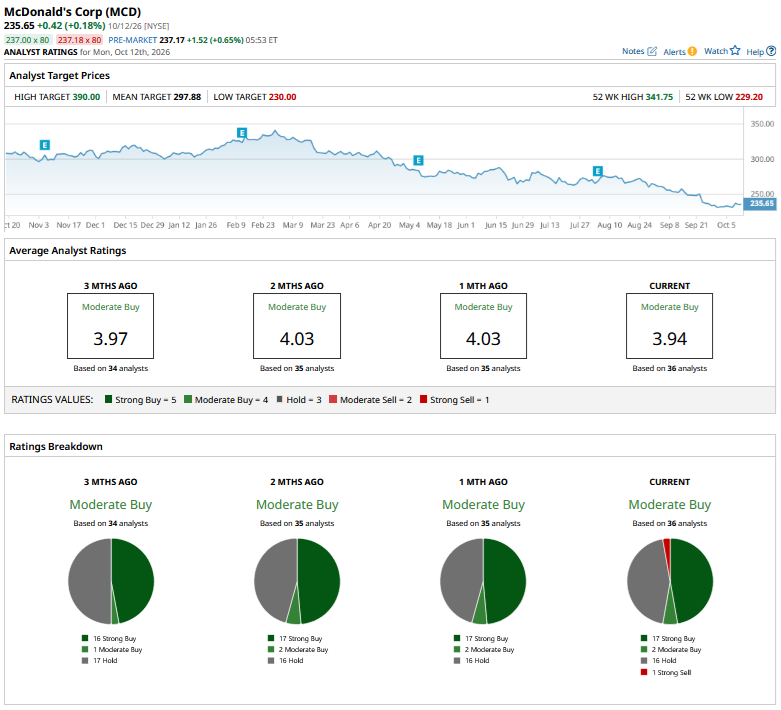
Overall, of the 36 analysts polled by Barchart, 19 rate MCD as a “Buy” or equivalent while 16 rate it as a “Hold.” One analyst rates the stock as a “Strong Sell,” and its mean target price of $297.88 is 26.4% higher than the current price. Thanks to the recent pullback, McDonald’s is now only a tad higher than its Street-low target price of $230.
Is McDonald’s Stock a Buy?
While the industry-wide challenges are certainly to blame, McDonald’s woes are compounded by the fact that it has lost market share to rivals like Burger King. McDonald’s forward price-to-earnings (P/E) multiple has corrected to 18.5x, which is below its historical valuations as well as that of the average S&P 500 Index ($SPX) peer.
The valuations are low for a reason, and we might not see a major expansion until McDonald’s shows improvement in its operating and financial performance. The macro environment hasn’t improved much either since I last covered the stock. Overall, while the stock could find a place in portfolios of investors who crave quality dividend stocks, particularly those whose payouts are not at risk, I still don’t see any triggers that can drive MCD’s re-rating in the short term.
On the date of publication, Mohit Oberoi did not have (either directly or indirectly) positions in any of the securities mentioned in this article. All information and data in this article is solely for informational purposes. For more information please view the Barchart Disclosure Policy here.