
How New Community Openings Will Impact KB Home Stock Investors
- KB Home recently opened several new residential communities in Florida and California, offering ENERGY STAR certified homes with customizable designs, varied floor plans and price points from the low $300,000s to the $600,000s.
- The push into Sebastian Oaks, Camellia Glen and Cypress Ranch signals KB Home allocating capital toward land and product in diverse, demand-sensitive markets, which can influence build times, cost control and the mix of future deliveries.
- This article examines how KB Home's broader investment narrative is influenced by this new wave of community openings and geographic expansion.
Scan how KB Home’s energy efficient, master-planned communities compare with other builders by reviewing a curated set of housing-related stocks in our list of solid balance sheet and fundamentals (25 results) for potential ideas.
KB Home Investment Narrative Recap
To own KB Home, you need to believe the builder can keep turning its land position and community openings into consistent closings despite softer demand and recent margin pressure. The near term swing factor is how quickly management converts current communities into deliveries without leaning heavily on further price cuts. The biggest risk is still prolonged weak buyer confidence that leaves more inventory on the ground and strains cash generation in a business where debt is not well covered by operating cash flow.
The latest community launches in Florida and California look incremental rather than thesis changing in the short run. They extend KB Home’s reach in markets where the firm already operates and support the existing narrative around improved build times and a growing lot pipeline. For now, the impact on the key catalyst, better execution and inventory turns, and on the main risk, uneven regional demand and pricing pressure, appears modest and will show up only as these projects move through the sales cycle.
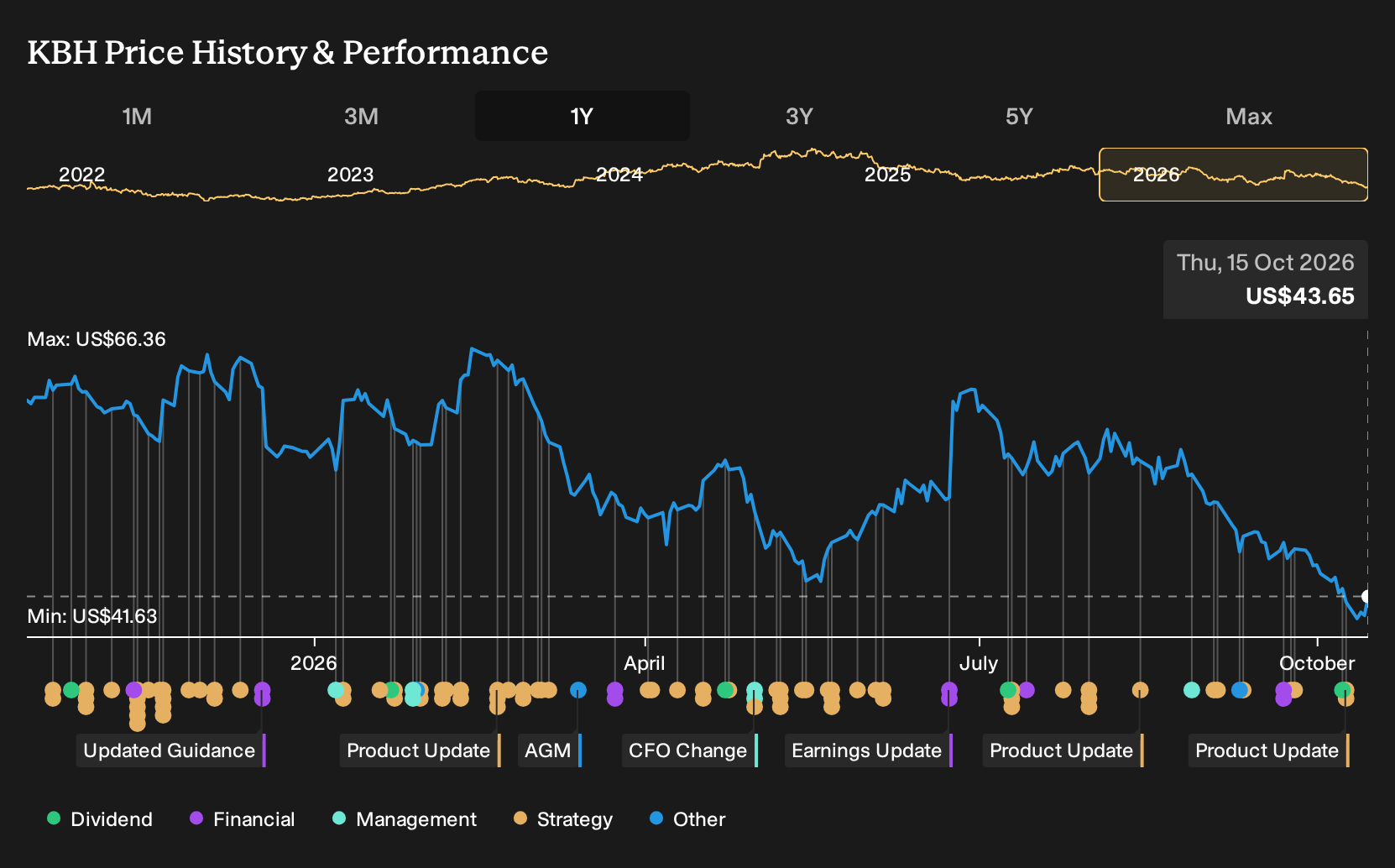
Among the recent updates, the dividend affirmation at US$0.25 per share stands out because it links directly to cash priorities while KB Home is still dealing with slower selling conditions and profit margins that are lower than last year. A regular payout can signal management’s intention to balance land spend, debt service and shareholder returns, which matters when debt coverage by operating cash flow is flagged as a weakness.
You can treat that distribution decision as a live test of how resilient the business model is if buyer traffic stays uneven across regions like Florida and California. If demand holds up enough for new communities such as Sebastian Oaks, Camellia Glen and Cypress Ranch to support steady orders and closings, maintaining the dividend could support confidence. If consumer confidence weakens further or price reductions deepen, the same commitment could constrain flexibility and sharpen the focus on execution, build times and cost control as the practical catalysts to watch.
How KB Home’s Analyst Assumptions Link Back To The New Communities
KB Home's current analyst narrative ties those new Florida and California communities to a longer term set of expectations rather than a quick swing in the numbers. Analysts are building in 1.9% yearly revenue growth over the next few years and are working off earnings today of US$224.9 million, with a consensus view that profit could reach US$299.5 million by 2029. That implies an earnings increase of about US$74.6 million by the 2029 forecast year, which is the level analysts also use when they talk about revenues of US$5.5b and earnings of US$299.5 million in their valuation work. This set of assumptions effectively asks you to judge whether communities like Sebastian Oaks, Camellia Glen and Cypress Ranch, along with the rest of the project pipeline, can justify that move in earnings while KB Home keeps working on build times, pricing discipline and cost control.
KB Home's narrative projects revenues of US$5.5b and earnings of US$299.5 million by 2029. That path uses 1.9% yearly revenue growth and an earnings increase of about US$74.6 million from earnings today of US$224.9 million.
Uncover why KB Home's fair value indicates a 25% potential upside to its current price before the discount closes.
Exploring Other Perspectives
One alternate angle focuses on KB Home’s shift toward higher priced West Coast deliveries as a catalyst. Bullish analysts, who were previously modelling revenue of about US$5.8b and earnings of roughly US$340.6 million by 2029, see much more upside than the consensus. You can compare those views to today’s new community openings and decide how your own narrative might change.
Explore 2 other KB Home fair value estimates, including one that suggests as much as 25% upside from the current price.
Decide For Yourself
Disagree with existing narratives? Extraordinary investment returns rarely come from following the herd, so trust your own research and judgment.
- A great starting point for your KB Home research is our analysis highlighting 2 key rewards and 4 important warning signs that could impact your investment decision.
- See our latest analysis for KB Home. The report includes a comprehensive fundamental analysis summarized in a single visual, the Snowflake, making it easy to evaluate KB Home's overall financial health at a glance.
Looking for more KB Home sized investment ideas?
If you want to put KB Home’s story in context, it helps to scan a wider field of stocks with different balance sheets, dividends and valuation profiles. The Simply Wall St Screener lets you do that quickly by filtering for the mix of quality, value and resilience that fits your own approach.
- If you are hunting for quality at a reasonable price, start with companies that score well on fundamentals and trade below internal fair value estimates through the 32 high quality undervalued stocks.
- Income focused investors who care about consistency as much as yield can examine companies with stronger payout profiles using the 8 dividend fortresses.
- For a focus on resilience and capital preservation, filter for businesses with healthier balance sheets and steadier financial metrics through the 32 resilient stocks with low risk scores.
This article by Simply Wall St is general in nature. We provide commentary based on historical data and analyst forecasts only using an unbiased methodology and our articles are not intended to be financial advice. It does not constitute a recommendation to buy or sell any stock, and does not take account of your objectives, or your financial situation. We aim to bring you long-term focused analysis driven by fundamental data. Note that our analysis may not factor in the latest price-sensitive company announcements or qualitative material. Simply Wall St has no position in any stocks mentioned.
Have feedback on this article? Concerned about the content? Get in touch with us directly. Alternatively, email editorial-team@simplywallst.com