
Tencent Holdings (SEHK:700) Tests Its Valuation Story With Fresh Bond Funding
Tencent Holdings (SEHK:700) just raised fresh capital in the bond market, completing multi-currency fixed-income offerings that include new US$ and CNY notes and extending its funding profile into 2036 and 2046.
The fresh bond issuance comes at a time when Tencent Holdings' share price has been under pressure, with the stock down about 33% year to date and the 1-year total shareholder return declining roughly 30%, even though the 3-year total shareholder return remains strongly positive.
Scan Tencent Holdings in context and compare it with hand-picked peers using our screener of 193 high quality undervalued stocks with stronger cash flows and balance sheets.
The bond sale lands just as Tencent Holdings' share price and recent total returns have come under pressure. Is this financing move a reflection of a resilient business, or mainly shifting sentiment that is weighing on the stock and its valuation metrics next?
Most Popular Narrative: 12.9% Overvalued
Tencent Holdings last closed at HK$417.8, while the most followed narrative on the stock assigns a fair value of HK$370. The gap is not huge in absolute terms, yet it implies Tencent is priced above what that valuation framework sees as justified based on its cash generation and reinvestment choices.
Tencent is currently in a “AI = capex + opex expansion phase” NOT in “AI = cost reduction phase”
Critical insight This is NOT “AI reduces costs → margins expand” This IS “AI increases costs → hoping revenue grows enough to compensate” 🔥 This completely changes the DCF profile
See why 38 investors see Tencent Holdings as 13% overvalued.
Result: Fair Value of HK$370 (OVERVALUED)
Still, Tencent Holdings faces risks that could flip this overvaluation story, including evolving China AI regulation and the recent US military blacklist designation.
Find out about the key risks to this Tencent Holdings narrative.
Another View: Tencent Holdings Through Earnings Multiples
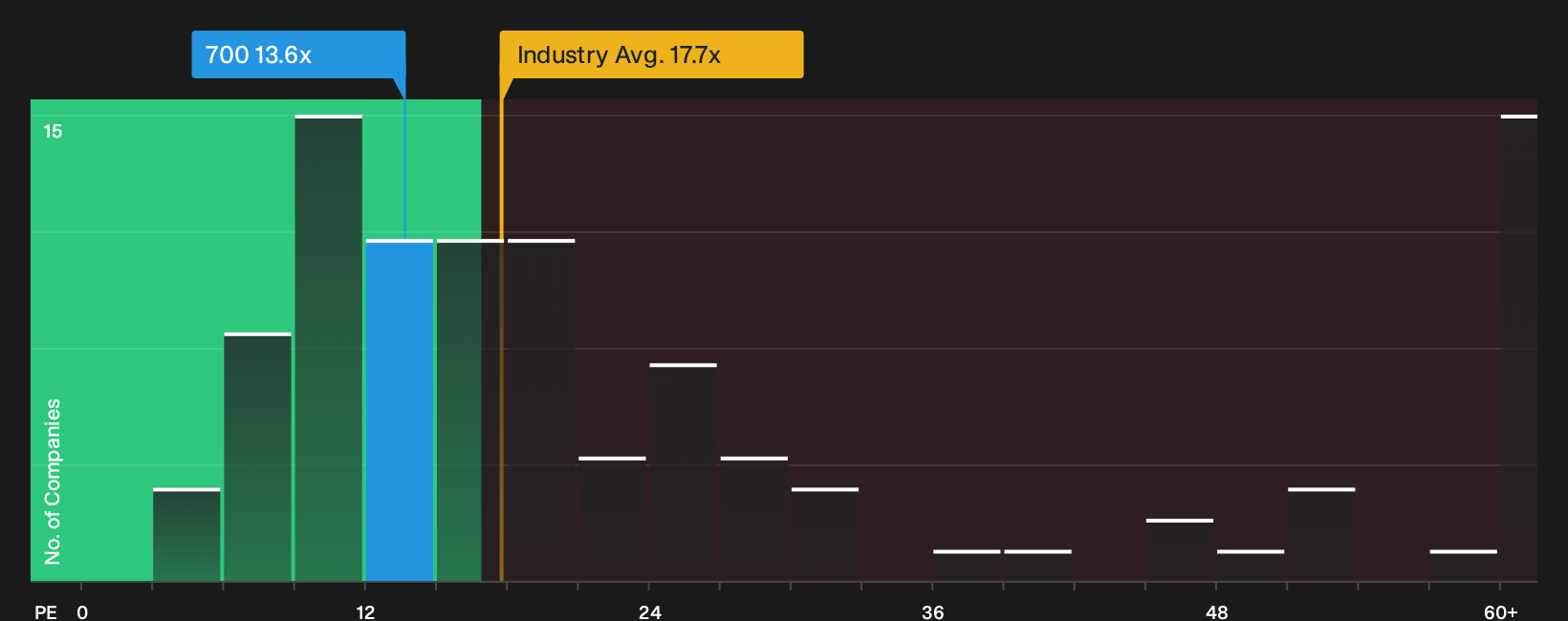
The popular narrative tags Tencent Holdings as about 13% overvalued at HK$370 fair value, yet the current P/E of 13.6x presents a more mixed picture. It is cheaper than the Asian Interactive Media and Services industry on 17.7x, but pricier than the peer average on 12.1x, with a fair ratio of 15.3x sitting in between.
That gap cuts both ways. Trading below the fair ratio suggests there may be room for the market multiple to move higher, while the premium to peers signals less margin for error if earnings forecasts around 4.5% profit growth and 8.7% revenue growth do not play out as expected. Which signal do you weigh more heavily when you look at Tencent today?
See what the numbers say about this price in our valuation breakdown, then pressure test your own view before acting See what the numbers say about this price — find out in our valuation breakdown.
Here is how Tencent Holdings’ P/E compares visually with its industry, which can help you judge whether the current discount or premium matters for your approach
Next Steps
If the mixed signals around Tencent Holdings leave you undecided, let that uncertainty motivate you to act quickly and stress test the data yourself using the 4 key rewards.
Looking for more Tencent Holdings investment ideas?
If Tencent Holdings leaves you questioning your next move, widen your options now and line up a few fresh watchlist candidates before the market moves without you.
- Target potential upside early by scanning carefully selected small caps through the 129 elite penny stocks with strong financials that already clear basic financial quality checks.
- Strengthen your core holdings by reviewing the list of solid balance sheet and fundamentals (203 results) that combine sturdier finances with business models built to handle shocks.
- Spot future contenders by working through the 618 high quality undiscovered gems that pair strong fundamentals with relatively low investor attention.
This article by Simply Wall St is general in nature. We provide commentary based on historical data and analyst forecasts only using an unbiased methodology and our articles are not intended to be financial advice. It does not constitute a recommendation to buy or sell any stock, and does not take account of your objectives, or your financial situation. We aim to bring you long-term focused analysis driven by fundamental data. Note that our analysis may not factor in the latest price-sensitive company announcements or qualitative material. Simply Wall St has no position in any stocks mentioned.
Have feedback on this article? Concerned about the content? Get in touch with us directly. Alternatively, email editorial-team@simplywallst.com