
Will New York Terminal Opening Change Saia's (SAIA) Narrative
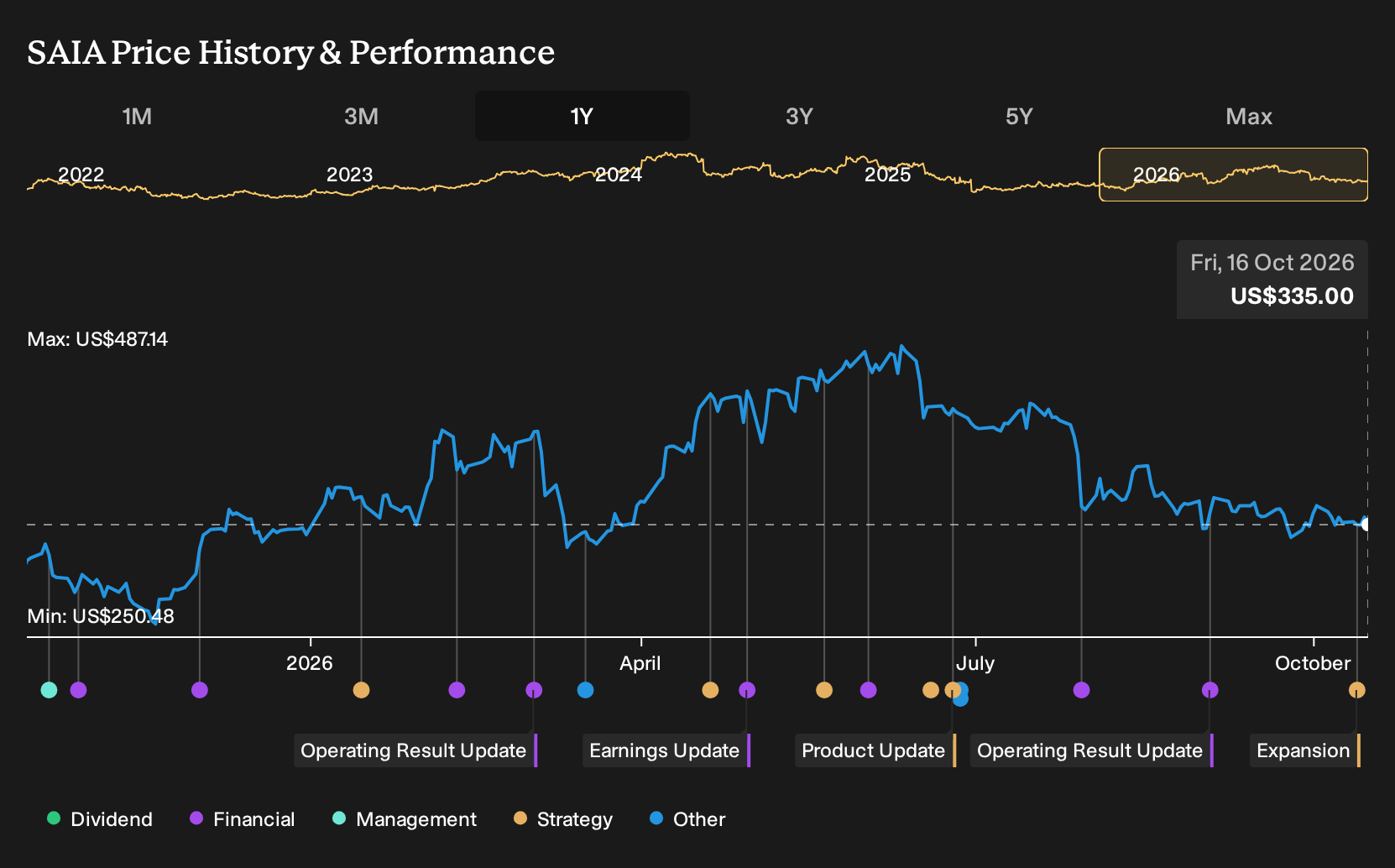
- Saia opened a new terminal in Deer Park, New York in October 2026, extending its less than truckload network reach across Long Island and the broader New York metropolitan area to support freight demand and add capacity.
- The Deer Park facility gives Saia denser coverage in one of the most economically significant and densely populated regions in the US. This can influence how effectively the business converts its existing real estate, fleet and labor costs into service quality and shipment density.
- We will look at how Saia's investment narrative is affected by this Deer Park terminal opening that targets dense New York freight.
Scan how Saia's Deer Park expansion compares with other freight and logistics plays by reviewing our hand picked list of solid balance sheet and fundamentals (25 results) that aim to convert network reach into resilient returns.
Saia Investment Narrative Recap
To own Saia, you generally need to believe that a larger terminal footprint, denser freight flows and technology like Saia REV can convert a higher cost base into better operating efficiency over time. The Deer Park terminal fits that story, giving the company more reach into dense freight on Long Island, although one site alone does not reshape the near term picture.
The more immediate swing factor still looks like cost control versus pricing power. Wages, benefits, fuel and insurance have all been rising and remain the core risk if they outpace yield and productivity gains. The Deer Park opening adds capacity, which only helps if it supports better mix, tighter routing and stronger shipment density.
The Deer Park move lines up cleanly with the existing catalyst around expanding and maturing Saia’s national terminal network. Management has added or upgraded more than 218 facilities since 2022, and the thesis is that newer locations can move their operating ratios closer to the levels seen in more established terminals as volumes build.
For you as a shareholder, the question is whether Deer Park accelerates that pattern or simply maintains it. Stronger Long Island and New York coverage can support transit time improvements and more reliable ETAs when combined with Saia REV. This in turn can help with contract renewals and rate discussions, but execution on efficiency and safety will still decide how much drops to the bottom line.
What The Deer Park Terminal Means For Saia's Numbers
Saia's Deer Park terminal fits into a financial story that already has clear expectations around growth, margins and capital efficiency. Analysts are building their revenue and earnings models on the idea that this bigger Long Island footprint helps the wider network push more freight through each tractor, dock and trailer without losing grip on service quality.
Current consensus has Saia's top line modeled to rise by 8.8% a year over the next few years, with profit margins moving from 8.2% today to 11.7% by around 2029. That margin lift is not pinned on Deer Park alone. It leans on the full grid of more than 218 facilities opened or upgraded since 2022, with the expectation that newer locations earn their way closer to the efficiency levels of long run terminals as volumes build.
Earnings sit at US$278.0 million today and analysts are penciling in US$510.4 million of profit by around 2029, with a more optimistic group modeling as much as US$638.2 million. That consensus path implies earnings would need to almost double, roughly an 84% increase from current levels, supported by tighter operating ratios and better use of Saia's real estate and fleet. The Deer Park build is part of that puzzle because it can help Saia push more dense New York freight through its owned network rather than relying as heavily on purchased transportation.
Those same forecasts assume the stock trades on a lower P/E multiple over time. The current P/E of 32.7x compares with an implied 27.9x on the 2029 earnings estimate, and analysts expect the share count to edge up only about 0.12% a year. For you as an investor, that mix means more of the heavy lifting is expected to come from actual profit growth and margin improvement rather than from multiple expansion or financial engineering.
The Deer Park site does not rewrite these models by itself. It plugs into the broader thesis that a denser, more controlled less than truckload network can absorb higher wages, fuel and insurance while still supporting the earnings trajectory analysts are using. If terminals like Deer Park improve routing options, cut empty miles and keep freight on Saia's own assets for more of the journey, they can help support the margin assumptions that sit behind the current forecasts.
Saia's narrative projects US$4.4b revenue and US$510.4 million earnings by 2029. Analysts are assuming 8.8% yearly revenue growth and that would require roughly an 84% earnings increase from US$278.0 million today.
Uncover why Saia's fair value indicates a 25% potential upside to its current price, which could narrow quickly.
Exploring Other Perspectives
One alternate view on Saia focuses on the risk that rising purchased transportation and fuel costs cap the payoff from all this network build out. The most bearish analysts were only assuming about US$4.2b of revenue and US$472.0 million in earnings by 2029, which is materially lower than consensus. Those projections came before the Deer Park news, so you have room to ask whether this new terminal nudges the story closer to the optimistic or cautious side. Exploring both sets of expectations can help you decide which version of Saia’s future feels more realistic.
Explore 4 other Saia fair value estimates, including one that suggests as much as 56% downside from the current price.
Decide For Yourself
Disagree with existing narratives? Extraordinary investment returns rarely come from following the herd, so trust your own analysis and judgment.
- A great starting point for your Saia research is our analysis highlighting 2 key rewards that could impact your investment decision.
- See our latest analysis for Saia. The report includes a comprehensive fundamental analysis summarized in a single visual, the Snowflake, making it easier to evaluate Saia's overall financial health at a glance.
Looking For More Ideas Beyond Saia?
If Saia's Deer Park story has you thinking about network quality, balance sheets and earnings power, it can be useful to line it up against other candidates that share similar strengths, or attack the problem from a completely different angle.
- For investors who want financial resilience front and center, start with a list of solid balance sheet and fundamentals (25 results) that focuses on companies aiming to pair robust balance sheets with steady fundamentals.
- If value is your priority, scan a 33 high quality undervalued stocks that targets businesses where strong cash flows and solid finances line up with compressed valuation multiples.
- Income driven portfolios might benefit from a curated 8 dividend fortresses highlighting companies that combine higher yields with an eye on sustainability.
This article by Simply Wall St is general in nature. We provide commentary based on historical data and analyst forecasts only using an unbiased methodology and our articles are not intended to be financial advice. It does not constitute a recommendation to buy or sell any stock, and does not take account of your objectives, or your financial situation. We aim to bring you long-term focused analysis driven by fundamental data. Note that our analysis may not factor in the latest price-sensitive company announcements or qualitative material. Simply Wall St has no position in any stocks mentioned.
Have feedback on this article? Concerned about the content? Get in touch with us directly. Alternatively, email editorial-team@simplywallst.com