
French riots hit Russia-Ukraine showdown, traders' mood was thwarted, and the euro fell
The Zhitong Finance App learned that in early Asian trading on Monday, the euro fell against most Group of Ten (G10) currencies. At one point, it fell 0.5% against the US dollar, hitting a low of 1.1183, then recovered some of the decline. As of press time, it was trading around 1.1212 US dollars. The two events that triggered this round of sell-off happened almost simultaneously: Ukrainian President Zelensky accused US President Trump of trying to pressure Kiev to surrender to Russia; protests in several French cities turned into clashes between the police and the public, leading to the country's worst street violence in many years.
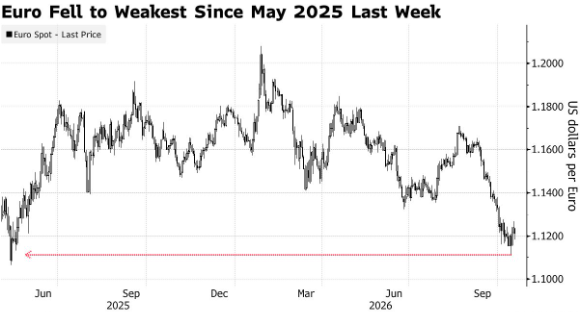
Europe's cumulative geopolitical pressure is at an already difficult point — high energy costs threaten economic growth, and the risk of inflation remains high. If the geopolitical context deteriorates further, the euro will be more likely to continue to fall. The euro underperformed among G10 currencies over the past month, and last week it fell to its lowest level since May 2025.
Zelensky's “forced surrender” accusations and diesel politics
Zelensky made these accusations during an interview. According to an interview on October 18, he said, “I think some steps are being taken to persuade Ukraine to surrender. I'm not saying this is what our partner wants to achieve, but it seems like it.” At the same time, he proposed a new plan: Ukraine would stop attacking Russian refineries in exchange for more “Patriot” anti-aircraft missiles — exactly what Trump is calling for to lower the price of US diesel.
Trump unilaterally announced a Russian-Ukrainian energy cease-fire on October 11, and exempted the anticipated energy sanctions against Russia on October 17; he blamed Ukraine's drone attacks on Russian refineries for disrupting the global diesel market and said he “didn't want to do anything that would foolishly push Russia off the negotiation table.” Zelensky said on October 18 that since the energy cease-fire was announced, Russia has attacked Ukraine's energy and oil and gas facilities 76 times, adding that “pressure must be applied to Russia before peace has a chance.”
For Europe, this is not a distant war: diesel and gas prices directly determine the Eurozone's inflation path, and therefore the ECB's policy space.
France: From street loss of control to bond market pricing
On October 17, the “Life Is Expensive” protests that broke out across France turned into clashes in Paris, Marseille, Lyon, Lille and many other places. The French Ministry of the Interior counted about 550,000 participants from all over the country (including 110,000 in Paris), while the French Federation of Trade Unions said that the number of participants reached 800,000; 2,397 people were arrested and 997 police and gendarmes were injured, 7 of whom were seriously injured — but on the night of the 17th, the government initially reported that only about 1,200 people had been arrested and 150 police were injured, and the numbers have since increased dramatically. The Paris police said 855 people were detained in the capital, which is a “record number.”
The extent of damage is also rare: the central city of Limoges, built in 1883, was set on fire, the roof collapsed, and about two-thirds of the façade was damaged. The local governor called it a “cultural heritage disaster”; Marseille City Hall was broken into by protesters; more than a dozen Paris Public Transport (RATP) subway lines were suspended for a while, and the Louvre limited the number of visitors.
The fuel for the protests was the cost of living. According to a poll released by the French L'Obsoco Institute and the CEVIPOF Center at the Paris School of Political Science on October 8, 45% of French respondents listed inflation and purchasing power as their top concerns; the previous student protests from September 17 were due to shortage of teachers, overcrowded classrooms, and poor facilities.
What really makes foreign exchange traders wary is the financial clock behind the protests. The French government is pushing ahead with the 2027 budget — reducing the deficit from 5.4% in 2026 to 5.0% with savings of around €43 billion — but to break through the divided National Assembly.
France's public debt has reached 3.60 trillion euros, equivalent to 119.0% of GDP (at the end of the second quarter, French National Institute of Statistics and Economics INSEE); the yield on 10-year French treasury bonds (OAT) was 4.79% on October 16, once approaching 5% earlier this month, the highest since 2002; the spread between OAT and German treasury bonds widened to about 150 to 160 basis points in early October, the widest since the 2011-2012 European debt crisis, October It fell back to about 137 basis points on the 16th. Moody's has now given France an Aa3 rating, the outlook is negative, and the review is scheduled for October 23.
It is worth noting that the ECB's two governing boards have made it clear: Bank of France Governor Moulin said, “There is no need to go to Frankfurt to find a solution; the solution is at home”; Bundesbank Governor Nagel emphasized that the ECB's bond market instruments are aimed at maintaining price stability and the transmission of monetary policy, and “have nothing to do with certain interest rate spreads.” In other words, the French spread is not something the ECB is preparing to take action against.
High energy costs: the third stone pressing on the head of the euro
Eurozone HICP rose to 3.8% year on year in September and 3.2% in August, the highest in three years; among them, energy inflation jumped from 14.3% to 18.8%, the main driving force behind this jump. Core inflation is 2.5% and service inflation is 3.2%.
The source on the price side is still there. As a European benchmark, Dutch TTF gas was about 73 euros/megawatt-hour in the week of October 7, about 120% higher than the previous year, with a peak of about 84 euros in September, the highest since December 2022; EU gas inventories were 71.5% on October 2, compared to 82.6% a year ago, which significantly thinned the buffer before the beginning of winter. Brent crude oil rose to about 105.20 US dollars on October 8, and shipping disruptions in the Strait of Hormuz have continued for eight months since the beginning of the year.
The ECB's response was to raise interest rates rather than cut interest rates: on September 10, the board raised interest rates by 25 basis points, the main refinancing rate to 2.65%, the deposit facility interest rate to 2.50%, and the marginal loan interest rate to 2.90%, effective September 16; before the October 29 meeting, the probability of market pricing staying on hold was about 86%. Meanwhile, ECB employees forecast overall inflation in 2026 at 3.0% and an increase of only 0.9% — the combination of higher inflation than target and near stagnant growth is the most difficult combination for the euro to gain support. At present, there is no obvious two-round effect on the wage side: the year-on-year growth rate of employees' per capita remuneration slowed from 3.5% in the first quarter to 3.3% in the second quarter.
What do institutions think, and the less pessimistic side
Commonwealth Bank of Australia (CBA) strategist Carol Kong judged: “The market may continue to include risk premiums in the euro. EURUSD is likely to test the 1.1130 support level this week, especially as geopolitical tension pushes the dollar further.”
Peers hit a similar but more specific point: ING forex strategist Francesco Pesole believes that France's fiscal risk premium is “still relatively limited,” the euro still has room to test 1.110 or even 1.100; Danske Bank's target for 12 months is 1.12. Ana Munera, BBVA's director of global market strategy, summed up the ECB's situation as an “obvious dilemma”: fighting inflation while preventing peripheral — and now core countries' — sovereign debt from being put under greater pressure.
However, there is also reverse fuel. The euro has already rebounded after falling to a 17-month low of around 1,100 on October 14. CFTC data shows that speculators' net shortfall in the euro reached 137,573 contracts on October 13, at the 0th percentile (Macro Agent Desk) of the 158-week range — extremely crowded positions themselves are fuel for recovery. The more critical variable is energy: the International Energy Agency (IEA) released the last 100 million barrels of reserves in accordance with its March agreement, and if the US were to ease sanctions on the shadow fleet, it could push Brent back below $100, thereby easing European inflation and improving trade conditions in the Eurozone. TradingNews called it “one of the strongest benefits” for the euro; the rebound path given by the agency was to break through 1.1293 first, then look at 1.1325 to 1.1350.
Europe's geopolitical tension is eroding the euro at an already fragile point, and whether it falls further depends on whether the geographical background continues to deteriorate. For traders, this means that risk premiums will be difficult to remove from euro pricing in the short term.