
After Philadelphia Semiconductor and NASDAQ plummeted, Morgan Stanley called “ready to increase positions”
The Zhitong Finance App learned that according to top strategists at Wall Street financial giants such as Morgan Stanley, the global AI computing power theme, which has recently been hit hard by sell-offs, and the logic of bucking the trend and buying on dips for technology stocks in a broad sense is being formed, but whether technology can achieve a bottom-up rebound and a continuous upward trend thereafter will enter a period of dual verification of performance disclosure season and AI financing conditions. Michael Wilson, chief stock market strategist from Morgan Stanley, said in the latest research report that the valuation adjustments for most stocks are nearing completion for several months. The market may quickly complete this round of adjustments, or it may fall until November. Investors should prepare to increase their risk exposure to the stock market in the process.
Wilson said he still favors high-quality fundamental companies, especially in capital goods and other fields where profit momentum continues to improve drastically. Therefore, this is a recent judgment on investment opportunities in the stock market after a sharp decline. The bullish views of the agency and Bank of America, another Wall Street financial giant, are basically the same. That is, after undergoing major adjustments, the valuations of most tech giants, including memory chip giants and leading forces in AI computing power topics, are close to historical cycle lows. Fundamental indicators such as price increases, orders, and profit trends of core chips associated with AI infrastructure have not deteriorated to a corresponding extent. The opportunity to buy at a low price after the pullback seems to have arrived.
Currently, new cloud leaders such as CoreWeave have revealed the most sensitive financing aspects of this round of adjustments. CoreWeave fell 25.21% last week, and the decline extended to 14.27% during the year; its 2031 bond yield hit about 16% last week, the 5-year credit default swap (CDS) spread exceeded 1,100 basis points, and the five-year cumulative default probability implied by relevant market pricing exceeded 60%. This probability is the result of a market model that includes a risk premium and is influenced by recovery rate assumptions. Nvidia-supported nScale was also hit by the IPO price — compared to the target valuation of about $30 billion, some investors are claiming $16 billion to $19 billion, a discount of about 37% to 47%, and the pricing is not yet complete.
Therefore, what the market recently re-examined on a large scale is that AI infrastructure core hardware components such as GPUTPU/ASIC, data center CPUs, etc., and expensive expenses related to large-scale computer room construction and electricity occurred first, but the revenue side had to wait for power generation, inspection, and customer activation; the more expensive the financing, the weaker the project's ability to withstand delays and underutilization.
At a time when the stock price of the memory chip sector, which is benefiting from an unprecedented AI infrastructure frenzy, the Bank of America analyst team believes that the market has significantly slowed in price increases in the future with early discounting, supply expansion and AI financing pressure, but the demand for hierarchical storage brought about by spot price resilience, HBM updates and iterations, and the AI intelligent reasoning frenzy, and overall AI computing power resource requirements can still support the strong profit expansion of AI computing power-themed stocks over a long period of time.
It is worth noting that at a time when the global semiconductor sector has plummeted, institutions have drastically reduced their directional allocation exposure, but retail investors' long-term favorite semiconductor leveraged ETF (that is, a leveraged ETF that tracks three times the Philadelphia Semiconductor Index — US stock code “SOXL”) has ushered in huge inflows. Potential recovery demand and leveraged capital can be said to have amplified the market's sensitivity to the strong catalytic fundamentals of the earnings season.
The latest bullish views of Dama and Bank of America can be described as echoing the latest trend in the market — the market has shown a breathing trend of technology stocks, but the damage left by the phased sell-off is still obvious: the NASDAQ 100 index fell by about 5.5% last week, the Philadelphia Semiconductor Index fell for eight consecutive trading days, and a weekly retreat of about 11.5% directly fell into the technical correction zone; as of October 16, Korea's KOSPI index fell 17.11% this month. Samsung Electronics and SK Hynix fell 19.74% and 28.38% respectively. By the close of the Asian market on October 19, KOSPI had rebounded 1.76%, but Samsung and Hynix had only risen 1.16% and 0.39%, respectively; pre-market NASDAQ futures rose about 1%, indicating that buying had begun an exploratory return. The leading trend in AI computing power after a lapse of many days.
Damo Wilson chants “buy on dips”: adjustments are coming to an end, ready to increase risk exposure
Wilson is one of Wall Street's most influential sell-side strategists: he joined Morgan Stanley in 1989, worked in investment banks, institutional stocks and investment strategy positions, is currently the chief US stock strategist and chief investment officer, and was ranked first in the 2022 “Institutional Investor” US research team's portfolio strategy category, far ahead of other well-known strategists.
His influence on the stock market mainly comes from integrating profit, valuation, interest rates, and institutional positions into allocation judgments; it sends positive bullish signals related to “preparing to increase positions,” which generally can push large institutional investors to re-evaluate the opportunity cost of excessive defense.
Morgan Stanley's Michael Wilson said investors should be prepared to increase the stock risk exposure of their portfolios as the major correction in technology stocks, which has continued for several months in some sectors of the stock market, comes to an end.
Although the S&P 500 index is only about 2% from its all-time high, market valuations have declined significantly over the past few months, and the market breadth within the index has also seriously deteriorated.
The strategist said that this market pattern, which is characterized by so-called quality factors outperforming and weighted indices such as the S&P 500 falling sharply, is coming to an end, thus providing a favorable window for investors to buy stocks on dips.
Wilson said in a client report: “We recommend investors be prepared. The market may complete the adjustment very quickly or continue with a slow decline until November, because in our opinion, we should increase risk exposure rather than avoid risk at that time.”
The strategist insisted on preferring high-quality stocks and emphasized that sectors that are more sensitive to the economy, such as finance, industry, and non-essential consumption, have borne one of the main shocks of this round of sharp valuation adjustments. He said that the reduction in valuations in some market sectors has created entry opportunities for areas where profit momentum per share has improved, such as capital goods and technology sectors.
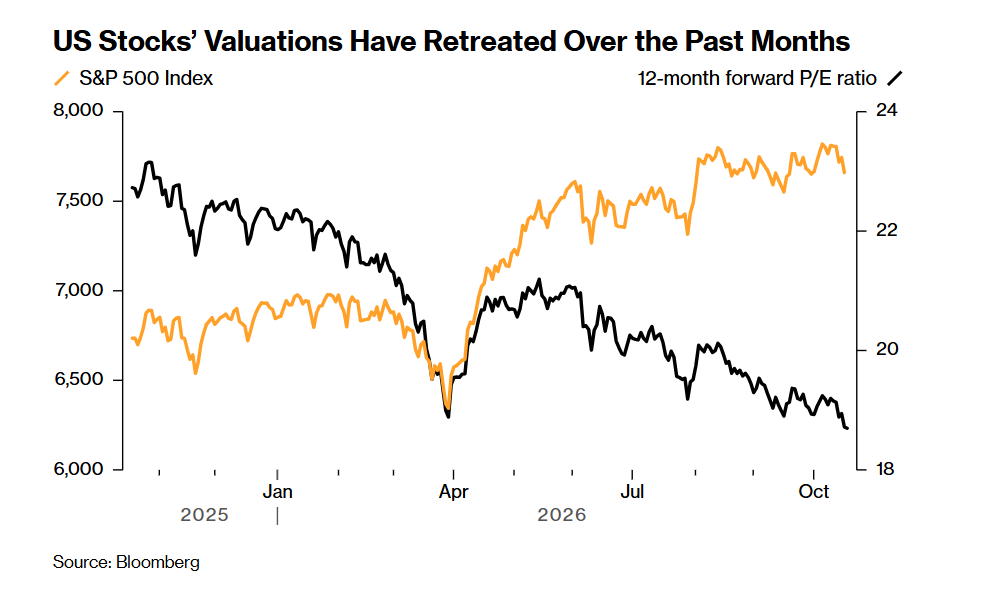
As shown in the chart above, US stock valuations have declined sharply over the past few months
Wilson's views may reassure some investors. These investors worry that the recent sharp rise in US Treasury yields and high-risk corporate bond yields may disrupt an unprecedented AI investment boom that is increasingly dependent on new debt financing. Given that the AI computing infrastructure frenzy played an important role in driving this four-year super-bull market in the global stock market, some market participants said they have seen signs of a bubble forming.
Goldman Sachs strategists also pointed out on Monday that investor positions are becoming more and more defensive; both J.P. Morgan's strategists and Morgan Stanley Wilson are optimistic. They said that the current trend of stabilizing bond yields will “go a long way” in supporting the stock market.
The market's broader confidence in stock prospects mainly comes from profit growth prospects driven by the increasingly strong AI computing power theme. According to Wall Street analysts recently compiled by Bloomberg Intelligence, the overall profit of S&P 500 companies in the third quarter is expected to increase sharply by 24.6% year-on-year.
Wall Street financial giant Jefferies recently said that the S&P 500 index is expected to soar to 8,000 points by the end of 2026 and further hit 9,000 points in 2027, driven by the dual engine of AI investment frenzy and rising profits of AI-related companies exceeding expectations. Jefferies's core logic is clear and powerful: in a cycle where AI-driven profit growth exceeds the historical average by more than two times the historical average, fighting against profit trends is dangerous. Jefferies's 2026 8,000-point S&P 500 benchmark forecast is based on earnings per share (EPS) reaching $373 (up 35% year over year, well above 29% of market consensus) and a price-earnings ratio of 21.5 times.
According to a recent research report released by J.P. Morgan Chase, the cooling of the early-trading memory chip cycle at the stock price level can occur at the same time as the profit supercycle of the global AI computing power industry chain, which includes memory chip components, for a long period of time. Based on this, the J.P. Morgan Asia Pacific analyst team led by Jay Kwon is optimistic about Samsung Electronics, SK Hynix, Kioxia, and Samsung Electric, ISU, and ISC over the next six months, and is betting that the storage upward cycle will continue for a longer period of time and the continuation of related substrates, PCBs, and testing requirements.
J.P. Morgan explains why storage pullbacks may create opportunities from the strong profit trajectory on the industrial side: market concerns about the sustainability of AI capital spending have not necessarily translated into an equal amount of deterioration in storage orders and profits. AI inference requires continuous reading of model weights, saving context and KV caches, and taking on data requirements at different levels through server memory and SSD; HBM upgrades also take up wafer, packaging, and yield climbing resources, making it difficult for effective supply to keep up with demand quickly.
According to J.P. Morgan's semiconductor research report on the Korean stock market, concerns about the sustainability of AI investment at the macro level are clearly disconnected from the storage industry's bottom-up supply and demand data, so the third quarter is viewed as an “expected reset season”. The next six months will be overequipped with Samsung Electronics, SK Hynix, and Kioxia, and extended to Samsung Electric, as well as ISU and ISC companies — leading manufacturers of AI PCBs and test sockets, respectively. The “long-term deal” here is betting that the upward cycle will last longer and that high profits will last longer: even if the DRAM/NAND price slope slows down, as long as demand for HBM, server DRAM, and enterprise-grade SSDs continues to absorb new production capacity and achieve a significant growth trajectory, the rapid decline in profits previously included in the market may need to be revised again. This also explains why storage stocks can peak and fall before profit, but they may rebound early after the profit duration is verified; what determines trading opportunities is the gap that continues to evolve between actual profit paths and implied stock price expectations.
Retail fund-raising is facing phased bottom-level valuations, and the AI-driven tech stock counterattack curve is still poor at confirming cash flow
The latest judgment of Howard Max, a legendary Wall Street investor and co-chairman of Oak Capital, provides a reverse perspective on the current pessimism: a really dangerous bubble is usually accompanied by a loss of awareness about risk, and continuing discussions about the bubble mean that investors have not completely relinquished their restraints. Currently, the forward price-earnings ratio of leading technology companies is significantly lower than during the Internet bubble period, which is also related to the fact that enterprises have already formed large-scale profits.
His judgment also intersects with the latest views of Bank of America and Morgan Stanley — whether a low price-earnings ratio can constitute an opportunity depends on whether profits can be maintained; if the market underestimates the duration of high profits, the valuation may be repaired; if the profit forecast is too high, the low multiple may just be a cyclical trap.
Howard Marx emphasized that real bubbles are often accompanied by collective disregard for risk, and the current market continues to discuss bubbles, indicating that doubts and restrictions still exist. Financial behavior also showed this split: Goldman Sachs team statistics showed that about $9.5 billion flowed into leveraged ETFs last week, of which about $7 billion went into semiconductor ETFs tripled — that is, high-leverage ETFs bought on behalf of SOXL; at the same time, the net exposure of US fundamental long and short funds fell to an all-time low, and the total exposure still reached 213.9%. These all mean that directional bets have shrunk, but the size of long and short positions is still huge: once financial reports weaken pessimistic expectations, increasing bulls and bears may jointly drive a rebound. It is worth noting that leveraged ETFs show a strong desire to cut back on retail capital, but they cannot alone prove that long-term institutional capital has been reallocated.
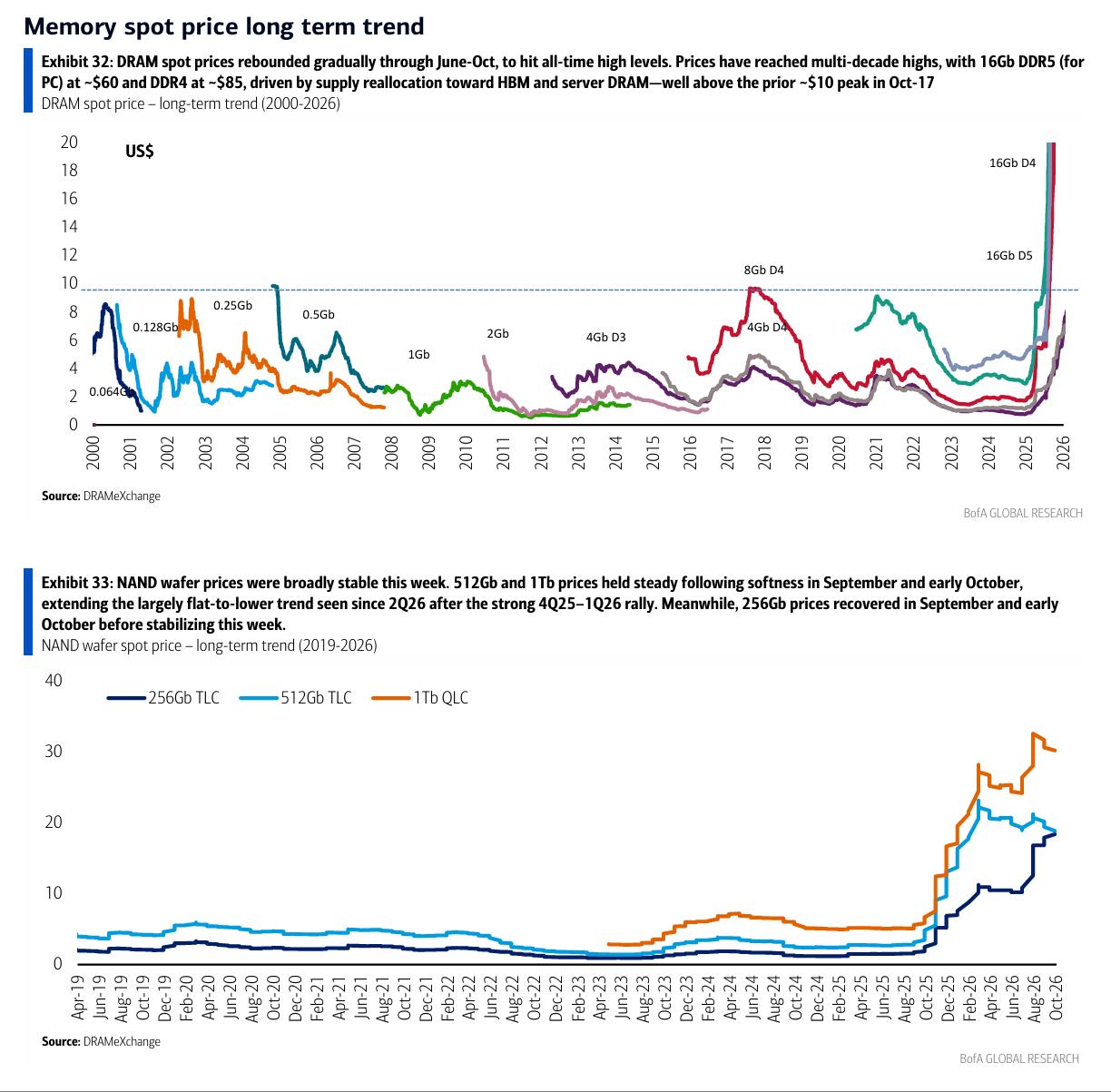
The Bank of America's latest research report can be described as providing more specific evidence of profit and valuation for the potential bottoming out of technology stocks dominated by AI computing power — according to the 2027-2028 market's consistent profit forecast, the price-earnings ratio of Samsung and Hynix is only about 2 to 3 times. The valuation is characterized by a downward cycle, but the actual storage market has yet to experience price collapse during the traditional recession period. According to the report, the 16Gb DDR5 spot price rose 3% to 60.6 US dollars during the week, and the relevant DDR5 contract price is expected to rise about 17% month-on-month in October; even considering the single-digit year-on-year decline in earnings per share in 2028, Bank of America still expects revenue and operating profit to remain close to record levels.
According to the Bank of America analyst team, the market has overpriced and profits will decline in the future. The underlying strong support factors for memory chips and even AI computing power resources cited by Bank of America include the introduction of HBM4 and HBM, SOCAMM, and enterprise-grade SSD requirements driven by advanced GPUs and ASIC updates: model weight, long context cache, and concurrency level. AI inference workloads require different levels of memory and storage, as well as collaboration between a wider range of AI computing power systems, including CPUs, GPU/TPUs, and high-speed optical interconnections in data centers. Even a change in the configuration of a single GPU cannot directly be equivalent to shrinking storage requirements for the entire data center.
There has also been a marginal improvement in the interest rate environment and the US bond yield environment. According to data from the US Treasury Department, 10-year and 30-year US Treasury yields fell 15 and 17 basis points, respectively, to 5.09% and 5.43%; before the US stock market on the 19th, oil fell back to about 107 US dollars, and the 10-year yield was about 5.085%. However, J.P. Morgan Chase pointed out that the recent rise in long-term bonds also includes safe-haven demand caused by AI sell-offs, and cannot be directly viewed as a release of inflationary pressure.
For the AI computing power industry chain and even technology stocks, the continued counterattack requires three pieces of evidence to reinforce each other — AI revenue and AI computing power order fulfillment related to AI computing power topics from large cloud companies and new cloud forces support capital expenses; delivery and repayment of new cloud projects improve solvency; and US Treasury yields and corporate credit spreads are mitigated together. When financial reports prove that computing power investments can be converted into profits and cash flow, valuation compression is more likely to become what Wilson refers to as an opportunity to increase risk, and institutions with low net exposure also have more reason to increase risk again.