
Roadster takes off, can Tesla (TSLA.US) boost the market again? The commercialization of Robotaxi and Optimus became the focus of financial reports
The Zhitong Finance App learned that the US artificial intelligence, humanoid robot, autonomous driving technology and electric vehicle manufacturing giant Tesla (TSLA.US), whose stock price has been on an upward trajectory since the end of July, has not stopped rising according to some Wall Street strategists. In their view, the luxury car Roadster is responsible for showing Tesla's strong engineering strength. Optimus (the “Optimus” humanoid robot) and Cybercab (i.e. Robotaxi fully autonomous taxi) carry Tesla's core imagination of breaking through the automobile industry's valuation framework. Tesla and CEO of SpaceX, Musk, the richest man in the world, made it clear over the weekend that humanoid robots and driverless taxis will constitute the vast majority of Tesla's future value.
Tesla is using cutting-edge flagship products to maintain brand attention, while betting long-term growth on autonomous driving services and labor technology automation. Tesla's stock price, on the other hand, has not escaped pressure — by the close of the US stock market on October 16, Tesla closed at $354.72, down 7.31% last week, and has remained flat since October, with a cumulative decline of about 21% during the year. On Monday, Beijing time, it once rose about 1% during the night trading session, but as of October 19, at 19:25 Beijing time, the pre-market price had fallen back to $353.45, or 0.36%. To a certain extent, it shows that the attention brought by the release of Roadster's blockbuster product has not yet turned into continuous buying.
Wall Street bulls are mainly betting on the strong growth trajectory brought about by the commercialization path of FSD's fully autonomous driving software, driverless taxis, and humanoid robots. Dan Ives, a well-known Wall Street analyst at Yorkville Ives, believes that Tesla has real-world data, dedicated hardware, manufacturing scale, and direct sales channels, and can extend vehicles from a one-time delivery to a platform that continuously generates software revenue — that is, Cybercab focuses on further expanding revenue from artificial intelligence autonomous mobility services based on fully autonomous driving technology, while Optimus is entering the global labor market of industrial automation and trillions of dollars.
Of the 27 Wall Street star analysts covered by TipRanks, 14 are “buying” or “outperforming the market”, 11 “holding”, and 2 “selling”; this also means that analysts are all optimistic about the future of AI, fully autonomous driving, and humanoid robot technology, which does not mean that the agency agrees that current valuations are cheap. Yorkville Ives continues to give Tesla an “outperforming market” rating, and the target price is as high as $500, which means more than 40% upside over the next 12 months.
Sports cars attract attention, Robotaxi and robots decide the distance
Morningstar, a well-known Wall Street rating agency, believes that although the agency's latest estimated annual delivery volume is less than 2,000 vehicles based on official Roadster data, it can still attract consumers to buy other Tesla models.
CEO Elon Musk placed the Optimus humanoid robot and Cybercab driverless taxis at the core of the company's future values; at the same time, a Morningstar analyst said the Roadster, which can “fly at high altitude for a short time,” may attract buyers to Tesla's wider model lineup.
Before Musk made these remarks, the highly anticipated sports car was finally unveiled. In the automatic control demonstration, it used an air-conditioning propeller to briefly vacate and flip, which not only won praise for Tesla's engineering strength, but also raised questions about the vehicle's practicality.
“Optimus and Cybercab will make up the vast majority of Tesla's value,” Musk said on X. He said that superintelligence, robotics, solar energy, and transporting materials to space are businesses that can reach extremely large economic scales, and advances in the first two will drive development in other fields. “But the Roadster is really cool, so we still have to do it,” he added.
At the same time, Morningstar sees the Roadster as a “brand aura model”: it showcases Tesla's best engineering and may stimulate consumer demand for its entire product lineup.
Morningstar said, “A high-end sports car that is both the fastest car in the world and can fly for a short time can very strongly highlight Tesla's image as a unique luxury car company. This should entice consumers to buy Tesla cars and may support increased deliveries after the car is put into production in 2028.”
Morningstar pointed out that Tesla claims that it only takes 0.81 seconds for the Roadster to accelerate from standstill to 60 miles per hour; if this result is officially recorded on the track, it will take slightly less than half of the current 1.66 seconds record.
Morningstar expects the Roadster to be delivered less than 2,000 vehicles a year after production climbs, making it Tesla's lowest-selling model.
“Laugh at Wall Street” author Chris Camillo believes that Musk is willing to take the risk of public failure, and this incident itself may bring greater rewards.
Camilo said on X: “Hardly any CEO would take the initiative to expose the company to the risk of being publicly humiliated for a product with such limited financial upside. But Elon did just that.”
He said that Musk is helping America regain its enthusiasm for pursuing the seemingly impossible, and its impact on future entrepreneurs may far exceed any product sold by Tesla.
“Whether Roadster can actually make a dollar for Tesla, or whether it affects Tesla's stock price, is hardly the point,” he said. “We need more people willing to risk failure to pursue things that others don't think are possible. Because when they succeed, we all benefit.”
Camilo said that he was both optimistic about Tesla and criticized it. He also questioned why people are rushing to turn this demonstration into a debate about whether it can be considered a flying car.
“We can't admit it; wasn't that moment unbelievably cool?” he added.
Musk even directly challenged F1 records over the weekend, and will show off “Spider-Man” stunts in the future. Musk's post over the weekend pushed expectations beyond last week's presentation.
“I think we can reach peak speeds of more than Mach 0.5, or about 400 miles per hour,” he stressed, stressing that this latest dynamic surpassed the top speed of 230 miles per hour. He also claims that the Roadster has an exclusive advantage over Formula 1.
“Even without rocket propellers, the Roadster will dramatically improve the best lap times on the F1 circuit because we use a suction system and actively control the wing, and F1 prohibits the use of these two technologies,” Musk said.
In another post, he said, “The Roadster can fly, spin, and stick to the bottom of the overpass like Spider-Man.”
Musk also said that car owners will be able to require the vehicle to automatically complete the stunts in the demonstration, and promised to build a test track with a circular rollover structure at Tesla's Texas headquarters, which is “crazier than the Hot Wheels toy track.”
Turing Award winner Jan Lekun, a researcher often known as the “Godfather of AI,” believes that the Tesla Flight Roadster demonstration was not practical. Musk retaliated against this.
“I'm farting at you,” Musk replied.
Lecun questioned the efficiency of the compressed air system and estimated that even if the air accounts for half of the vehicle's mass, it can only provide effective thrust for less than 10 seconds.
“Actually, it's probably closer to 5 seconds,” he said, and believes that this kind of vehicle must use a lightweight housing to accommodate a large gas tank.
“The demo was very interesting, but it wasn't useful at all. Of course, you know that yourself,” Lequin added.
Roadster pre-orders are up to $250,000, but delivery is not guaranteed. Tesla listed the two-seater Performance Edition and the Thrust Edition, which require pre-order payments of $50,000 and $250,000 respectively; in addition, there is also an invitation-only single-seat Rocket version, equipped with propellers around the body.
Bookings can only lock in a queue and do not guarantee delivery. The car has not yet been approved for use on public roads, and the extent to which it can be sold depends on local laws. Musk acknowledged that it has security restrictions, and it is uncertain whether it can be used legally everywhere.
In terms of model caliber supplementation - Tesla's official website specifically lists the instructions “not yet approved for use on public roads” under the single-seat Rocket version. This also means that the single-seat Rocket version equipped with a flight system has not yet been approved for use on public roads.
Tesla will announce third-quarter results late Wednesday local time. Morningstar expects investors to focus on the latest developments in fully driverless taxis and humanoid robots, as well as free cash flow; the agency expects Tesla's free cash flow to be negative for the second consecutive quarter.
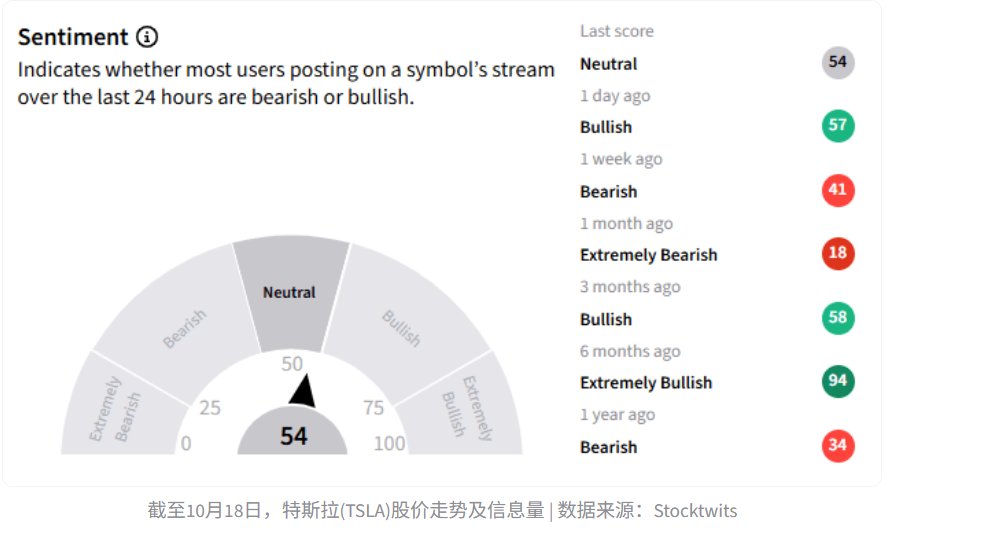
What do retail investors think of Tesla? On the Stocktwits platform, Tesla's retail investor sentiment declined from “bullish” a day ago to “neutral,” while the volume of related discussions was “high.” The chart above shows Tesla market sentiment and news release volume as of October 18. Source: Stocktwits.
One user said, “Tesla, you bearish guys don't understand. Tesla will fly like a Roadster on Monday!”
Another user said, “Tesla, judging from the legal process, if an acquisition actually occurs, it is likely that it will be announced when the next earnings report is released. The financial report is scheduled to be released on October 21. Ready to take off? $500.”
Since this year, Tesla's stock price has lagged behind other companies in the “Big Seven in Technology”, falling by about 21%, making it the worst performer among them.
From selling cars to selling “independent technological capabilities,” Tesla's earnings report should answer how to fulfill the “sci-fi movie future outlook”
Looking at the commercial mechanism, Cybercab is trying to extend one-time vehicle revenue to continuous travel revenue over the life cycle of the vehicle: models specially designed for driverless driving have the opportunity to reduce manufacturing and operating costs, but profits ultimately depend on paid mileage, vehicle utilization, and depreciation, insurance, cleaning and remote support costs.
Tesla has provided Cybercab's driverless ride-hailing guide; however, Morgan Stanley is still concerned about how the size of Austin's RoboTaxi fleet and FSD penetration rate can be further expanded. At the same time, it emphasizes that utilization, safety performance, and unit economy are the focus of the next phase of verification. The rating is still “hold”, and the target price has always been $400.
Optimus is expanding the market where labor tasks can be performed. The core value comes from reliably completing work, not just having a human appearance.
Derived from engineering and investment logic, Tesla's AI training, inference deployment, and manufacturing experience can help reduce development and mass production costs, but driving ability cannot directly replace the dexterous operation, contact force control, and long-term reliable operation required by robots. How much a customer is willing to pay depends on effective work hours, task success rates, and maintenance costs. The company revealed in the second quarter that the first-generation Optimus production line is still being installed, so this part of the valuation mainly corresponds to future commercialization potential and cannot yet be used as a mature source of profit, but investors are anxious to know further mass production plans and delivery roadmaps.
The Roadster, on the other hand, undertakes brand and technology demonstration functions: the air-conditioning propeller provides short-term thrust, suction systems, and active aerodynamics to enhance downward pressure, but these stunts themselves do not directly prove that driverless cars or robots already have large-scale profitability. What Tesla's earnings report on October 21 really needs to be linked is the ability of automobiles to generate cash from the energy storage business and the progress of AI investment into revenue. Tesla delivered 486,532 vehicles and deployed 13.7 GWh of energy storage in the third quarter; Goldman Sachs believes that the FSD, Robotaxi, and Optimus forecasts may be more important to stock prices than earnings per share in a single quarter, while Morningstar expects free cash flow to be negative for the second consecutive quarter.