
Visteon (VC) Could Be 32% Undervalued Following Argus Price Target Cut
Visteon (VC) moved back into focus after Argus cut its research price estimate to $82 on 14 October 2026, following updated earnings assumptions and a refreshed outlook for the automotive electronics supplier.
The Argus revision arrives after a choppy period for Visteon, with the 1-day share price return declining 1.60% to US$87.25, capping a 30-day share price pullback of 7.78% and a 90-day share price drop of 16.13%. This contrasts with a 7-day share price gain of 2.95% and a more extended picture of weaker momentum, reflected in a year-to-date share price return down 9.94% and a 1-year total shareholder return down 22.84%, alongside total shareholder returns down 29.14% over three years and 13.35% over five years as investors reassess both earnings risk and longer term potential.
Compare how Visteon stacks up by scanning a curated group of auto and tech suppliers on the list of solid balance sheet and fundamentals (25 results) for ideas with sturdier fundamentals.
Visteon now trades above the revised Argus target, yet at a sizable discount to both analyst and intrinsic estimates. Is that a pricing error or a fair reflection of the risk investors see here?
Most Popular Narrative: 32% Undervalued
Against Visteon’s last close of $87.25, the most followed narrative pegs fair value at $129.00 using an 8.85% discount rate. This creates a wide gap that hinges on how much credit you give to its long-dated cockpit and cash return plans.
The current valuation implies the share price does not fully reflect Visteon’s booked HPC programs, the expected mix shift toward higher content displays and Asia, and the plan to return about US$1b of cash to shareholders through 2029.
See why 6 investors see Visteon as 32% undervalued.
Result: Fair Value of $129.00 (UNDERVALUED)
Still, the narrative can break if memory cost inflation continues to squeeze EBITDA margins or if shrinking sales to Ford, GM and other legacy customers are not replaced.
Find out about the key risks to this Visteon narrative.
Another View: What Visteon’s P/E Is Telling You
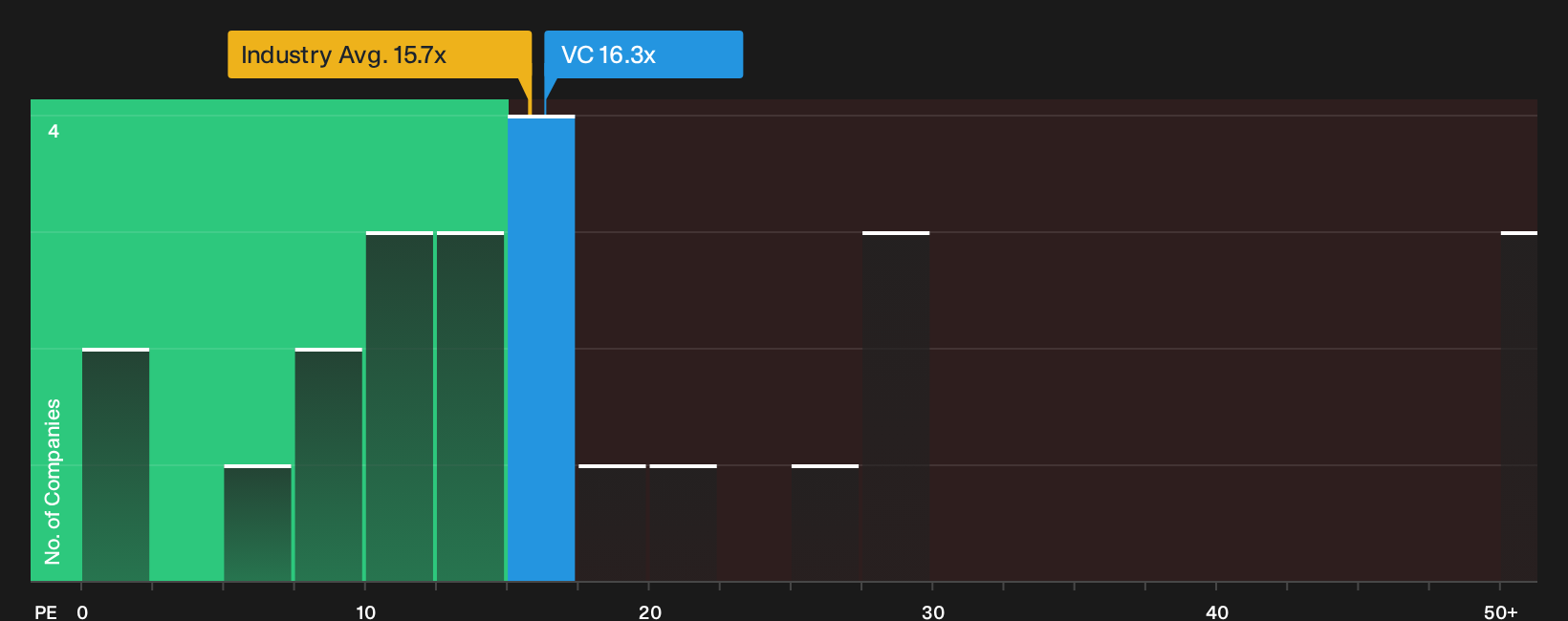
The SWS fair value work points to Visteon being undervalued. The P/E picture is less generous. At 16.3x earnings, VC trades above the US Auto Components sector on 15.7x, peers on 11.6x, and the fair ratio of 15.5x. That richer tag suggests less room for error if the growth story wobbles.
If you lean more on earnings multiples than cash flow models, it is worth asking which signal you trust when those two views do not quite line up. See what the numbers say about this price — find out in our valuation breakdown.
Next Steps
Mixed messages in the Visteon story so far. Act while the data is fresh and weigh both sides for yourself with 3 key rewards and 1 important warning sign.
Looking for more investment ideas beyond Visteon?
Do not stop with Visteon. Fresh opportunities sit a few clicks away, and waiting too long could mean watching the next move happen without you.
- Target resilient performers that aim to balance return potential with smaller drawdowns by scanning 32 resilient stocks with low risk scores tailored to lower risk scores.
- Hunt for quality at a discount through 33 high quality undervalued stocks that filters for stronger fundamentals at prices some investors may be overlooking.
- Zero in on under the radar prospects before wider attention arrives by working through 20 high quality undiscovered gems built around solid underlying metrics.
This article by Simply Wall St is general in nature. We provide commentary based on historical data and analyst forecasts only using an unbiased methodology and our articles are not intended to be financial advice. It does not constitute a recommendation to buy or sell any stock, and does not take account of your objectives, or your financial situation. We aim to bring you long-term focused analysis driven by fundamental data. Note that our analysis may not factor in the latest price-sensitive company announcements or qualitative material. Simply Wall St has no position in any stocks mentioned.
Have feedback on this article? Concerned about the content? Get in touch with us directly. Alternatively, email editorial-team@simplywallst.com