
What J.K. Cement Bears Spotted Before The Slide
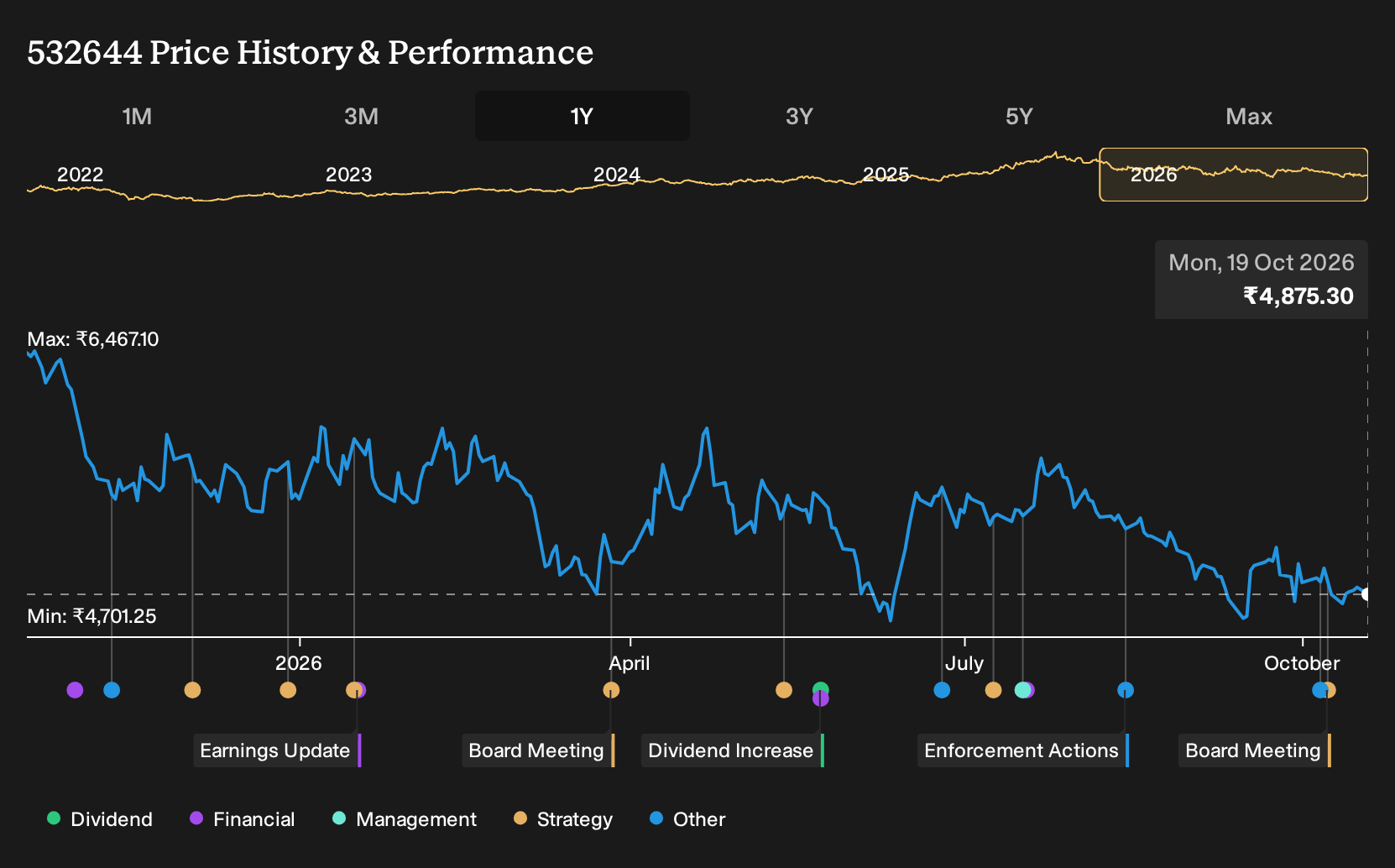
J.K. Cement’s latest quarterly filing on 18 July 2026 told a mixed story, with revenue of ₹40,317.2m, net income of ₹2,774.7m and a lower net margin than a year earlier. For J.K. Cement shareholders, the loss over the past year was 23.9%, including dividends. If you had been weighing a purchase back on 19 October 2025, how should that outcome reshape expectations for what needs to improve next?
On Simply Wall St, a Narrative is an investor's thesis written down: the reasoning, plus the numbers it rests on. Run those numbers and you get an estimated Fair Value.
J.K. Cement has already moved. See which of 200 high quality undervalued stocks still trade below our estimates.
The Two Stories J.K. Cement Investors Had To Weigh
The shares cost ₹6,495 at the start of the period, and anyone looking at J.K. Cement then was choosing between two very different stories about the same business.
The bullish narrative put Fair Value at ₹7,700, built on the idea that capacity could push toward 50 million tonnes ahead of 2030 and that premium products like white cement, wall putty, and paints would reshape the margin mix.
The bearish view anchored Fair Value at ₹3,350 and focused on risks that aggressive expansion and rising leverage could meet softer demand, leaving new plants underutilized and returns under pressure.
What The Results Changed For The J.K. Cement Story
The clearest fresh fact is that J.K. Cement reported revenue of ₹31,498.2m in Q1 2026 and ₹40,317.2m in Q1 2027, while net income slipped from ₹3,356m to ₹2,774.7m and net margin moved from 10.7% to 6.9%. That combination of higher sales with thinner profitability affected both the earlier bullish and bearish cases.
The main takeaway to apply elsewhere is simple. When a thesis leans on margin expansion, keep checking net margin alongside revenue in each set of results rather than only tracking top-line progress.
What J.K. Cement’s Drop Asks You To Believe Now
J.K. Cement trades at ₹4,875 today, with the share price down 23.9% over the past year. The selected Narrative’s Fair Value sits above the current price and leans on capacity, product extensions and energy initiatives to argue the business story is stronger than the share price implies.
For the fall to look like an opportunity rather than a warning, a buyer would need confidence that J.K. Cement can execute its large capex and energy plans while keeping net debt, fuel costs and payroll from eroding earnings.
"Key Takeaways: Analysts expect JK Cement to continue scaling capacity and ancillary businesses in line with its expansion roadmap, enabling the company to support higher volumes across grey cement, white cement, putty, paints and RMC. The key requirement is effective execution on large capex and energy transition plans while keeping net debt and the earnings impact from higher fuel and employee costs under control."
One Narrative disagrees with today's price. → See where this Narrative says J.K. Cement should trade
Where J.K. Cement Connects Sideways
Watching J.K. Cement, you are really watching heavy industry meet energy limits. Kilns, grinding units and logistics all depend on reliable computing power.
That pressure for efficiency rhymes with a different world entirely. Data centers running AI tools also chase more work from every watt consumed.
One specialist designer tackles that challenge inside the chips themselves. Its blueprints help customers create processors that squeeze more performance from limited electricity.
As cement plants and cloud servers both seek efficiency gains, that quiet design layer could matter far beyond phones and laptops.
Could this be another way into the opportunity? → Explore the robotics opportunity and its 47% discount to one Narrative's Fair Value
Have feedback on this article? Concerned about the content? Get in touch with us directly. Alternatively, email editorial-team@simplywallst.com