
3 India Stocks Riding The Food Delivery And Quick Commerce Price War
India’s food delivery story just gained a new twist, with Flipkart moving into a segment already shaped by Zomato, Swiggy and a fast-growing quick commerce crowd. A market growing 18–20% a year can create winners, but it can also crush weaker models as fees, discounts and delivery economics get squeezed. This article unpacks that tension and spotlights 3 stocks exposed to this news, helping you decide which ones may deserve a closer look.
The three stocks below are a useful starting sample, but the full screen pulled out 10 more India food-delivery and quick-commerce ecosystem companies with equally interesting business stories that are not covered in this article.
Head straight into the India Food-Delivery and Quick-Commerce Ecosystem screener to identify potential leaders, analyze fundamentals and refine your highest conviction ideas before you commit any fresh capital.
Swiggy (NSEI:SWIGGY)
Swiggy sits right on the fault line of this theme, giving you direct exposure to India’s app based food delivery, restaurant discovery and quick commerce habits as they shift from occasional treats to everyday infrastructure for meals and essentials.
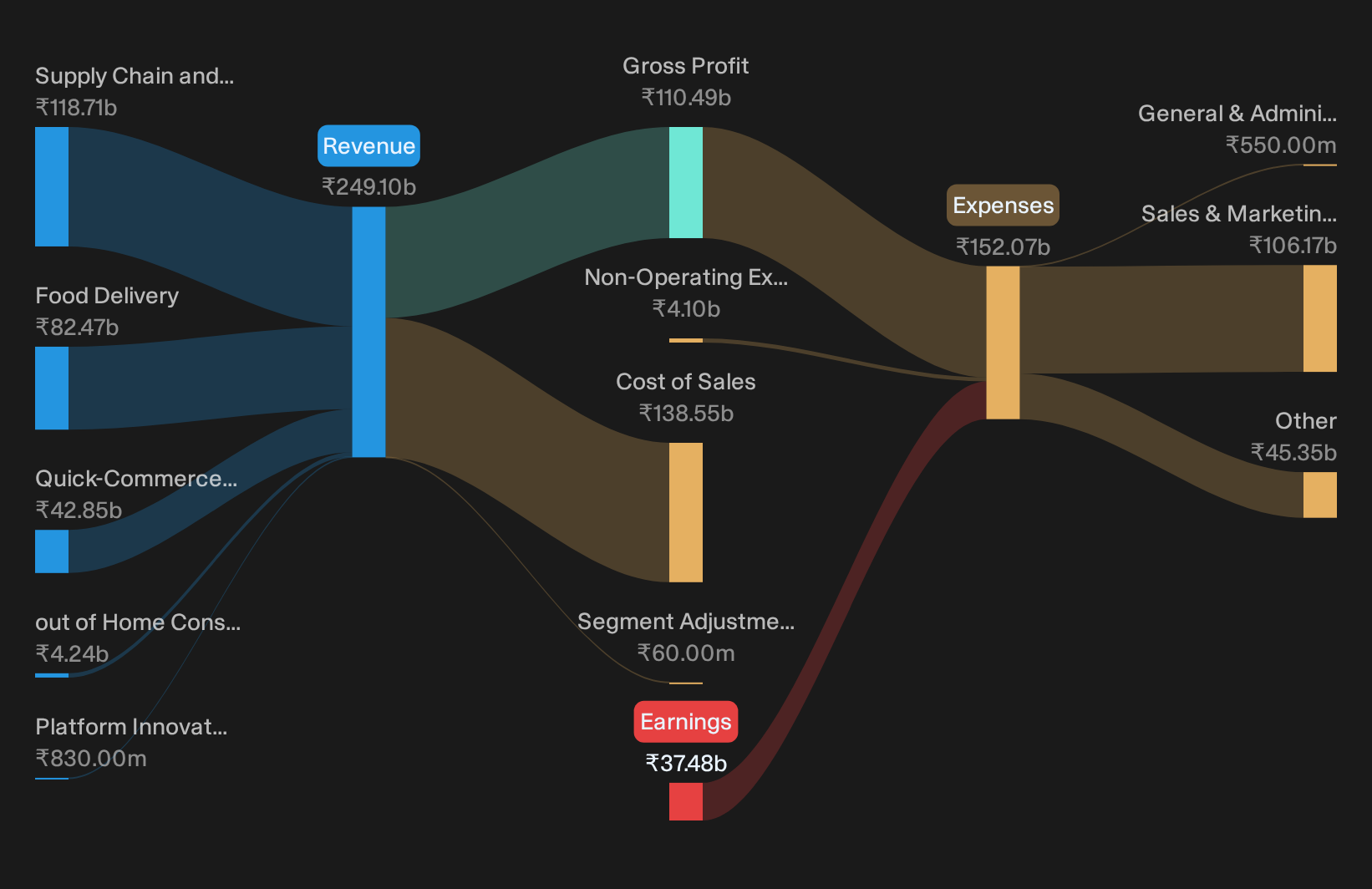
Swiggy runs a broad convenience platform anchored in Indian food delivery and quick commerce, with revenue concentrated in Supply Chain and Distribution (₹118.7b), Food Delivery (₹82.5b) and Quick-Commerce (₹42.9b). Smaller lines like Out of Home Consumption and Platform Innovations add scale, and the group carries a market cap of about ₹610.6b.
"Quick commerce is showing very large GOV growth on the back of strong demand for faster deliveries and broader assortments. This can support higher revenue and help contribution margins move toward management’s profitability targets."
The real swing factor for Swiggy will be how one unresolved pressure in its delivery ecosystem feeds through into long term profitability.
To see how that pressure could reshape Swiggy’s unit economics and market share, read the full narrative for Swiggy and see what current headlines might be masking.
Shadowfax Technologies (NSEI:SHADOWFAX)
Shadowfax Technologies gives you exposure to the plumbing behind India’s food delivery and quick commerce theme, handling the last-mile work for platforms that want faster orders without owning every delivery fleet themselves.
Shadowfax Technologies runs technology-led third-party logistics across India, earning about ₹47.4b from logistics and delivery services in FY data provided, all from domestic clients, and carries a market cap of roughly ₹169.8b.
"Rapid expansion of express parcel coverage from roughly 15,000 pin codes toward the full India network and the launch of 80 to 100 new last-mile facilities each month increases addressable shipment volumes and can support higher revenue over time."
The key question from here is how one less visible cost pressure will shape the balance between higher volumes and future margins.
That cost pressure is exactly what the full narrative for Shadowfax Technologies unpacks, showing how Shadowfax Technologies could convert rising volumes into accelerating cash generation as weaker delivery partners fall behind.

Eternal (NSEI:ETERNAL)
Eternal sits at the crossroads of food delivery, quick commerce and restaurant enablement in India, giving you exposure to the platforms that power how meals, essentials and entertainment get ordered rather than just the couriers bringing them to the door.
Eternal runs multiple digital platforms tightly linked to India’s food delivery and instant commerce theme, earning about ₹510.5b from Quick Commerce, ₹110.6b from India Food Ordering and Delivery, ₹42.3b through Hyperpure B2B supplies, and smaller sums from Going Out and other units, with a market cap near ₹2,990.8b.
"Acceleration to a full inventory-ownership model in quick commerce remains important as Eternal aims to capture a larger share of gross margin, now framed within a higher 6% quick commerce EBITDA margin ambition and a contribution to the US$1b EBITDA target."
What happens to Eternal’s longer term earnings power depends heavily on how one less visible pressure in this quick commerce engine ultimately plays out.
That pressure point is exactly why reading the full narrative for Eternal can be so useful, as it maps how Eternal’s quick commerce ambitions could accelerate or stall from here.

Seeking Alternatives Before Momentum Flies
Fresh opportunities move quickly. By the time every headline catches up, the cleanest entries can be gone or dropping out of reach. Scan what is still under the radar for now and get in early.
- Target resilient cash generators while volatility is still shaking weaker businesses by filtering for a curated list of solid balance sheet and fundamentals (202 results) that can weather tougher conditions.
- Ride structural shifts in energy and infrastructure by zeroing in on carefully selected 16 nuclear energy infrastructure stocks positioned to capture demand for long-dated power projects.
- Position ahead of the next automation wave by focusing on pre-vetted 92 robotics and automation stocks that tie real-world production lines to long-term efficiency gains.
Have feedback on this article? Concerned about the content? Get in touch with us directly. Alternatively, email editorial-team@simplywallst.com