
Should AWS Growth Upgrade Require Action From Amazon (AMZN) Investors?
- Amazon.com has seen renewed attention after Morgan Stanley highlighted the importance of its AWS and AI businesses, pointing to accelerating cloud demand, heavy data center and chip investment, and stronger visibility around services like Bedrock and custom Trainium hardware.
- The upgrade frames Amazon.com less as a retailer and more as an infrastructure and software platform, where high margin AWS, advertising and AI services carry most of the profit weight, while capital intensive projects test how efficiently the group can turn spending into durable cash flows.
- Next, the focus shifts to how this renewed spotlight on AWS driven profitability and AI infrastructure spending could reshape Amazon.com's investment narrative.
Compare Amazon.com's AI push with other potential winners by sizing up the hand picked 55 AI infrastructure stocks that could also benefit as spending on chips, data centers and cloud accelerators scales up.
Amazon.com Investment Narrative Recap
To own Amazon.com, you need to believe its heavy AI and infrastructure spending can turn into durable, contract backed cash flows from AWS, advertising and newer platforms like custom chips and satellites. The key short term catalyst is execution in AI workloads on AWS, including how quickly enterprises standardise on its stack.
The Decart talks sit right inside that thesis. If completed, they would speak to Amazon's push to make Trainium and other in house chips easier to adopt, which supports that AI led story. The biggest near term risk stays the same: very high CapEx and rising political and regulatory scrutiny on how that spending is treated.
The potential Decart acquisition connects directly to Amazon's recent launch of TorchNeuron, the open source tool that lets developers move PyTorch workloads onto Trainium with fewer code changes. Both point to an emphasis on software and tooling that lowers switching costs away from Nvidia dominated stacks and toward Amazon controlled silicon.
For you as an investor, this pairing highlights a clear operational swing factor. If Amazon can get more AI customers to adopt Trainium, backed by tools like TorchNeuron and, potentially, Decart's orchestration software, AWS has a clearer runway to deepen high margin services. If developer uptake is slow, the large AI focused CapEx load becomes a more pointed risk.
Analyst Expectations Behind Amazon.com's AI Centric Story
Analysts are effectively tying Amazon.com's AI and infrastructure push to a set of fairly specific financial milestones that you can sanity check for yourself. The current consensus assumes revenue expands by 14.4% a year over the next three years, while profit margins soften from 17.4% today to 14.0% by 2029 as heavy cloud and data center spending runs through the income statement.
On earnings, the group sits at US$135.3b today, with forecasts pointing to US$163.0b by 2029 and a wide spread between bullish US$196.1b and cautious US$116.5b scenarios. That path implies a material uplift in profit dollars even as margins ease, which reflects an assumption that AWS, advertising and AI services keep scaling on top of a larger revenue base.
On the top line, the same analyst set is working with roughly US$1,161.3b of revenue by 2029 if Amazon.com meets those expectations. That level of sales, paired with US$163.0b of earnings, underpins the idea that the stock could trade on a P/E of 29.2x in 2029, compared with 20.1x today and 20.1x for the wider US multiline retail peer group.
Consensus also builds in modest dilution, with share count projected to climb by 0.9% annually for the next three years. That matters for you as a shareholder because per share outcomes depend on how quickly AWS and AI profits scale relative to that extra equity, not just on the absolute earnings pool.
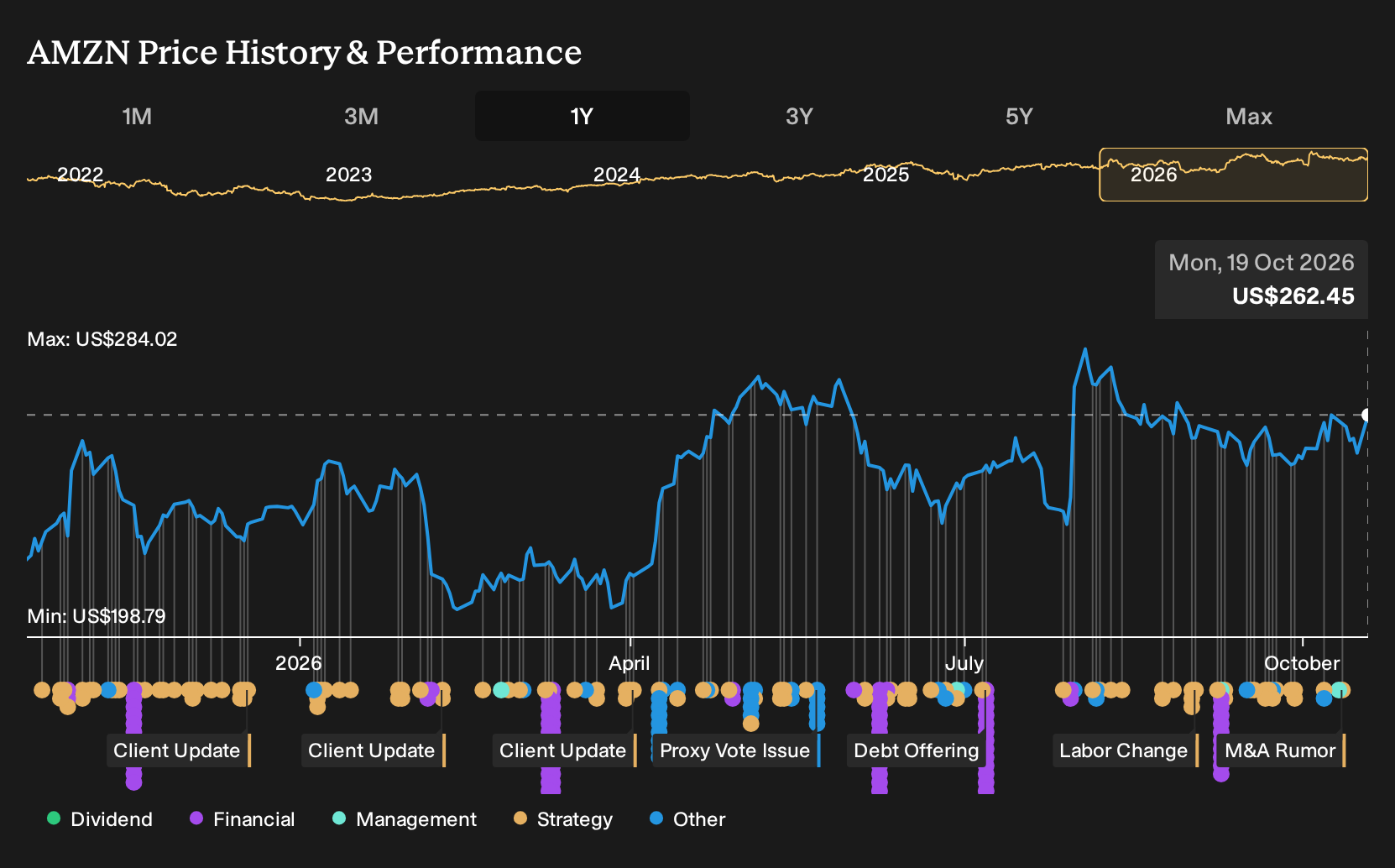
Those assumptions feed directly into the current US$330.59 average price target, set against a US$251.52 share price and a roughly 23.9% gap between the two. Analyst targets span from US$230.0 on the low side to US$405.0 at the upper end, which gives you a quick sense of how differently professionals view the payoff from Amazon.com's AI, chip and satellite investments.
Amazon.com's narrative projects US$1,161.3b revenue and US$163.0b earnings by 2029. That path assumes 14.4% yearly revenue growth and an earnings increase of about US$27.7b from US$135.3b today.
Uncover why Amazon.com's fair value indicates a 26% potential upside to its current price, which could narrow quickly if sentiment keeps shifting toward AI heavy platforms.
Exploring Other Perspectives
Fair value estimates from 35 members of the Simply Wall St Community span a wide band, from US$269.78 to US$475.09, with views spread across every bucket in between. You are seeing both conservative and very optimistic takes on Amazon.com. When you consider Decart talks, nuclear power commitments and regulatory scrutiny together, it becomes clear that opinions can diverge sharply. Treat these as starting points and explore several competing narratives before deciding how Amazon fits your portfolio.
Explore 34 other Amazon.com fair value estimates, including one that suggests it could be worth just $269.78.
The Verdict Is Yours
Don't just follow the ticker. Dig into the data and build a conviction that's truly your own.
- A great starting point for your Amazon.com research is our analysis highlighting 4 key rewards and 2 important warning signs that could impact your investment decision.
- See our latest analysis for Amazon.com. The report includes a comprehensive fundamental analysis summarized in a single visual, the Snowflake, making it easy to evaluate Amazon.com's overall financial health at a glance.
Looking for more investment ideas beyond Amazon.com?
If the Amazon.com story has sharpened your thinking about AI infrastructure and cash flow durability, you can apply that same lens across the rest of your watchlist. The Simply Wall St Screener can help you quickly surface stocks that align with the balance of return potential and risk you are comfortable with.
- If you want steadier compounders with a valuation tilt, you can scan for businesses that combine quality and mispricing by checking out the 35 high quality undervalued stocks.
- If balance sheet strength matters most to you, you can focus on companies with robust finances by reviewing the list of solid balance sheet and fundamentals (25 results).
- If you prefer backing quieter opportunities before they are widely followed, you can cast a wider net across the 20 high quality undiscovered gems.
Have feedback on this article? Concerned about the content? Get in touch with us directly. Alternatively, email editorial-team@simplywallst.com