
Jefferies Backing Might Change The Case For Investing In Vulcan Materials Stock
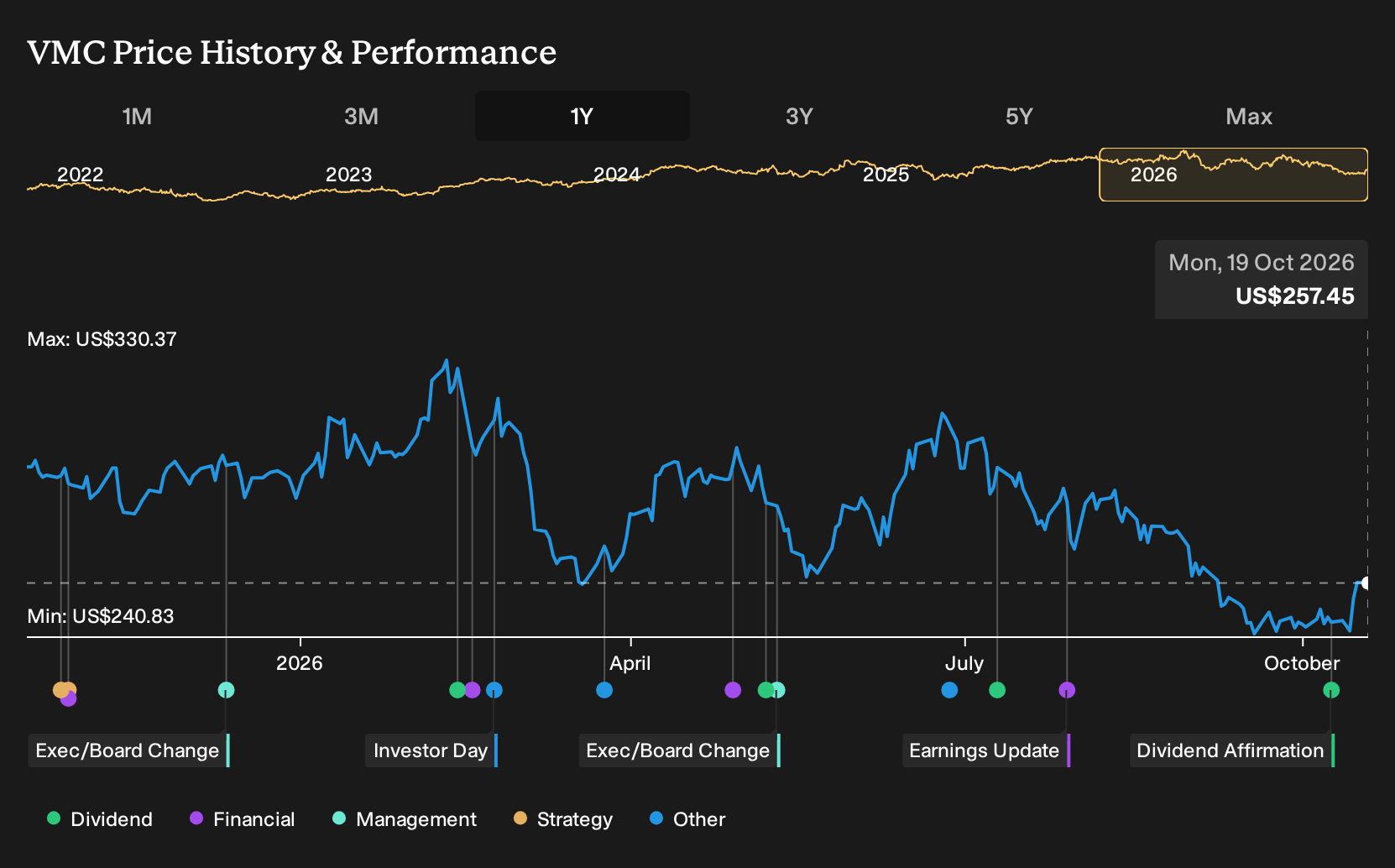
- Vulcan Materials recently declared a quarterly cash dividend of $0.52 per share, payable on November 24, 2026 to shareholders of record on November 9, 2026, and was also highlighted in Jefferies' US Building Products sector outlook.
- The combination of a consistent cash dividend and Jefferies citing Vulcan Materials' upcoming pricing framework underscores that the aggregates focused model relies on disciplined pricing and capital returns rather than short term volume swings.
- We will now look at how Vulcan Materials' investment narrative could be influenced by Jefferies' focus on its pricing discipline.
Vulcan Materials Investment Narrative Recap
To own Vulcan Materials, you need to be comfortable with a slow grind story that leans on aggregates pricing discipline, infrastructure exposure and a willingness to live with cyclical volume swings. The near term upside case still leans on public projects in Vulcan Materials' Sunbelt footprint moving from award to full production, with pricing holding against input inflation.
The biggest swing factor over the next year remains how well pricing covers diesel and other operating costs while demand from highways, housing and private projects holds up. Higher fuel and a more cautious view on volumes into 2027 sit opposite the main risks, so this dividend and pricing update does not radically change that equation.
The recent quarterly dividend affirmation at $0.52 per share signals that Vulcan Materials is comfortable funding cash returns alongside capex and potential bolt on deals. With net debt to adjusted EBITDA previously reported at 1.7x and operating cash flow of US$1.8b over twelve months, balance sheet flexibility remains an important part of the story investors are underwriting.
In Jefferies' sector work, Vulcan Materials is linked with January pricing letters in the 8% to 10% range and a mid single digit pricing framework for 2027. You can read that as management leaning into the core catalyst for the stock: disciplined pricing on aggregates. The key watchpoints stay the same: diesel sensitivity, government spending levels and the risk that shipments undershoot if end markets cool.
What The Current Vulcan Materials Forecasts Assume
Vulcan Materials' narrative projects US$9.4b revenue and US$1.5b earnings by 2029. This rests on analysts assuming 5.1% yearly revenue growth and an earnings increase of about US$400m from US$1.1b today.
Uncover how Vulcan Materials' fair value indicates a 21% potential upside to its current price, a gap that could narrow quickly if pricing discipline continues to hold.
Exploring Other Perspectives
One alternate view stresses dividend sustainability as the key risk. Those more cautious analysts were assuming Vulcan Materials would reach about US$8.8b in revenue and US$1.3b in earnings by 2029, before this dividend affirmation and Jefferies’ pricing focus. That is a much more pessimistic story. Use that spread in opinions as a prompt to explore several narratives, then judge which assumptions you find most realistic.
Explore 4 other Vulcan Materials fair value estimates, including one that suggests it could be worth just $247.06.
Form Your Own Verdict
Don't just follow the ticker. Dig into the data and build a conviction that's truly your own.
- A great starting point for your Vulcan Materials research is our analysis highlighting 3 key rewards and 2 important warning signs that could impact your investment decision.
- See our latest analysis for Vulcan Materials. The report includes a comprehensive fundamental analysis summarized in a single visual, the Snowflake, making it easy to evaluate Vulcan Materials' overall financial health at a glance.
Looking For More Ideas Beyond Vulcan Materials?
If you want to pressure test your Vulcan Materials thesis against other opportunities, the Simply Wall St Screener can help you line up companies with similar qualities, compare their fundamentals side by side, and see where the risk and reward trade off looks more appealing for you.
- If capital preservation sits high on your list, filter for sturdier businesses using our 32 resilient stocks with low risk scores and see which stocks keep volatility and risk scores in check.
- For investors hunting for strong fundamentals at reasonable prices, sort through our 20 high quality undiscovered gems and find companies the market may not be fully focused on yet.
- If you care most about balance sheet strength supporting the story, build a shortlist using the list of solid balance sheet and fundamentals (25 results) and focus on businesses with healthier financial foundations.
Have feedback on this article? Concerned about the content? Get in touch with us directly. Alternatively, email editorial-team@simplywallst.com