
Are Higher Earnings Estimates Altering The Investment Case For Dow Stock?
- Dow declared a dividend of $0.35 per share payable on December 11, 2026, extending a payout streak that began in 1912 and has reached 461 consecutive dividends.
- The dividend affirmation arrives alongside higher analyst earnings and revenue estimates, as well as fresh industry reports that highlight Dow’s role in glycolic acid and silane coupling agent markets.
- Next comes a look at how Dow’s updated earnings expectations could reshape the existing investment narrative built around self help programs.
Scan for other income focused stories that pair long running payouts with earnings momentum by running the 8 dividend fortresses alongside your work on Dow.
Dow Investment Narrative Recap
For an investor to stay in Dow, there needs to be confidence that multi year cost cuts, portfolio shifts in silicones and data center solutions, and big capital projects like Alberta polyethylene can offset pressure from weaker polyethylene demand and higher energy and feedstock costs. The latest dividend affirmation does not fundamentally change that near term operating story.
The key near term swing factor remains how quickly margins stabilize as those cost and mix actions feed through against a soft macro backdrop. The main risk still sits in prolonged demand and pricing weakness that keeps earnings under pressure while Dow is also dealing with legal exposure around chlorpyrifos and ongoing interest and dividend commitments.
The most relevant development alongside the dividend is the higher earnings and revenue expectations around Dow’s upcoming quarter, with analysts now looking for US$0.63 in EPS and higher sales versus last year. That projected recovery sits directly on top of the self help narrative because it gives an early read on whether cost programs are starting to show up in reported numbers.
If coming results line up with those upgraded estimates, the market gets more evidence that Dow’s US$1.3b 2026 self help target and broader US$3b program toward 2029 are tracking. If earnings land closer to the reduced Q3 2026 EBITDA outlook of US$1.5b to US$1.6b or below, investors will likely refocus on input cost inflation, slower polyethylene volumes, and the strain of funding interest and a dividend that currently is not well covered by earnings.
What The Dow Consensus Is Really Pricing In
On the numbers, the analyst story around Dow is very specific. The group is effectively tying the current self help narrative to a future earnings and revenue profile that they think can support today’s dividend and the long running capital projects that are already in motion.
In the assumptions section, the consensus leans on a 2.3% annual lift in revenue over the next three years, paired with profit margins moving from a loss position of 3.1% today to a positive 4.7% by 2029. That shift is what would turn today’s earnings loss of US$1.3b into forecast earnings of US$2.1b in roughly three years’ time, helped by the cost programs, portfolio repositioning and new capacity that analysts already have in their models.
Dow's narrative projects US$44.3b revenue and US$2.1b earnings by 2029. This leans on 2.3% yearly revenue growth and an earnings increase of about US$3.4b from the current loss of US$1.3b.
The valuation work then pulls those same inputs into a single picture. To line up with the consensus price target of US$33.29 per share, the stock would need to reach that US$44.3b revenue mark and US$2.1b in earnings in 2029 while trading on a P/E of 15.8x, compared with a current P/E that screens as a loss making multiple. That prospective multiple also sits below the US Chemicals sector snapshot at 21.3x, which implies analysts are not assuming a premium rating even if the self help targets are delivered.
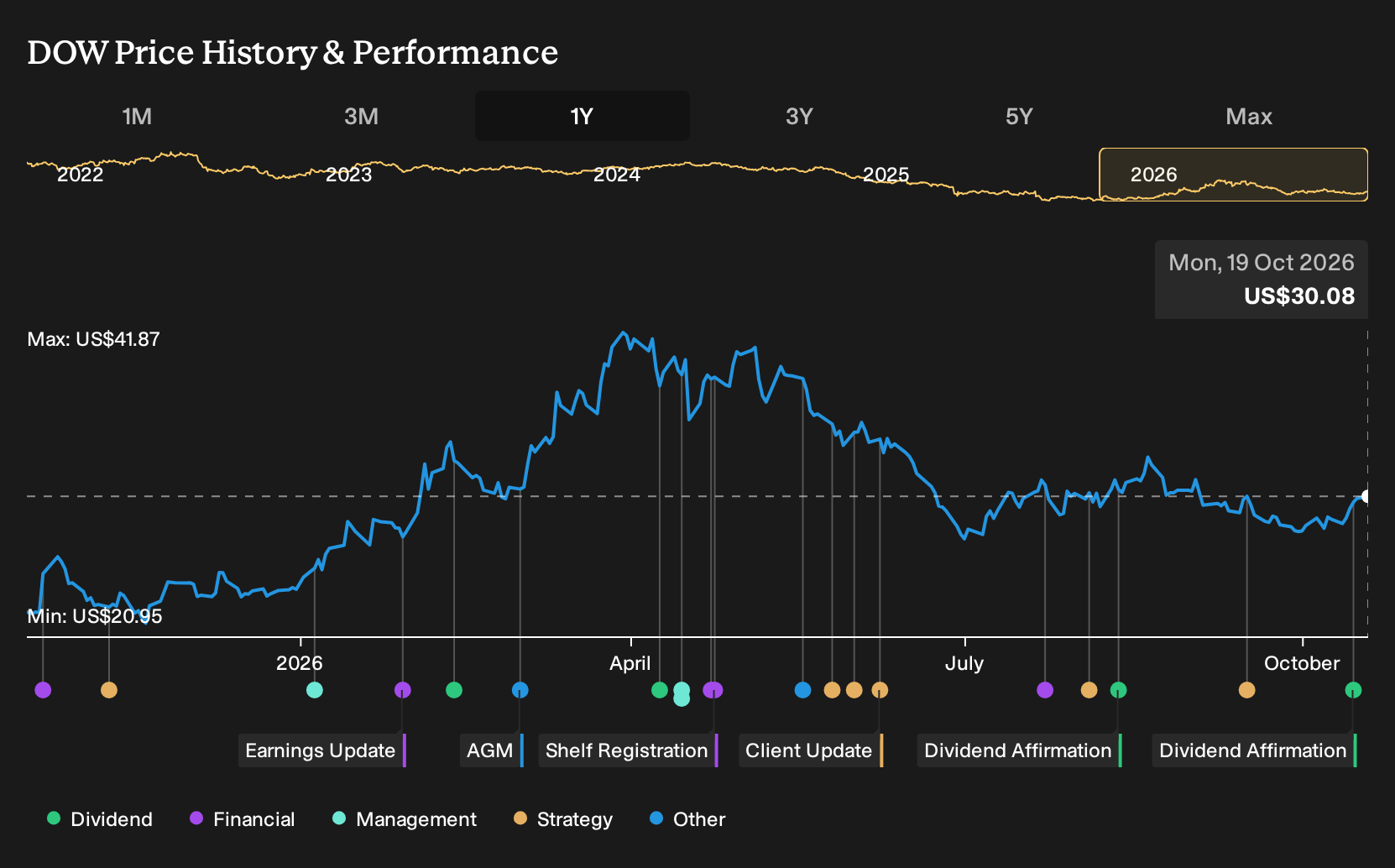
Price dispersion across the covering brokers is wide. The most optimistic target comes in at US$41.00 while the lowest sits at US$29.00, all anchored to the same broad view of cost savings, margin repair and polyethylene normalization. At a current share price of US$28.51, the average of US$33.29 implies about 14.4% upside, but the spread in targets underlines how differently each analyst weighs risks such as chlorpyrifos litigation, energy and feedstock costs, and the pace of any polyethylene recovery.
For an income focused holder, the key takeaway is not the price objective itself. It is the combination of modest top line growth, improving profitability off today’s loss, and a P/E assumption that is lower than the wider sector. All of these elements need to come together if Dow is going to keep funding both dividends and heavy capital spending from a healthier earnings base instead of leaning more on the balance sheet.
Uncover why Dow's fair value indicates an 11% potential upside to its current price before the market closes that discount.
Exploring Other Perspectives
You can read Dow’s dividend news alongside a very different story from the most cautious analysts. They were working off flatter revenue assumptions of about US$41.9b and earnings of US$1.7b by 2029, which underpins the US$29.00 price target. That camp treats chlorpyrifos litigation as a much heavier overhang. These views pre date the latest payout decision, so use them as a starting point to explore how opinions might shift as fresh data arrives.
Explore 4 other Dow fair value estimates, including one that suggests it could be worth just $29.00.
Decide For Yourself
Disagree with existing narratives? Extraordinary investment returns rarely come from following the herd, so trust your own analysis and proceed carefully.
- A great starting point for your Dow research is our analysis highlighting 3 key rewards and 2 important warning signs that could impact your investment decision.
- See our latest analysis for Dow. The report includes a comprehensive fundamental analysis summarized in a single visual, the Snowflake, making it easier to evaluate Dow's overall financial profile at a glance.
Looking For More Investment Ideas Beyond Dow?
If Dow's mix of long running dividends and self help programs has your attention, it can be useful to line it up against other opportunities that share similar traits or offer a different risk profile. The Simply Wall St Screener helps you do that quickly by filtering for businesses that match the income, quality, or downside profile you care about most.
- For investors who want income without ignoring balance sheet strength, scan a list of solid balance sheet and fundamentals (25 results) that pair financial resilience with fundamental support for their payouts.
- If your focus is on quality at a reasonable price, review a curated 35 high quality undervalued stocks that combine strong cash generation with more conservative valuations.
- For readers who put reliability of income first, compare Dow's payout record with a hand picked 8 dividend fortresses offering substantial yields backed by underlying fundamentals.
Have feedback on this article? Concerned about the content? Get in touch with us directly. Alternatively, email editorial-team@simplywallst.com