
Wall Street is looking forward to a new bull market curve for semiconductors! Under the AI intelligence frenzy, EDA, the “mother of chips”, may become a new capital anchor
The Zhitong Finance App learned that just as the Philadelphia Semiconductor Index ended eight consecutive declines on Monday, the Morgan Stanley analyst team emphasized that the time had arrived for the semiconductor sector to fall and provided another key AI investment clue for the AI computing power trading theme: supporting fundamentals with recurring revenue, the two largest EDA supergiants in the world — Synopsys (SNPS.US) and Kengteng Electronics (CDNS.US) are expected to expand the EDA software market size and stronger profit and valuation expansion space through AI smart application products.
Statistics from another Wall Street financial giant, J.P. Morgan Chase, on October 19 show that as of October 16, global stock ETFs had inflows of 46.3 billion US dollars, of which SOXL (that is, a leveraged ETF that tracks three times the Philadelphia Semiconductor Index — US stock code “SOXL”) had a record weekly absorption of 7.2 billion US dollars, and the ETF product line tracking South Korea had a cumulative sharp inflow of 1.3 billion US dollars, the strongest since July. About 600 million US dollars of this amount has tripled into the Korean ETF KORU; at the same time, DRAM-themed ETFs have been continuously redeemed around the corner, the latest 8th There was an outflow of 900 million US dollars in a single week. These financial developments can be described as highlighting that the market is actively betting on a semiconductor rebound, but bullish confidence in the semiconductor valuation and profit expansion cycle, including the memory chip industry chain, has not been repaired simultaneously, reflecting the coexistence of undermining leverage and institutional risk reduction.
In this context, the Dama analyst team emphasized that the two major EDA giants have the dual potential for profit growth and valuation repair compared to other semiconductor stock stocks.
Stock market analysts from Damo said in the research report that the next round of market revaluation paths and stronger gains of the two major EDA software giants urgently require “adoption of EDA AI agents — large-scale commercialization — and profit growth contributions.” For these two major EDA giants, Damo gave an increased (Promised) rating: Synopsys' target price was raised from 500 to 574 US dollars, while for Keng Teng Electronics it remained at 400 US dollars; compared with the October 16 closing prices used in the report, the potential increases were 26.3% and 25.2%, respectively.
The EDA software market, which is dominated by two EDA supergiants, Cadence Electronics (Cadence) and Synopsys, can be called the “operating system, verification center, and manufacturing signing infrastructure” for chip design. It is also the “first infrastructure” for all advanced process chips in the AI computing power chain from concept to streaming, so it is called the “mother of chips” by chip industry participants. Without EDA, it is impossible for modern advanced chips to manually complete tens of billion transistor-level logic design, wiring, timing, power consumption, thermal, reliability, and yield constraints; without validated PDK, standard cell libraries, IP modules, simulators, form verification, and physical sign-off tools, even the largest chip design drawings cannot be reliably and mass-produced by a fab.
EDA software benefits from the underlying logic of an unprecedented AI agent frenzy
Synopsys and Keng Teng Electronics, the two major EDA leaders, have very clearly embedded “AI application tools/AI agents” into the entire process of their EDA software ecosystem since ChatGPT became popular around the world in 2023, and recently they have focused more on “full-stack AI+EDA platforms.” Synopsys Synopsys.AI, for example, already covers AI-driven processes from system architecture to design, verification, testing, and manufacturing.
Proxy AI inference workloads that focus on AI agents not only drive a significant expansion in design requirements for increasingly customized AI chips and increasingly complex semiconductor systems, but also expand the usage space of EDA tools through automated design, verification, and simulation. Charging by usage is expected to turn additional workloads into revenue and profit; compounding the recurring revenue base of traditional licensing businesses, Synopsys and Keng Teng Electronics therefore have the dual potential for profit growth and valuation repair.
As far as the development path of EDA chip design software technology is concerned, the emergence of AI agents can be described as expanding design generation and chip design software iteration space in all aspects, and has also strengthened the value of reliable verification systems. It can write register transport-level code (RTL), create tests, and modify constraints, but the results must still pass simulation, formal verification, equivalence checks, and physical signature. Cadence has made agents use professional engines such as Xcelium and Jasper to obtain feedback. It is deduced from this that the more intensive the design iteration, the greater the space required for verification and optimization; EDA's process adaptation, engineering algorithms, and trusted results system have become an important foundation for agents to complete engineering tasks.
In terms of growth paths, large-scale penetration of AI applications into various industries can be described as actively promoting accelerated upgrades and iterations of GPUs, customized AI ASIC chip systems, storage components, data center CPU systems, and data center optical interconnection systems. Chip design intelligence for EDA software can significantly reduce R&D time costs, enabling the same budget to explore more architectures and versions. If new projects, tool coverage, and paid usage increase simultaneously, efficiency improvements can be translated into expansion of the EDA market. Therefore, Damo's bullish research report on Synopsys and Kengteng Electronics points to long-term opportunities: more chips need to be designed, each design uses a wider range of tools, and charges can be added for new design activities, so that EDA chip design software can fully share the strong revenue space of AI from application expansion to hardware iteration.
What to buy after the Philadelphia Semiconductor Index starts to rebound? EDA, which has the dual support of increasingly strong chip design requirements and recurring revenue, is worth watching
It is worth noting that compared to most stocks in the semiconductor sector, the relative defenses of the two major EDA chip design software giants, Synopsys and Keng Teng Electronics, can be described as very scarce — mainly from their main service chip research and development, and revenue does not directly change with current chip shipments or storage spot prices.
Multi-term contracts, recurring revenue, and R&D project continuity have made revenue recognition relatively smooth. According to Dama's judgment, if semiconductors enter a downward trend, the two companies are expected to be superior to the other semiconductor companies they cover. Synopsys' optimized IP for hyperscale cloud applications will increase capital expenditure sensitivity, but the new model has not replaced the original business. This, in turn, enables EDA giants to combine existing revenue resilience with AI growth opportunities.
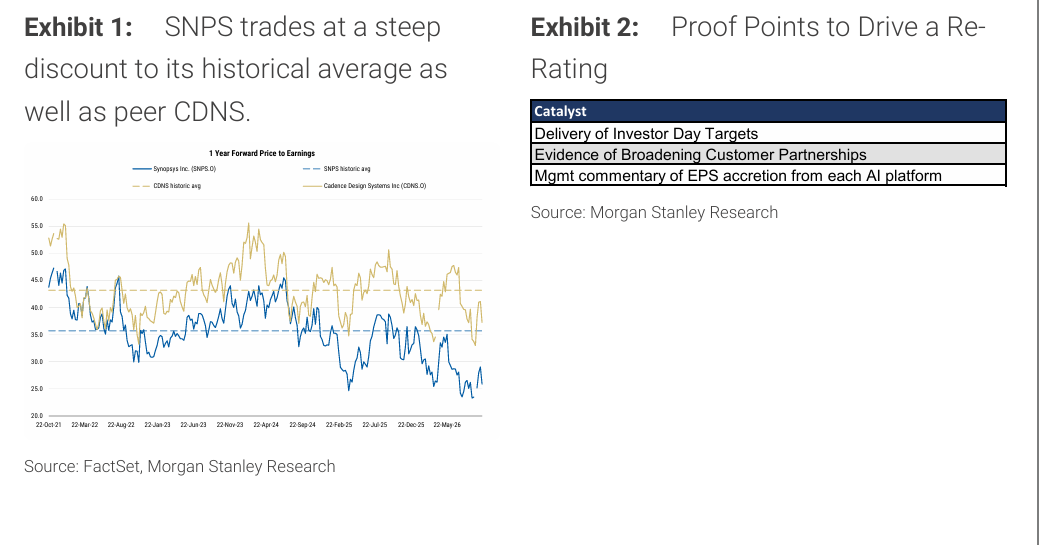
Synopsys' most significant growth and change was first reflected in an improvement in profits. Management raised long-term EDA and design IP growth expectations to about 10% respectively; Damo used 13%, 15%, and 9% EDA, IP, and simulation growth rates for FY27 (FY2027 benchmark), estimated revenue of US$10.896 billion, and adjusted earnings per share of US$19.12. The latter was about 6.5% higher than the original forecast of US$17.96, and FY28 (the 2028 benchmark) further rose to US$23.14. IP recovery, ANSYS collaboration, and physical AI (Physical AI) form the main driving force. Damo believes that the December earnings report may narrow the FY27 guidelines to the upper end. The target price of $574 is estimated at about 30 times the profit of FY27, which is still 36 times lower than the five-year historical average forward price-earnings ratio, reflecting a combination of profit improvement and valuation repair.
Turning Intelligent Entity Calls into Own Revenue: EDA Shuangxiong's Incremental Commercialization Path
Synopsys proposed three AI paths: Full Stack (Full Stack), customer-owned platforms and agents, and Frontier Models (Frontier Models). The Dama analyst team said that judging from the commercial mechanism, this has expanded the entry point for professional EDA capabilities into different customer workflows, and charging for usage is expected to capture new execution requirements. Application Optimization IP (Application-Optimised IP, “Factory 2”) enhances the degree of integration of IP with customer specific application requirements; Ansys fusion products extend opportunities to systems and multiphysics simulation.
Damo clearly stated in the research report that these paths are still in the early stages, and the next round of revaluation will need to rely on the active fulfillment of investors' daily goals, the expansion of customer cooperation, and evidence that various AI platforms contribute to earnings per share.
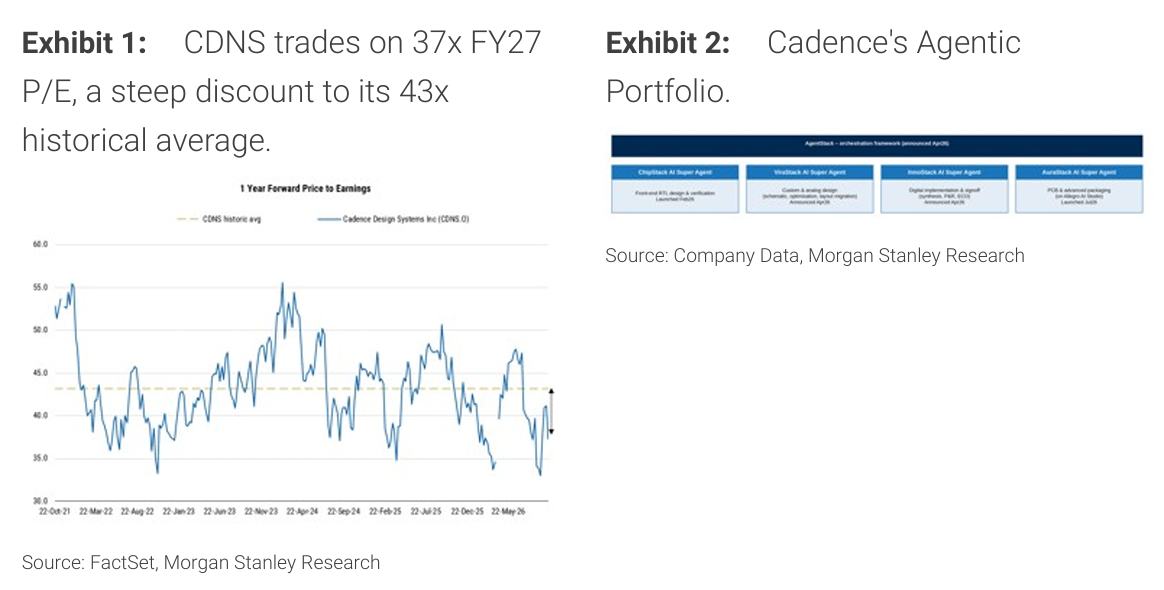
The advantage of Keng Teng Electronics is that the existing business is stable and the intelligent portfolio covers a wide range of companies. Damo expects third-quarter revenue of US$1,612 million, adjusted earnings per share of US$2.07 billion, and backlog orders of US$8.2 billion; earnings per share for the fourth quarter are US$2.10, which is about 3% higher than the consensus. IP grew 40% in the last quarter, and the hardware business set a record. Intel, Samsung, and TSMC's design-process collaborative optimization (DTCO) supports EDA requirements. ChipStack has had more than 20 customer collaborations, including ViraStack, InnoStack, and AuraStack covering digital design verification, analog design, implementation of sign-off, and PCB and advanced packaging; more significant contributions are expected to fall in 2027, and the current guidelines have not yet taken into account the jump in smart device adoption rates. Damo anticipates that in the future, the company will place more emphasis on broad customer adoption and increased penetration rates, rather than announcing major AI collaborations similar to Synopsys.
The common share price catalyst of the two is the ability of AI value to enter the income statement. The Dama analyst team said that although Keng Teng Electronics had record orders last quarter, the stock price remained basically flat the next day, so the October 26 earnings report needed to further explain the commercialization path. Damo expects its FY27 (that is, 2027 fiscal year) revenue of approximately US$7.366 billion, earnings per share of US$9.82, adjusted operating margin of about 46.1%, and a target price of US$400, corresponding to a profit of about 41 times; the analog and mixed signal product line, system analysis, and customer relationship growth path support its valuation premium. In comparison, Synopsys is less valued, but Ansys collaboration and new business execution are more critical. The new idea/aggressive bull market scenario presented in the report was $1000/600, and the bear market was $200, respectively, reflecting different scenarios such as accelerated growth and contraction in R&D; the benchmark target is still $574/400.