
Did Community Acquisitions Just Shift LTC Properties (LTC) Investment Narrative?
- LTC Properties acquired two seniors housing communities in Alabama and Iowa for US$95 million, lifting 2026 SHOP acquisitions to more than US$830 million and keeping Charter Senior Living and Arrow Senior Living as operators of the properties.
- The newly purchased communities carry a weighted-average occupancy of 93% and an average age of six years, which highlights LTC Properties’ focus on relatively young, highly occupied SHOP assets managed by established operating partners.
- This article examines how LTC Properties’ investment narrative is shaped by faster SHOP expansion following the US$95 million community acquisitions.
Scan LTC Properties alongside other healthcare-focused real estate plays to see how it stacks up against our hand-picked list of solid balance sheet and fundamentals (25 results) for income and defensiveness.
LTC Properties Investment Narrative Recap
To own LTC Properties, you need to believe the shift toward a larger seniors housing operating portfolio can translate into healthier, more repeatable cash flows over time, even as reported earnings are forecast by analysts to soften. The US$95 million SHOP deal fits that story, but it does not, on its own, resolve the near term tension between rapid acquisition activity and only modest expected normalized FFO growth.
The key short term swing factor stays the same. Execution in SHOP, from occupancy to pricing, needs to better support per share cash generation that has recently been flat and occasionally below expectations. The biggest risk is that acquisition driven NOI keeps getting diluted by equity issuance, asset sales and interest costs, leaving earnings and cash flow per share stuck.
The fresh acquisition news ties directly into prior guidance that SHOP could become a much larger slice of LTC Properties’ NOI over the next few years. Management has been targeting newer, relatively large, mostly private pay communities, and these Alabama and Iowa assets, with 93% weighted average occupancy and an average age of six years, fit that template.
That pattern matters for the current catalyst because the business is relying heavily on SHOP NOI growth, supported by an expanded US$1.1b unsecured credit facility and more operational data, to offset rising interest expense and past dilution. If newer SHOP communities underperform on occupancy or resident rates, the risk outlined by analysts of stagnating or declining FFO per share becomes more immediate.
LTC Properties Consensus Forecasts In Context
LTC Properties is being modeled on some punchy growth assumptions. Analysts are penciling in revenue expansion of 43.2% a year over the next three years, even as the business mix tilts further toward SHOP and away from traditional triple net exposure.
On the earnings line, the story looks very different. Profit margins are modeled to move from 39.6% today to 10.1% by 2029, with consensus calling for earnings of US$101.1 million by that year versus US$134.7 million today. That represents an earnings decline of US$33.6 million from current levels, despite the rapid revenue build analysts are assuming.
LTC Properties' narrative projects US$997.1 million revenue and US$101.1 million earnings by 2029. This requires 43.2% yearly revenue growth and an earnings decrease of US$33.6 million from US$134.7 million today.
The 2029 target also embeds a richer valuation multiple. To line up with the current analyst models, LTC Properties would need to trade on a P/E of 37.4x those 2029 earnings, compared with 17.0x today and an industry P/E of 26.6x for US health care REITs. That gap means the forecast does not just lean on higher SHOP driven revenue. It also leans heavily on investors being willing to pay a much higher multiple on those future earnings.
Revenue and earnings forecasts sit alongside capital structure assumptions that matter for equity holders following the SHOP expansion. Analysts expect shares outstanding to grow by 7.0% a year for the next three years, which can make per share progress harder to see even if total revenue and NOI are rising. A US$1.1b unsecured credit facility and the use of interest rate swaps are already in place to help fund acquisitions while keeping leverage in a 4x to 5x debt to EBITDA range.
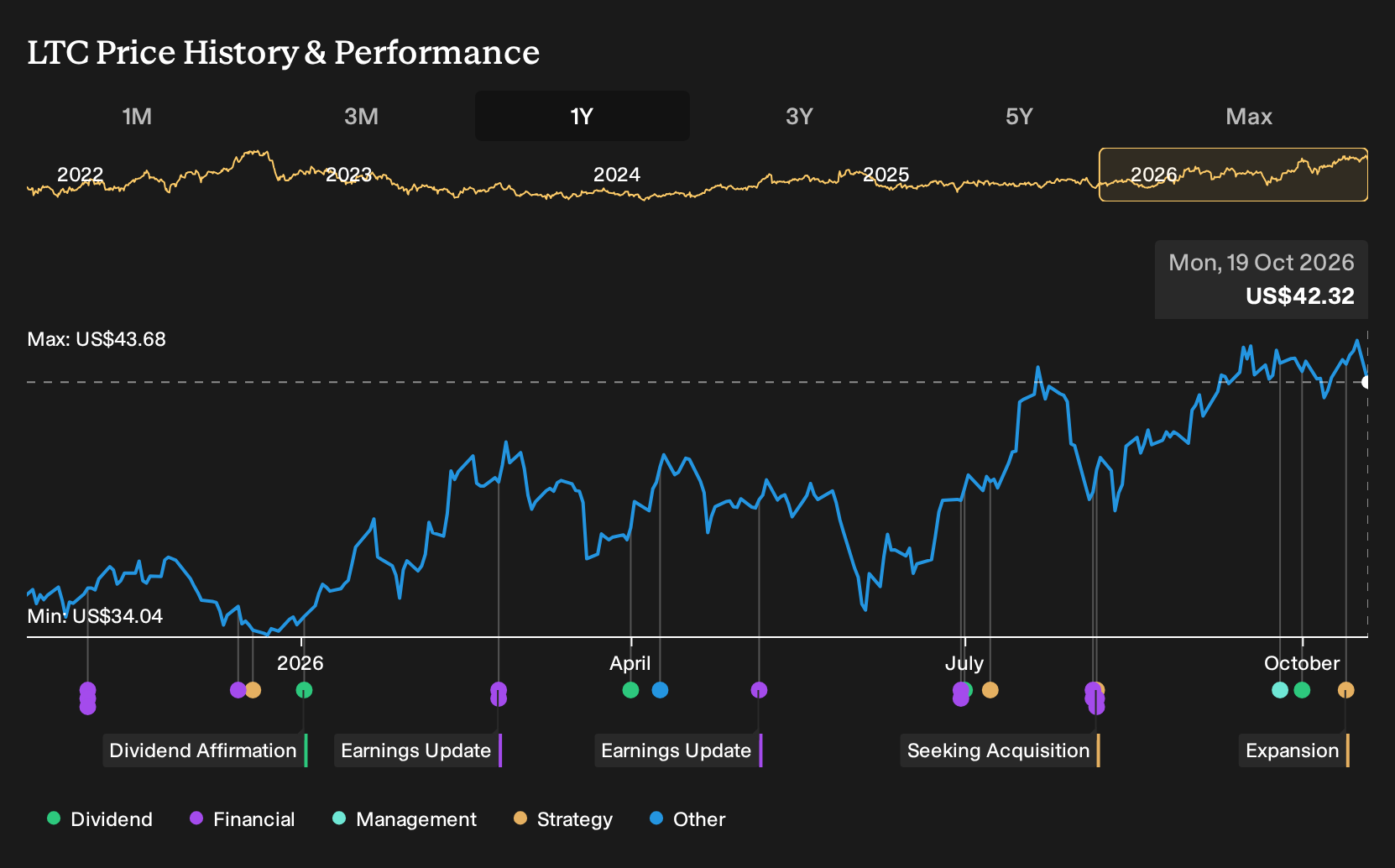
On current numbers, broker targets cluster in a relatively tight band. The consensus price objective of US$46.0 sits only 7.8% above the recent US$42.43 share price, with estimates ranging from US$40.0 to US$55.0. That narrow gap between prevailing trading levels and the average target hints at a view that LTC Properties is broadly fairly priced on the existing forecasts rather than deeply mispriced either way.
Uncover why LTC Properties' fair value indicates a 9% potential upside to its current price that may not last much longer.
Exploring Other Perspectives
Three fair value views from the Simply Wall St Community span roughly US$46 to about US$147, which shows how widely opinions on LTC Properties can diverge. Those estimates were set before the US$95 million SHOP acquisitions, so you are weighing them against fresh execution risks around occupancy, pricing and acquisition driven dilution. Consider exploring multiple community viewpoints before forming your own stance.
Explore 2 other LTC Properties fair value estimates, including one that suggests it could be worth just $46.00.
The Verdict Is Yours
Disagree with existing narratives? Extraordinary investment results rarely come from following the herd, so trust your own research and judgment.
- A great starting point for your LTC Properties research is our analysis highlighting 4 key rewards and 5 important warning signs that could impact your investment decision.
- See our latest analysis for LTC Properties. The report includes a comprehensive fundamental analysis summarized in a single visual, the Snowflake, making it easier to review LTC Properties' overall financial health at a glance.
Looking For More Investment Ideas Beyond LTC Properties?
If the LTC Properties story has sharpened your thinking about risk, income and balance sheet strength, broaden that lens across a wider watchlist before committing fresh capital.
- For investors who want growth potential without ignoring financial resilience, scan a curated 20 high quality undiscovered gems and see which businesses pair quality fundamentals with quieter market attention.
- If capital preservation and lower downside risk sit high on your checklist, review a focused 32 resilient stocks with low risk scores that surfaces companies with more robust risk profiles.
- Income oriented readers who still care about fundamentals can weigh LTC Properties against a targeted 8 dividend fortresses and compare yields, balance sheets and payout setups side by side.
Have feedback on this article? Concerned about the content? Get in touch with us directly. Alternatively, email editorial-team@simplywallst.com