
Homebuilder Stocks Facing a Housing Slowdown as Mortgage Rates Stay High
Housing is cooling again, with record-low pending home sales and stubbornly high mortgage rates choking off activity just as the Fed signals it may keep policy tight for longer. That mix can punish some homebuilder stocks and reward others. If you care about where capital might shift as this slump deepens, keep reading, because this article unpacks three US residential homebuilder stocks exposed to this latest round of housing stress.
The three stocks covered next are just a starting sample, as the full screen surfaced 14 more US residential homebuilder companies with equally compelling narratives that are not included in this article. To identify potential front-runners for your own watchlist, head straight into the US Residential Homebuilder Stocks screener.
PulteGroup (PHM)
PulteGroup is one of the purest plays on the US Residential Homebuilder Stocks screener theme. It has a broad national footprint that ties its fortunes directly to single and multi family construction, land development and mortgage activity as housing cycles tighten and loosen.
PulteGroup generates almost all of its US$16.4b revenue from US homebuilding, led by Florida at about US$4.2b, the West at roughly US$3.5b and the Southeast and Midwest at about US$2.9b and US$2.6b. This is alongside a smaller US$365 million financial services arm, and the stock carries a market value near US$20.8b.
"Although PulteGroup is increasing the share of build to order homes and trimming spec inventory, the shift has not prevented net income from falling from US$523 million in Q1 2025 to US$347 million in Q1 2026 and from US$608 million in Q2 2025 to US$472 million in Q2 2026."
For investors tracking homebuilders, the real swing factor is whether one unresolved pressure on pricing and incentives tightens or eases from here.
If that pressure on pricing is the real story for you, the full narrative for PulteGroup shows how PulteGroup could still turn this slowdown into an opportunity hiding in plain sight.

D.R. Horton (DHI)
D.R. Horton is one of the purest ways to track the US Residential Homebuilder Stocks screener theme, with a nationwide footprint that pushes it right into the middle of the single family housing slowdown and any future recovery that follows.
D.R. Horton runs a broad US homebuilding operation, generating most of its US$33.4b revenue from regional home construction. This is led by Homebuilding South Central at US$6.8b, Southeast at US$6.6b and East at US$6.2b, alongside rental, Forestar lot development and financial services, and carries a market value around US$37.8b.
"Ongoing emphasis on affordability at D.R. Horton, with an average closing price of US$362,000 that is about US$155,000 below the U.S. new home average, positions the company to keep targeting a wide entry level buyer pool that can support volume and revenue."
What ultimately matters for D.R. Horton is how one quiet shift in future housing affordability filters through to both pricing power and margins.
That affordability tilt is only the starting point, with the full narrative for D.R. Horton unpacking how D.R. Horton’s volume engine could accelerate or stall as conditions reset from here.

Lennar (LEN)
Lennar is a heavyweight in U.S. residential construction, which puts it right in the middle of this homebuilder theme as new housing supply, land development, and mortgage activity all come under pressure from higher rates and a cooling market.
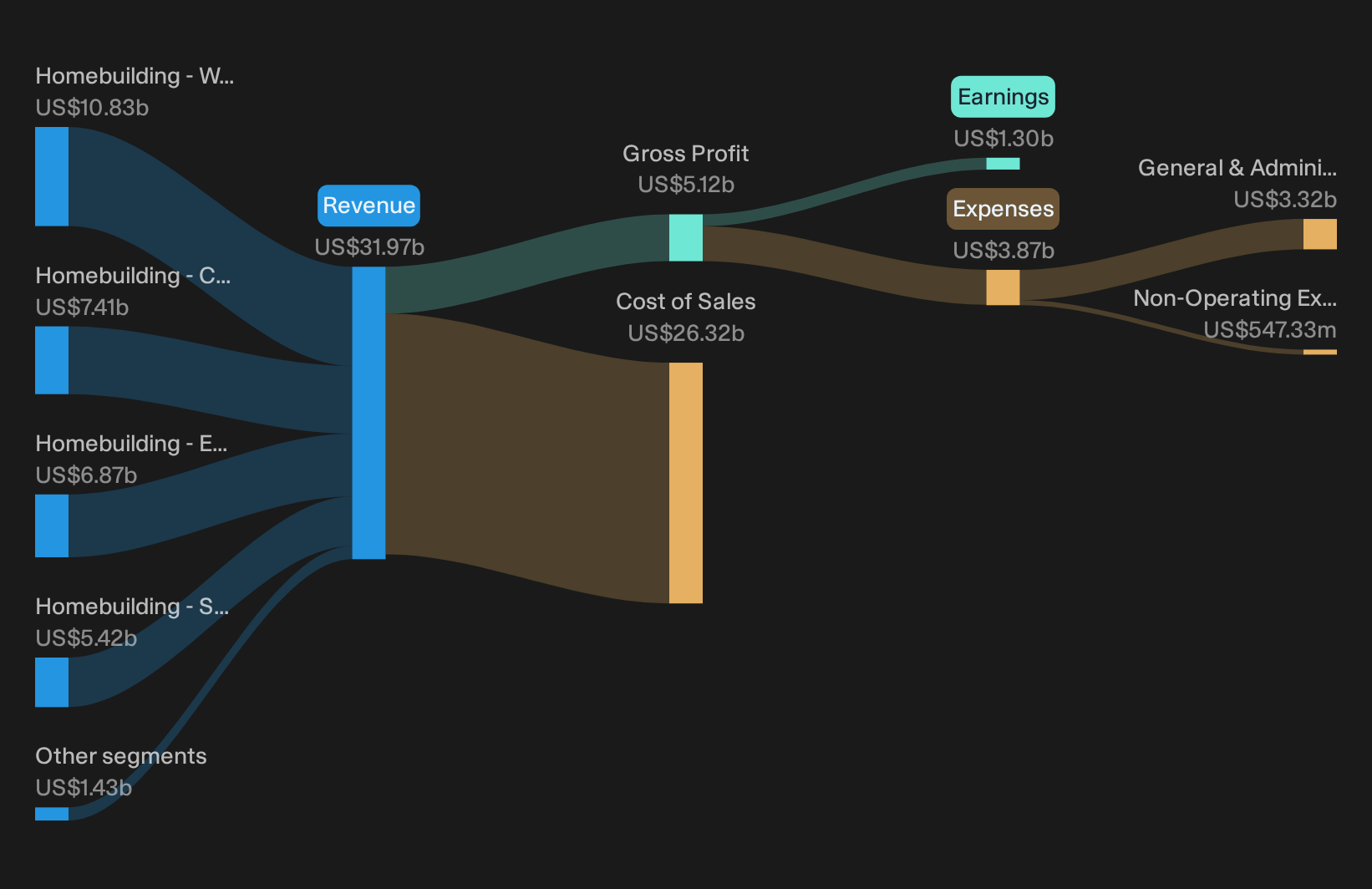
Lennar designs, builds, and sells single and multifamily homes tied to U.S. housing cycles, with homebuilding in the West generating about US$10.8b, Central US$7.4b, East US$6.9b, and South Central US$5.4b. This is alongside smaller multifamily and financial services operations, and the stock is valued near US$18.0b.
"Lennar's transition to an asset light, land light model with just in time delivery is expected to keep reducing the owned asset base while relying on controlled homesites, supporting more efficient use of capital and influencing future net margins and earnings."
What comes next for Lennar largely depends on how one still unresolved affordability pressure reshapes demand, pricing power, and housing supply from here.
That affordability squeeze is only one angle, with the full narrative for Lennar mapping how Lennar’s asset light pivot could convert today’s pressure into accelerating long term earnings power.
Seeking Alternatives Before Momentum Flies
Fresh ideas move first. Once momentum hits, the easy entry points can vanish as prices start flying and attention floods in. Spot what others miss while it matters, get in early.
- Chase durable income potential with a curated group of high-yield payers by scanning the 8 dividend fortresses before yield hunters crowd in.
- Track where AI profitability already exists, not just stories, by running through the hand picked 38 profitable AI stocks that aren't just burning cash while these tickers stay under the radar for now.
- Position ahead of possible resource squeezes by reviewing the carefully filtered 16 top copper producer stocks before any supply headlines start dropping into the mainstream.
Have feedback on this article? Concerned about the content? Get in touch with us directly. Alternatively, email editorial-team@simplywallst.com