
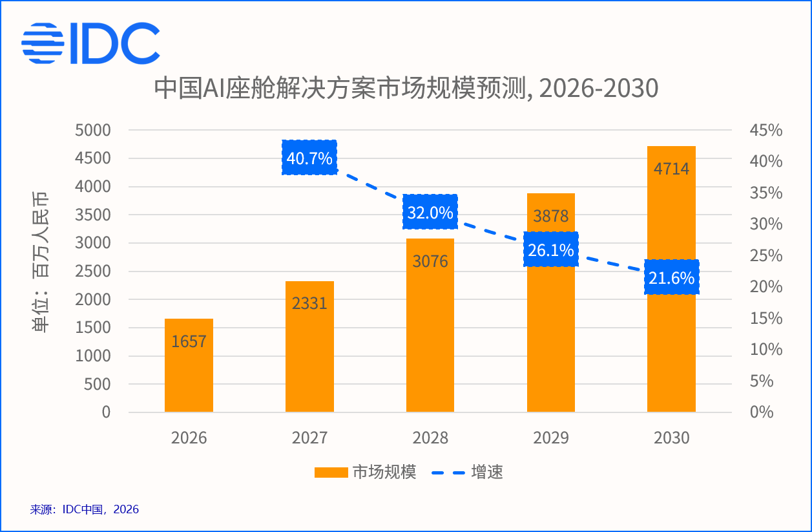
IDC: China's AI cockpit market is expected to reach 1.66 billion yuan in 2026 and increase to 4.71 billion yuan in 2030
The Zhitong Finance App learned that IDC published an article stating that as large language models, multi-modal interaction, and cloud-based collaboration architectures continue to mature, AI native applications such as intelligent voice, AI assistants, navigation Q&A, content generation, and personalized recommendations are being launched at an accelerated pace. As a result, the cockpit interaction experience has become a key variable for car companies to build differentiated competitiveness. AI cockpits are moving from “function integration” to “experience reconstruction,” and for the first time, this trend has had a quantifiable market scale.
The AI cockpit solution market as defined by IDC covers four levels: AI development platform/software (model development, agent orchestration, deployment management, etc.), model service MaaS (cloud, car-end and end-cloud collaborative call of large language models, multi-modal models and voice models), AI applications (intelligent voice, AI assistant, navigation Q&A, content generation, etc.), and AI operation services (model update, knowledge base management, operation monitoring and continuous optimization).
According to IDC data, in the first half of 2026, China's AI cockpit solutions market reached 710 million yuan. This scale shows that AI cockpits have entered the stage of scale development, market demand is accelerating at the same time as the commercialization process, and the market is shifting from early exploration to large-scale mass production and continuous operation. IDC predicts that China's AI cockpit solutions market will reach 1.66 billion yuan in 2026, and is expected to further grow to 4.71 billion yuan by 2030, with a compound annual growth rate of nearly 30%.
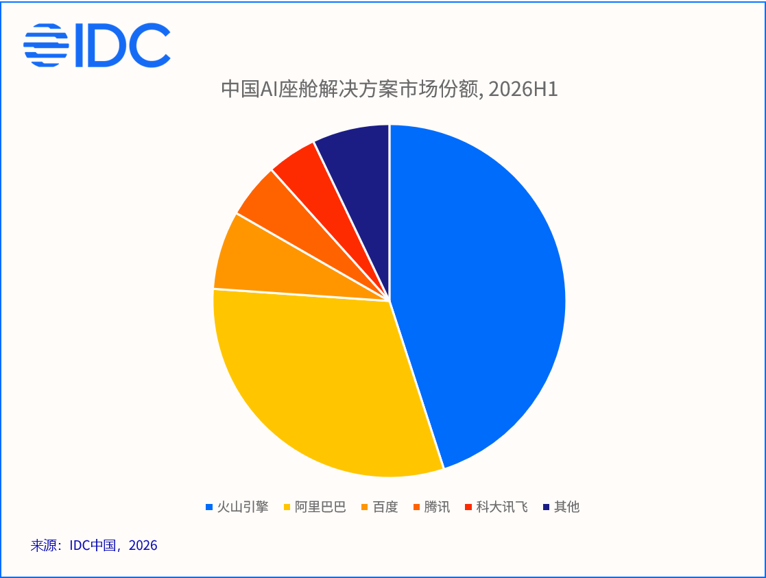
The competitive landscape has surfaced: the first place share exceeds 40%, and the market showed high concentration characteristics in the early stages
Judging from the competitive landscape, the market's leading agglomeration effect is remarkable: in the first half of 2026, Volcano Engine ranked first with a 45% market share, and Alibaba ranked second. Judging from the sources of advantage, the leading manufacturers are mainly based on the coverage scale of mass-produced models and the project experience of leading customers. They are in a market position at this stage, and the pattern is far from solidified. In the second tier, Baidu relies on cockpit business inventory and maps to maintain market participation; iFLYTEK relies on cockpit software and hardware solutions and existing customer base to steadily advance AI capability upgrades; in addition, model startups such as Step Star have also entered the market through deep ties with car companies and industry chain partners, and some technologies have already been launched. Overall, the market pattern is still evolving dynamically, and mass production project experience, ecological collaboration capabilities, and C-side brand awareness are becoming key competitive chips for manufacturers.
License authorization goes hand in hand with pay-as-you-go, and the business model evolves towards value orientation
Judging from the business model, the current billing method in the AI cockpit market shows diverse characteristics: license licensing for functional package combinations is still the mainstream model, and the pricing differences are obvious; for customers with strong self-development capabilities and only basic model capabilities, the public cloud model, which is billed by token or call volume, is an important addition; end-side deployments generally use one-time activation billing, which is complemented by annual technical support and model iterative maintenance fees.
It is worth noting that car companies' attention to AI's input-output ratio has increased markedly, pricing negotiations are increasingly centered around actual usage results and value density, and the value difference between deep empowerment projects and basic function licensing is growing. At the same time, some manufacturers have begun to use benchmark projects as a starting point to explore the transition path from car companies' purchase orders to subscription payments for C-end users, opening up new revenue imagination space for the market.
Cloud collaboration has become the mainstream architecture, and competition for interactive experiences is deepening
Judging from the evolution of technology, cloud-to-cloud collaboration has become an industry consensus: the end-side model undertakes rapid response to simple high-frequency instructions, and the large cloud model handles complex reasoning and multi-modal interactions to balance experience, delay, and cost. The number of end-side model parameters continues to increase, putting higher demands on the supporting capabilities of high-computing power vehicle chips. In terms of industrial division of labor, cloud and model manufacturers generally cooperate with Tier 1 suppliers to integrate software capabilities into domain controllers, and physical multi-modal interactive hardware has also been piloted in some models. Furthermore, following the pace of Chinese car companies going overseas, the overseas implementation of cockpit AI capabilities is becoming a new direction of growth; exploration in cutting-edge fields such as embodying intelligence also brings more possibilities for the medium- to long-term evolution of cockpit interaction patterns.
From passive response to active service, Agentic AI reshapes the cockpit interaction paradigm
Judging from the interactive paradigm, the AI cockpit is undergoing a critical transition from “passive response” to “active service.” The previous generation cockpit voice assistants generally used a turn-based architecture of “intent segment+multi-agent collaboration”, with fragmented interaction and limited frequency of use; since 2026, many leading manufacturers have successively released next-generation cockpit solutions based on the Agentic AI (Agent-based Artificial Intelligence) architecture. The common denominator of the technology route is to link functional domains such as vehicle control, navigation, and smart driving with a unified AI hub to drive the evolution of cockpit interaction from turn-based question-and-answer to task-driven autonomous execution.
Judging from information publicly disclosed by manufacturers, leading manufacturers have carried millions of large model models, and the average number of daily cockpit interactions has reached tens of millions of times; although the statistical caliber of each company varies, cockpit AI is gradually shifting from a low-frequency “early access configuration” to a daily service for users to use at high frequencies, and it has become an observable industry trend. IDC believes that the commercial implications of this transition are also profound: only when cockpit AI evolves from low-frequency functionality to high-frequency services can the closed-loop payment logic around services be truly established, and car companies and suppliers have a basis to explore the migration from B-side licensing to C-side subscription charging models. The combination of the upgrading of the interactive paradigm and the evolution of the business model will jointly determine the growth slope of the AI cockpit market over the next five years.
Chen Qijin, senior analyst of cloud computing products at IDC China, said that AI cockpits are an emerging sector with high growth certainty in the automotive cloud market. Currently, the market is still in its early stages. The business model, technical architecture, and competitive pattern have not been fully defined. The coverage of mass-produced models and benchmark project experience of leading manufacturers form a first-mover advantage, and the demand for balance between cost and experience, and the maturity of the C-side payment model will largely determine the speed at which the market moves from “configuration competition” to “value competition”. For suppliers, refining interactive experiences around actual vehicle usage scenarios, building engineering capabilities for cloud collaboration, and establishing a sustainable billing model are the keys to seizing this market opportunity.