
The $110 oil price hit a financial impasse! France's debt risk premium hit a 15-year high. Is a new round of “European debt crisis” imminent?
The Zhitong Finance App learned that France is currently under heavy pressure from energy inflation and the fiscal credit side. As the price of Brent crude oil, the global crude oil benchmark, broke through 110 US dollars in one fell swoop, and European gas futures rose by about 4% to the highest level since December 2022, the yield spread on French and German 10-year treasury bonds once widened to 159.4 basis points, a 15-year high; after France's 10-year yield rose to 5%, the euro also weakened at the same time. Public debt reached 119 percent of GDP in the second quarter, and the government plans to reduce the deficit rate from 5.4% expected this year to 5% next year.
However, in Paris and on the streets of France as a whole, people's extreme dissatisfaction with rising living costs and cuts in public services and social benefits has led to continued violent protests and riots. Partial curfews in Paris and other places can be described as further increasing the French government's resistance to reducing the deficit.
The ECB raised deposit interest rates to 2.50% in September; according to the October Reuters survey, economists' mainstream expectations are to suspend interest rate hikes on October 29 and add another 25 basis points in December. The interest rate futures market pricing on the 21st still points to the ECB's interest rate hike in December. From this perspective, energy inflation continues to raise the yield and future interest rate prospects of Eurozone long-term treasury bonds, while the decline in the credibility of fiscal consolidation continues to increase the risk premium in the French market; high interest rates and high yield trajectories are gradually increasing the burden of refinancing, but reducing the deficit is constrained by social pressure. Market transactions increasingly focus on whether centralized budget planning can restore credibility, and whether fiscal deficits and sovereign debt pressure spread to the asset portfolios and financing systems of large commercial banks.
The price of oil rose to 110 US dollars, budget concerns deepened, and the risk of French treasury bonds reached a new high in 15 years
As rising energy prices heightened concerns about France's fiscal outlook, an indicator measuring the risk of the French government's sovereign bonds rose to its highest level in 15 years.
National income investors held the additional yield index required for 10-year French treasury bonds rather than German treasury bonds for the same period. At one point, it rose 6 basis points to 159.4 basis points.
This spread is seen as a key measure of credit risk in the Eurozone. Since the end of September, interest spreads have widened dramatically as France's ability to push for the adoption of a budget to deal with its debt burden has been increasingly questioned. Over the weekend, public anger over the cost of living turned violent protests, further fueling concerns.
“Interest spreads are likely to continue to weigh on the upcoming budget vote,” said Puja Kumra, senior UK and European interest rate market strategist at Dominion Bank of Toronto. “Even after the budget is approved, investors are concerned about broader fiscal malfunctions and signs of political fragmentation.”
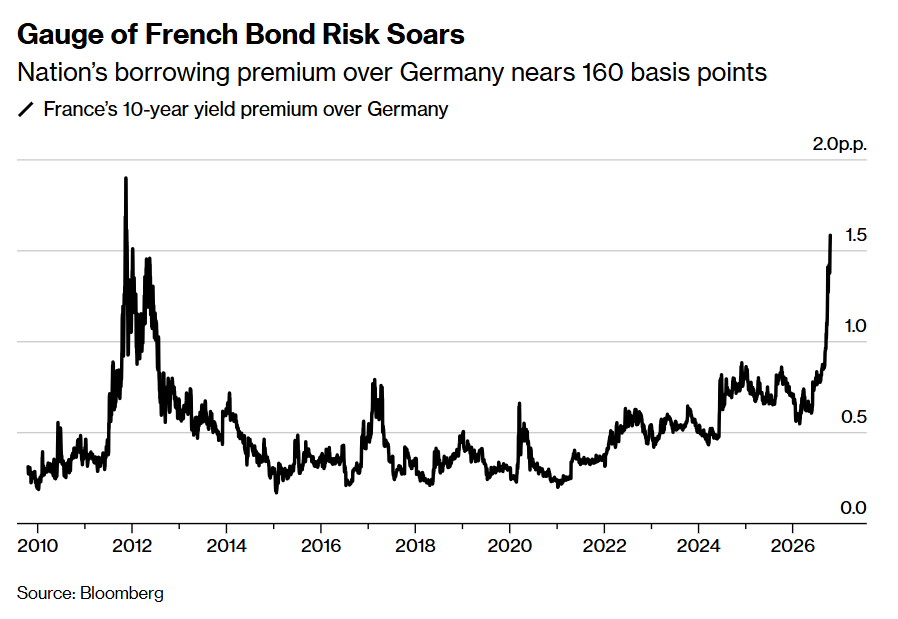
As shown in the chart above, the risk index for French treasury bonds continues to soar — the French treasury bond market's borrowing premium compared to Germany is approaching 160 basis points.
On Wednesday, rising energy prices further fueled sharp fluctuations in the European bond market. Europe's benchmark natural gas futures rose by about 4%, and the price of Brent crude oil once again exceeded 110 US dollars per barrel.
Earlier on Wednesday, Deutsche Bank CEO Christian Zewin said that financial and political instability in France is cause for concern, and market fluctuations may continue until next year's presidential election.
The yield on French 10-year treasury bonds rose to 5% for the first time since 2002. The performance of the euro against the US dollar lags behind most G10 currencies. At one point, it fell 0.2% to 1.1214 US dollars per euro.
The French parliament has serious differences. Reaching a compromise on next year's budget and getting the relevant bill passed is becoming a difficult process. With only six months left until the presidential election, the process probably won't get any easier.
Historical Mirroring: The Old Transmission of the European Debt Crisis
In the last round of the European debt crisis, the financial crisis revealed financial distortions in Greece and real estate and banking risks in some countries; falling treasury bonds damaged banks, and government bailouts increased debt, further worsening debt repayment capacity. The bailout mechanism, Greek debt restructuring, and the European Central Bank's commitment to protect the European Union in 2012 gradually contained the panic.
The Five European Pigs (the Chinese version of “PIIGS”) refers to the five European countries Portugal (Portugal), Italy (Italy), Ireland (Ireland), Greece (Greece), and Spain (Spain). It is Wall Street's derogatory term for five European economies with low credit ratings for sovereign debt.
However, the country that is likely to trigger a new round of European debt crisis this time is the “Five European Pig Countries” that have been at the end of the European economy for a long time, but France, the second-largest economy in Europe.
As the second-largest economy in Europe, France's treasury bond market's influence on Europe as a whole and the global economy is much larger than the “Five European Pigs” that sparked the European debt crisis 14 years ago. More and more investment institutions are worried that French treasury bonds will continue to be drastically sold off. The spillover effects may trigger a new round of euro depreciation crises and European debt crises impacting global financial markets.
Looking back at the last round of the European debt crisis — Greece drastically raised its fiscal deficit in 2009. The recession after the financial crisis and the burden of bank bailouts further revealed the financial vulnerability of member states. The pressure then spread to Ireland, Portugal, Spain, and Italy. Falling treasury bonds have weakened banks' assets and financing capacity, and bank bailouts have increased the burden on the government, creating a “vicious circle of sovereign banks”; fiscal austerity further depressed growth. The European bailout mechanism was gradually established. In particular, market confidence gradually recovered after then-ECB President Mario Draghi promised to maintain the euro “at any cost” in 2012 and the ECB introduced a conditional direct currency transaction instrument (OMT).
The schedule of the current sell-off in the French treasury bond market and the fiscal credit crisis is not enough to determine the repetition of the full crisis — currently the European market bank capital buffer is stronger, and the ECB has transmission protection tools (TPI), but intervention must assess fiscal and debt sustainability, and is not unconditional. The real signal of the escalation of the French fiscal and treasury debt crisis is that the wave of sell-off of French treasury bonds and the budget impasse turned into a commercial bank-side treasury bond asset portfolio detonated a liquidity crisis in the Eurozone, and the financing process was blocked, and then spread to other member countries through banks.