
Apple Has Joined the $5 Trillion Club. Its Holiday Quarter Now Faces a Big Test
Apple (AAPL) has officially entered the territory only one other company, Nvidia (NVDA), has reached before. On Oct. 14, the iPhone maker became only the second publicly traded company after Nvidia to close above a $5 trillion market capitalization.
As the holiday shopping season gets closer, iPhone demand, higher memory costs, and Wall Street’s mixed opinions will all play a role in whether Apple stays in the $5 trillion club.
Apple's Business Has Genuine Momentum
Apple didn’t reach a $5 trillion market cap just on hype or the latest iPhone. Its business gained real momentum in the June quarter. Total revenue grew 16% year-over-year (YoY) to $109.4 billion. iPhone sales were up 22% to $54.3 billion, and Mac revenue increased 29% to $10.4 billion. The Services segment also stood out, bringing in $30.7 billion, which is 12% higher than the same quarter last year.
The company reported growth across categories, including the App Store, AppleCare, Apple Music, and cloud services. Its paid subscriptions also surpassed 1.5 billion. That recurring business gives Apple another revenue source beyond selling new devices, though it does not eliminate the company's dependence on hardware demand. Apple’s earnings rose 29% to $2.02 per share, and gross margin reached 50.1%.
The Holiday Quarter Could Make or Break Apple's Rally
Apple’s September quarter report will show whether the $5 trillion valuation can hold. In the July quarter, management predicted September revenue would grow 9% to 11% from last year, pointing to foreign-exchange pressure and tighter supply. Apple also expects iPhone revenue growth to slow to the mid-teens, even though demand remains strong. However, these are forecasts for the quarter ending in September. The holiday season offers another chance to drive sales, particularly with Apple's new foldable iPhone Duo, priced from $1,999 in the U.S. Reports indicate strong initial orders and delivery estimates extending into January 2027. However, if supply cannot keep up with demand, some sales could shift into a later period.
Rising memory costs are another concern. During its July earnings call, Apple said it expects to pay more for memory in the September quarter than it did in June, and market prices may keep going up. Management pointed to memory costs as the main reason for expected pressure on gross margins. If component expenses continue to rise, Apple’s profitability could take a hit unless it offsets it through pricing, product mix, or savings elsewhere.
During the upcoming September quarter earnings call, investors should watch the December quarter revenue outlook. This will offer important clues about whether iPhone sales can maintain momentum and whether higher costs might affect profits. Recently, Apple’s chairman Tim Cook announced that Apple Intelligence has received regulatory approval in China. This move allows Apple to finally launch its AI services in a key market. At the same time, Apple’s India business saw revenue grow 31% in fiscal 2026, with net profit up 66%. These results strongly suggest that Apple has opportunities beyond the usual holiday iPhone sales, both by making its devices more competitive with AI and by growing in fast-expanding markets.
Wall Street Is Divided on AAPL Stock
Apple has hit an impressive $5 trillion market cap, but analysts are split on what it means for the company’s future growth. Evercore ISI analyst Amit Daryanani is optimistic, raising Apple's price target from $365 to $380 and maintaining an “Outperform” rating. He believes Apple’s earnings are stable because of strong iPhone pricing, a good product mix, and steady Services revenue. Unlike some tech companies, Apple doesn’t need investors to rely on heavy AI infrastructure spending.
Similarly, Bernstein analyst Mark C. Newman kept a “Buy” rating and a $370 price target but cautioned that Apple’s December-quarter guidance might fall short, especially on gross margins. He pointed to higher memory costs and the timing of product launches as main concerns.
Meanwhile, Loop Capital is taking a cautious approach, with analyst Ananda Baruah downgrading Apple stock from “Buy” to “Hold” and lowering the price target from $370 to $330. He thinks the stock requires a new reason to move higher and is worried about lower iPhone shipments and margin pressure. UBS is also neutral, setting a $296 price target. UBS expects Apple’s September-quarter revenue to be about $112.8 billion, with $56 billion coming from iPhones, and predicts iPhone growth will slow to 14% YoY. Analysts can agree that Apple is a high-quality business, yet disagree on whether its shares offer sufficient upside at current levels.
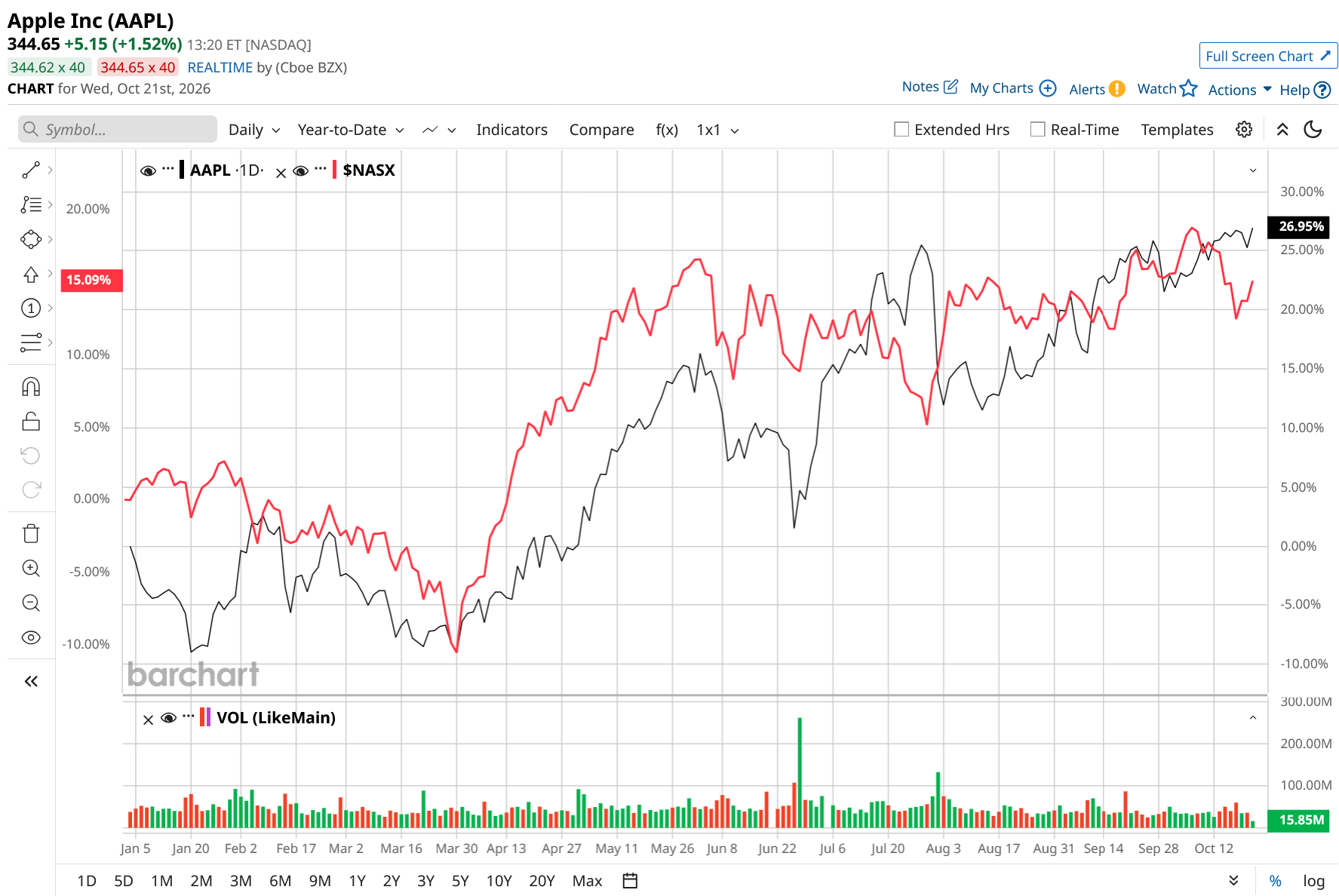
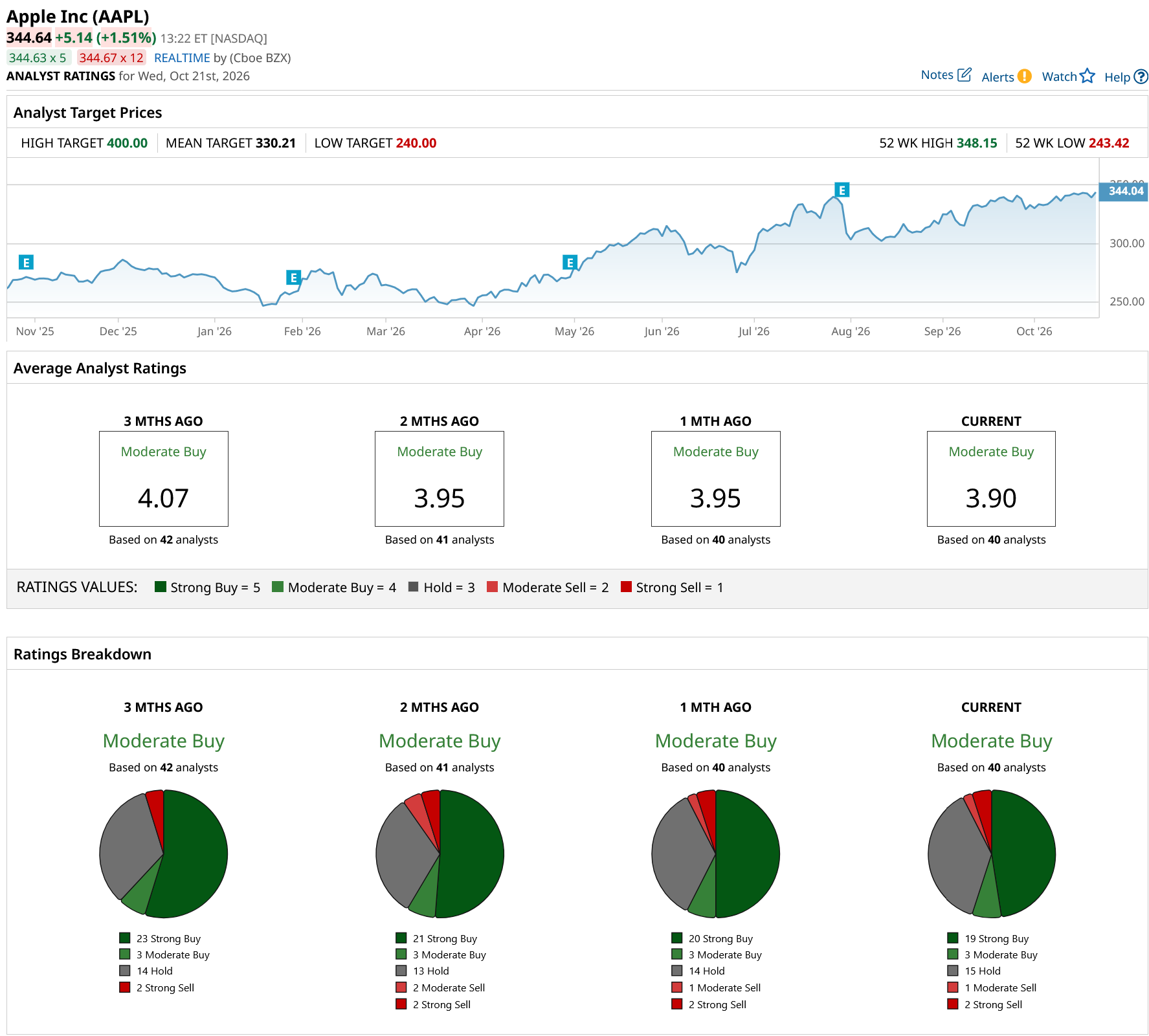
AAPL stock has climbed 27% so far this year, outperforming the tech-led Nasdaq Composite ($NASX) and surpassing its mean target price. Apple’s September quarter earnings on Nov. 2 will tell us if this rally is here to stay. The high price target of $400 implies a potential gain of 16% from current levels. Overall, AAPL stock is a consensus “Moderate Buy” on the Street. Of the 40 analysts covering the stock, 19 offer a “Strong Buy” rating, three have a “Moderate Buy,” 15 rate it a “Hold,” while one gives a “Moderate Sell,” and two give it a “Strong Sell.”
On the date of publication, Sushree Mohanty did not have (either directly or indirectly) positions in any of the securities mentioned in this article. All information and data in this article is solely for informational purposes. For more information please view the Barchart Disclosure Policy here.