
Did Earnings Beat Just Shift Levi Strauss' (LEVI) Investment Narrative?
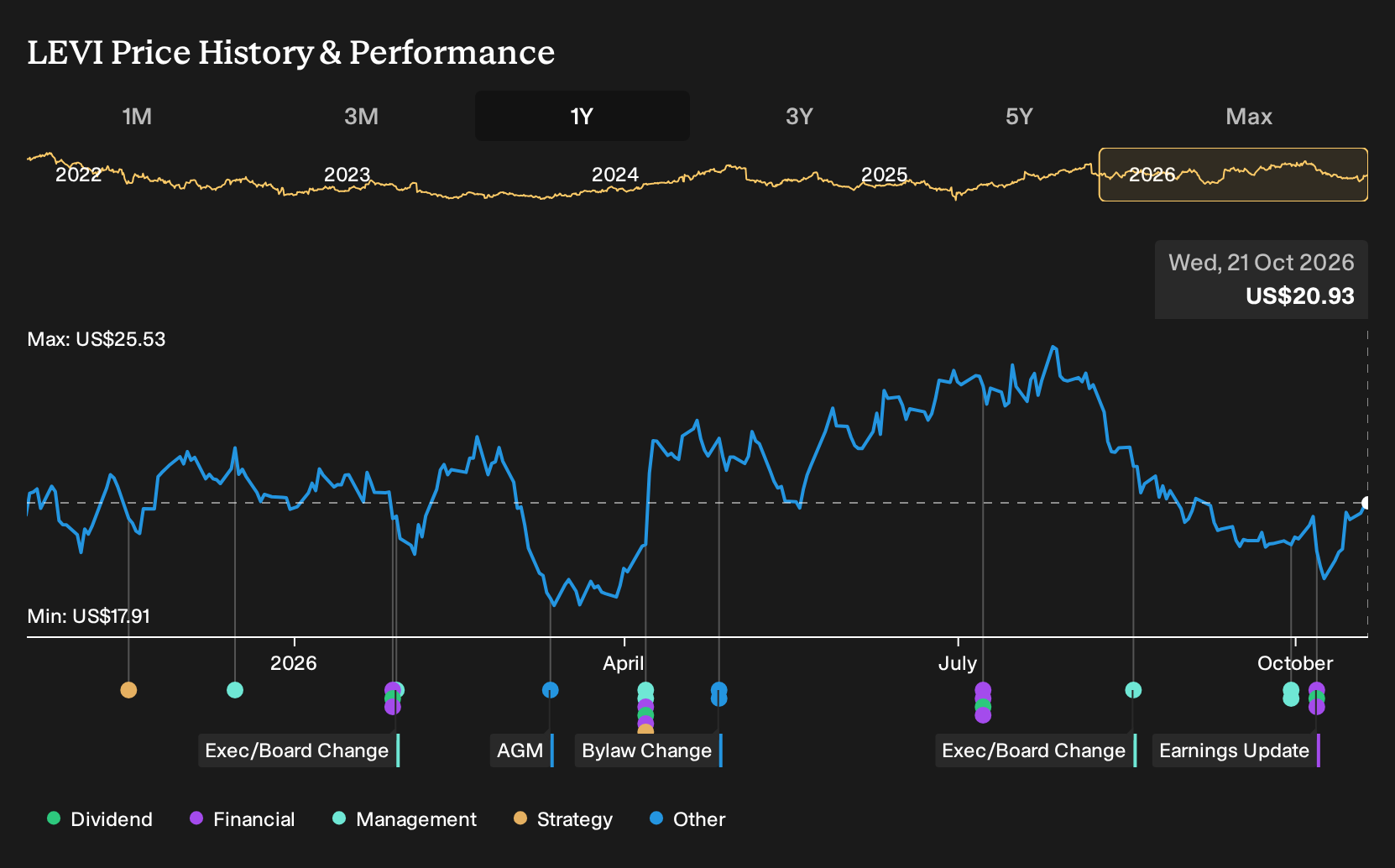
- Levi Strauss reported Q3 2026 sales growth and raised its quarterly dividend by 14%, while also tightening full year revenue guidance because of foreign exchange effects and continuing to fund growth priorities alongside dividends and buybacks.
- A new consumer class action lawsuit now questions how Levi Strauss handled tariff related price increases on jeans and other items. This puts pricing decisions and potential legal liabilities, alongside its dividend policy and capital allocation choices, in investors’ crosshairs.
- We will look at how Levi Strauss' investment narrative is affected by the higher dividend alongside the new tariffs pricing lawsuit.
Scan how Levi Strauss stacks up on quality, then compare it with a hand picked 33 high quality undervalued stocks that could be pricing in different risks and dividend profiles.
Levi Strauss Investment Narrative Recap
To own Levi Strauss, you need to be comfortable with a relatively steady consumer story that leans on denim heritage, higher margin direct to consumer sales and broader lifestyle categories, while cost work in areas like the Groveport distribution center plays out more slowly. The new pricing lawsuit adds legal and reputational noise, but the core near term swing factor still sits in execution on margins and product mix rather than litigation outcomes.
The biggest operational risk right now is that elevated logistics and transition costs linger longer, which would pressure EBIT margins if pricing and mix cannot offset them. The class action around tariff related price increases could raise questions on pricing power and customer trust, yet it does not automatically change demand trends unless shoppers clearly pull back.
The recent dividend increase of 14% is the most relevant announcement to weigh against this lawsuit. On one side, it signals that Levi Strauss is comfortable committing more cash to shareholders while still talking about funding growth priorities. On the other side, an unstable dividend track record and new legal claims mean investors may watch free cash flow coverage more closely.
For catalysts, that higher payout sits alongside efforts to scale direct to consumer, premium denim and international operations as the key levers for future earnings. If legal costs or any settlement related outflows emerge, they could compete with those uses of capital and slow the room for further dividend growth or buybacks. That keeps execution discipline and cash allocation under tighter scrutiny.
Levi Strauss Lawsuit, Dividend And Analyst Assumptions
Levi Strauss' current story ties the higher dividend and the tariff pricing lawsuit back to a simple question: Do future cash flows support both a richer shareholder payout and potential legal costs if analyst assumptions on revenue and earnings play out only partly as expected?
Analysts are building their models around mid single digit top line expansion, with Levi Strauss' revenue forecast to grow by 5.2% per year over the next few years, while profit margins are expected to lift from 8.4% today to 10.9% in three years. That margin step up is what underpins the jump in earnings from US$554.1m today to a consensus of US$836.2m by 2029, which is an increase of roughly US$282m in annual profit.
Those same forecasts help frame how much room Levi Strauss may have to keep growing its dividend while handling lawsuit related cash drains. A move to US$836.2m of earnings and a 10.9% margin implies more profit per dollar of revenue, which can support a larger pool for dividends, buybacks, capex and any legal settlements if actual free cash flow tracks those profit forecasts.
Analysts effectively assume that by 2029 Levi Strauss will be a company earning more on each pair of jeans and each non denim category, not just selling more units. If that margin story stalls because logistics costs at facilities like Groveport stay elevated or tariff related promotions become more frequent, the earnings uplift to US$836.2m becomes harder to reach and the board may face tougher trade offs between dividend growth and risk management around the pricing lawsuit.
On top of the profit bridge, earnings per share are expected to benefit modestly from a shrinking share count, with analysts modeling a 1.53% yearly decline in shares outstanding over the next three years. That kind of reduction slightly magnifies earnings growth per share, which can help Levi Strauss defend or increase its dividend per share even if total profit falls a bit short of the US$836.2m consensus, although any unexpected legal costs would still eat into the cash available for buybacks.
The valuation work in analyst reports pulls these pieces together. For the current price targets to make sense, Levi Strauss would need to reach about US$7.7b of revenue and US$836.2m of earnings by 2029, trade on a P/E of 15.8x those earnings and be discounted at 9.3%. Each of those inputs can shift if investors reassess the durability of pricing power in light of the tariff lawsuit or if the higher dividend is seen as constraining future reinvestment.
Levi Strauss' narrative projects revenue of about US$7.7b and earnings of US$836.2m by 2029. This assumes annual revenue growth of 5.2% and an earnings increase of roughly US$282m from US$554.1m today.
Uncover why Levi Strauss' fair value indicates a 32% potential upside to its current price that may not last much longer.
Exploring Other Perspectives
For a different angle on Levi Strauss, focus on the lawsuit risk around tariff related pricing. The most bearish analysts were already using softer assumptions, with revenue only reaching about US$7.5b and earnings of roughly US$747.1m by 2029. That view could now look even more cautious or, in your eyes, more realistic. These forecasts were all set before the class action and dividend hike, so treat them as starting points and explore how your own expectations might shift from here.
Explore 4 other Levi Strauss fair value estimates, including one that suggests there could be as much as 33% downside from the current price!
Reach Your Own Conclusion
Don't just follow the ticker; dig into the data and build a conviction that's truly your own.
- A great starting point for your Levi Strauss research is our analysis highlighting 3 key rewards and 1 important warning sign that could impact your investment decision.
- See our latest analysis for Levi Strauss. The report includes a comprehensive fundamental analysis summarized in a single visual, the Snowflake, making it easy to evaluate Levi Strauss' overall financial health at a glance.
Looking for more investment ideas beyond Levi Strauss?
Once you have a view on Levi Strauss, it can help to set it alongside other opportunities so you can judge risk, income and balance sheet strength on the same footing.
- For income focused investing, compare Levi Strauss' dividend profile against a curated pool of high yield opportunities through 7 dividend fortresses that put cash returns to shareholders front and center.
- If capital preservation and steadier fundamentals sit higher on your priority list, line up Levi Strauss next to a 31 resilient stocks with low risk scores and see how the risk trade off feels in practice.
- When you want to broaden the watchlist beyond well known brands, weigh Levi Strauss against a 21 high quality undiscovered gems that combine solid financials with less crowded ownership.
Have feedback on this article? Concerned about the content? Get in touch with us directly. Alternatively, email editorial-team@simplywallst.com