
Japanese Food Tax Cut Could Lift Kobe Bussan Stock and Grocery Shares
Japan’s latest inflation data and the prospect of another Bank of Japan rate hike have pushed everyday prices and borrowing costs into the spotlight at the same time. A proposed cut in food consumption tax to 1% could shift more of your weekly budget toward supermarkets and packaged foods. This article looks at how that policy twist links to three Japanese consumer staples stocks that are more exposed to this tax move and what that might mean for your watchlist.
The three stocks below are a starter set, and the full screen on Simply Wall St surfaced 18 more Japanese domestic consumer staples with equally interesting stories that are not covered here. To identify and analyze the ideas that best fit your own view on a potential food tax cut, head straight into the Japanese Domestic Consumer Staples Benefiting from Food Tax Cut screener.
Kobe Bussan (TSE:3038)
Kobe Bussan runs the Gyomu Super franchise grocery chain in Japan, tightly linked to domestic food spending that could react quickly to a lower consumption tax. Most revenue comes from the Gyomu Super business at about ¥558.4b, with restaurants and delicessens adding roughly ¥18.9b, and the stock is valued around ¥661.3b.
Kobe Bussan is tightly wired into Japan’s weekly food shop through its Gyomu Super outlets, so any tax break on groceries feeds straight into its aisles and private label shelves. Investors watching this theme may focus on what happens when volumes rise faster than the cost pressures that have been squeezing recent profit margins.
If that volume story is what you care about, go straight to the DCF valuation analysis for Kobe Bussan to see where tax relief could be masking or amplifying expectations.
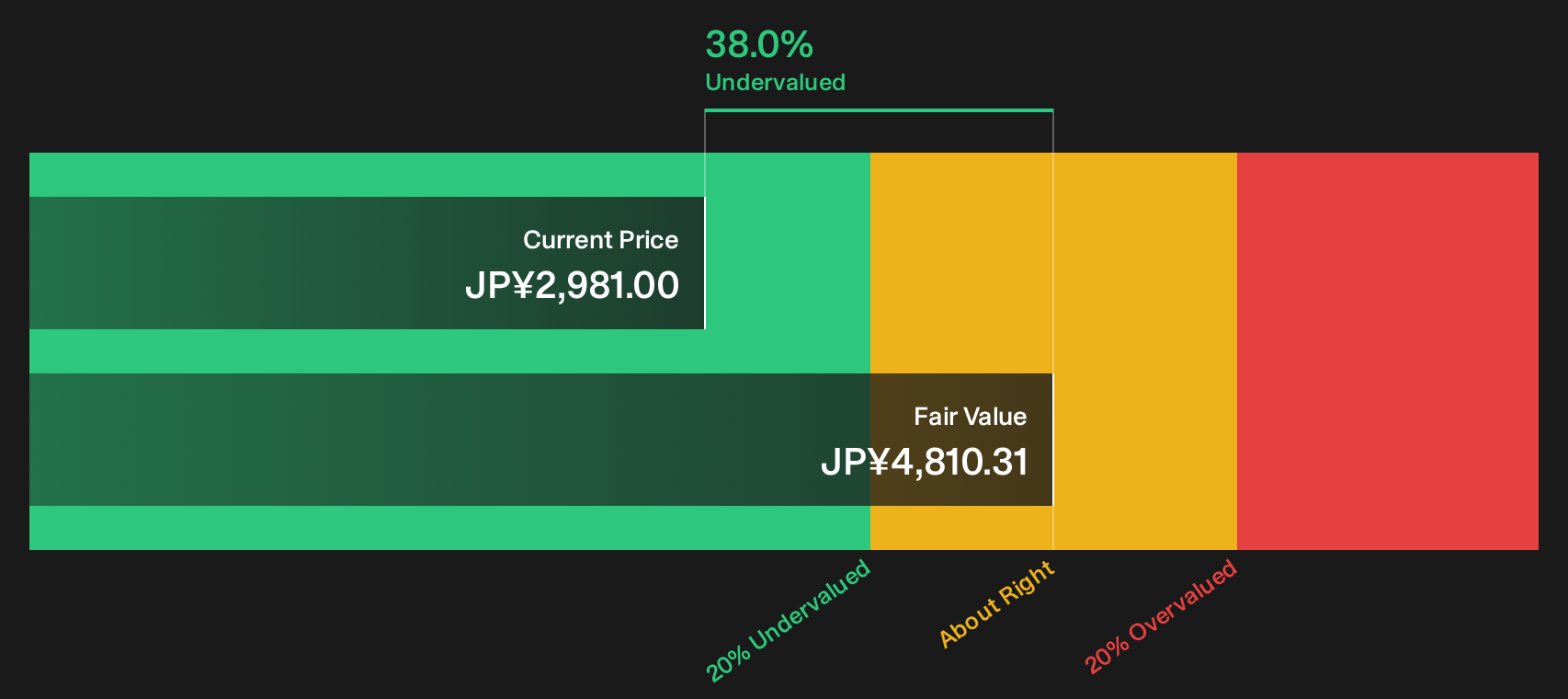
DaikokutenbussanLtd (TSE:2791)
Daikokutenbussan is a pure-play Japanese supermarket operator focused on everyday food and essentials, with related activities from food manufacturing to farming. All reported revenue of about ¥323.5b comes from within Japan, and the stock carries a market value near ¥51.5b.
Daikokutenbussan sits directly in the aisle where a temporary cut in Japan’s food tax would affect shoppers’ baskets, with all its ¥323.5b in sales tied to domestic spending and a forecast earnings rebound that depends heavily on what happens when thin margins meet any extra checkout volume.
If that earnings rebound is central to your thesis, go straight to the 1 key reward and 2 important warning signs to see how thin margins could be amplified or squeezed by tax driven volume shifts.

United Super Markets Holdings (TSE:3222)
United Super Markets Holdings runs supermarket chains across Japan that fit squarely into the domestic food retail theme, where a temporary cut in consumption tax could support grocery volumes. All ¥1,030.6b in revenue comes from its supermarket business, and the stock is valued around ¥159.3b.
United Super Markets Holdings gives focused exposure to Japanese grocery spending at a time when a proposed food tax cut lines up with a low 0.2x P/S and high forecast earnings growth. However, the group is still loss making and reliant on borrowings, so margins depend heavily on the interaction between consumer volume and funding costs.
Margins, debt and volume can quickly decouple, so check the analysis report for United Super Markets Holdings to see how United Super Markets Holdings balances tax relief with potential funding pressure.

Seeking Alternatives Before The Crowd Moves
Fresh ideas move first, and slow research often misses the breakout, the early momentum and the stocks quietly dropping off radar while it matters. Scan new angles and act now.
- Spot dependable cash generators and use the 29 dividend fortresses to focus on income opportunities before yields get compressed by late money chasing the same payout.
- Track the infrastructure behind AI momentum and run through the 55 AI infrastructure stocks while these under the radar picks are still being priced before enthusiasm really flies.
- Target future electrification demand and work through the 16 top copper producer stocks while these producers are still being priced on yesterday’s attention, not tomorrow’s supply story.
Have feedback on this article? Concerned about the content? Get in touch with us directly. Alternatively, email editorial-team@simplywallst.com