
What Progressive (PGR)'s Earnings Upgrades Mean For Shareholders
- Progressive reported nine month 2026 results with revenue of US$68.989b, net income of US$8.671b, and diluted EPS from continuing operations of US$14.83, all above the prior year period.
- The insurer paired this earnings progress with stronger auto underwriting metrics, where an improved combined ratio and expanded telematics use point to tighter risk selection and pricing discipline.
- We will look at how Progressive's investment narrative is affected by this earnings progress and improved auto underwriting profitability.
Scan beyond Progressive and see how other insurers with firm underwriting and balance sheet strength are lining up in our hand picked 30 resilient stocks with low risk scores.
Progressive Investment Narrative Recap
To own Progressive, you need to be comfortable with an insurance model that relies heavily on analytics, telematics, and quick pricing changes to help keep underwriting profitable even when auto markets become more competitive. The latest nine month 2026 results, with higher revenue, net income, and EPS versus last year, indicate that this approach is still working operationally.
The near term swing factor remains underwriting discipline in personal auto, given past pressure from claim severity and a higher consolidated combined ratio earlier in 2026. If claim costs increase faster than pricing adjusts, profitability could tighten again. The fresh earnings beat helps, but it does not eliminate that risk.
The most relevant update in this story is Progressive’s nine month 2026 earnings, which showed revenue of US$68.989b, net income of US$8.671b, and diluted EPS from continuing operations of US$14.83. Each of those figures was above the prior year period, which reinforces the narrative that Progressive’s scale and data heavy model are still translating into solid financial output.
For catalysts, the key link is between that profit picture and the insurer’s improved auto combined ratio and wider telematics usage highlighted in recent commentary. Better underwriting metrics can support returns on equity and give Progressive more flexibility on growth and product mix. The main operational risk is that a more aggressive, potentially deflationary auto pricing cycle could put pressure on those same margins again.
Progressive earnings assumptions and valuation setup
Progressive's current analyst narrative points to revenues of US$99.0b and earnings of US$9.5b by 2029, based on a revenue growth rate of 2.9% a year and expectations that profit margins ease from 12.8% today to 9.6% over the next three years. That earnings outcome would represent a decrease of US$2.2b from current earnings of US$11.7b, with the 2029 figures serving as the consensus anchor for valuation work.
Uncover why Progressive's fair value indicates a valuation gap that aligns with its current price.
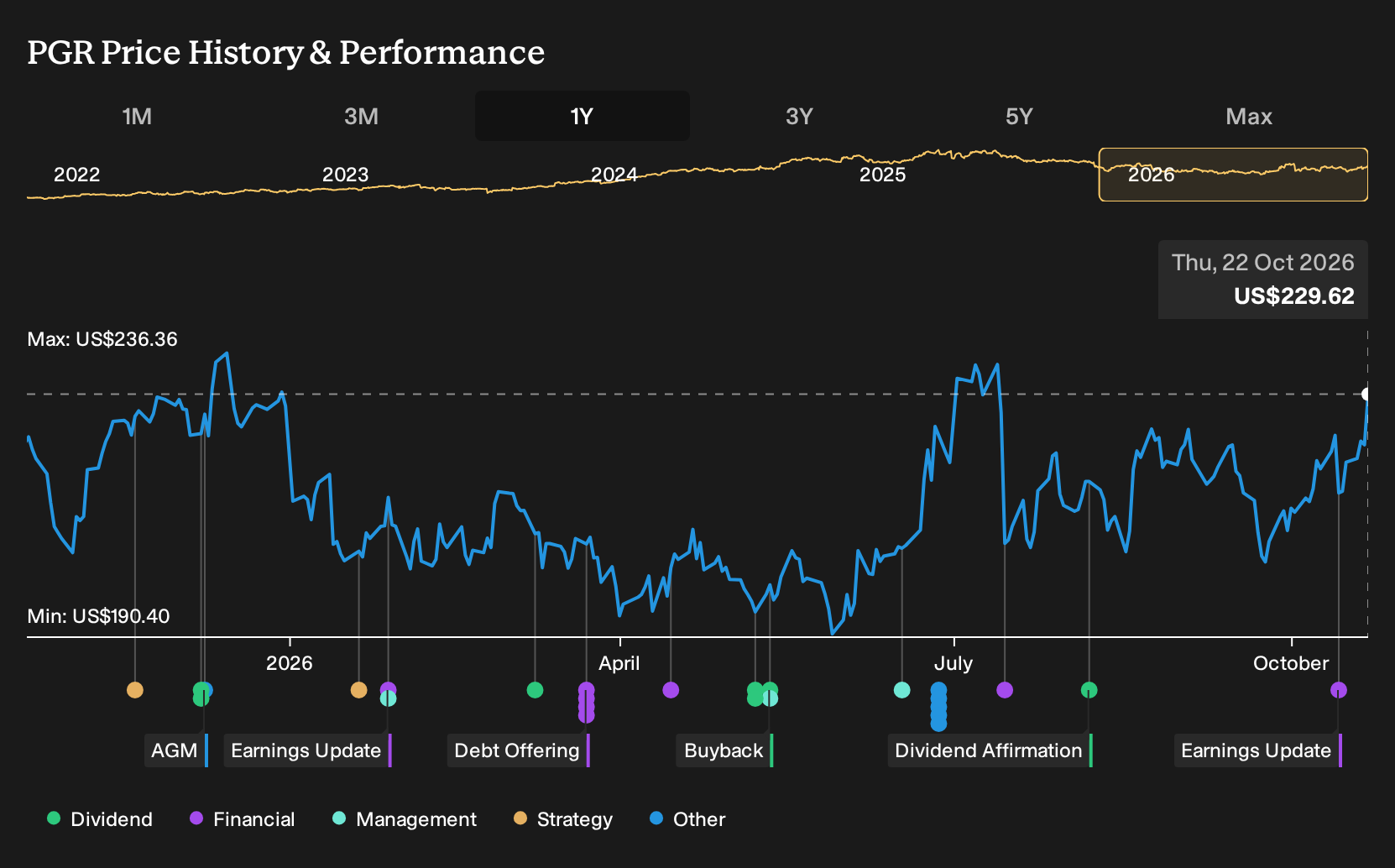
Exploring Other Perspectives
Some of the most optimistic analysts on Progressive focus less on claim cost pressure and more on the potential upside from bundling. Before this latest earnings release, the bullish group was working off revenue projections of about US$105.0b and earnings around US$9.4b by 2029. That is a very different tone from the more cautious consensus. These views have not yet absorbed the fresh profit numbers you just saw. Opinions may change as new data feeds in. Use that spread in expectations as a reminder to compare several viewpoints before deciding how Progressive fits your own portfolio plans.
Explore 3 other Progressive fair value estimates, including one that suggests as much as 103% potential upside from the current price.
Form Your Own Verdict
Don't just follow the ticker. Dig into the data and build a conviction that's truly your own.
- A great starting point for your Progressive research is our analysis highlighting 2 key rewards and 3 important warning signs that could impact your investment decision.
- See our latest analysis for Progressive. The report includes a comprehensive fundamental analysis summarized in a single visual, the Snowflake, making it easy to evaluate Progressive's overall financial health at a glance.
Looking for more investment ideas beyond Progressive?
Once you have a view on Progressive, it can help to line it up against a wider watchlist built around the traits you care about most, whether that is income, value, or financial resilience.
- If you want income potential with higher yields, scan companies in the 6 dividend fortresses that combine strong payouts with supporting fundamentals.
- For investors focused on quality at a reasonable price, review the 29 high quality undervalued stocks that filters for solid businesses trading at what may be discounted valuations.
- If balance sheet strength is your starting point, build a shortlist from the list of solid balance sheet and fundamentals (26 results) to see which stocks pair financial resilience with sound fundamentals.
Have feedback on this article? Concerned about the content? Get in touch with us directly. Alternatively, email editorial-team@simplywallst.com