
After Blackstone ignited the AI chip financing frenzy, a trillion-dollar bond market map surfaced! The AI bull market ushered in the ultimate test of “credit and cash flow”
The unprecedented global AI computing infrastructure craze is turning the “future AI computing power resource revenue prospects” into a powerful financing capability to purchase AI chips today, and completely connecting chip manufacturers and cloud computing vendors with Wall Street creditors. At the time, Kuroishi was able to single-handedly promote the expansion of a financing model that used AI chips as collateral and used cash flow from customer computing power contracts to repay debts. This kind of “AI chip-backed debt” covers private equity loans, bank financing, and leveraged loans; bonds are only one possible form.
In 2023, private equity supergiant Blackstone (Blackstone) took the lead in providing a $2.3 billion loan to AI cloud leader Coreweave, which became an early model for chip mortgage financing; today, this market is growing to a trillion dollar scale. Large customer procurement contracts provide repayment cash flow, and underlying computing power clusters such as AI chips provide collateral assets — that is, the borrower uses computing equipment such as GPUs purchased and held as collateral for loans, and AI chip vendors such as Nvidia, Broadcom, and AMD provide further credit support. But when energy inflation, a surge in US bond yields led to a rise in capital costs, and a simultaneous rise in the global supply of new bonds, the market began to re-measure whether these future revenues can be paid on time, and who will ultimately bear the losses if they are insufficient.
Under normal circumstances, it depends on the computing power service fee or equipment rent paid by the customer to repay principal and interest; if the borrower breaches the contract, the lender can dispose of the collateral equipment in accordance with the contract and legal procedures and recover the funds through sale or re-lease. The recovery amount depends on the value of the equipment at the time. The revenue generated by customer contracts provides cash flow for debt repayment, and equipment such as GPUs provide collateral guarantees, and the sustainability of financing mechanisms unique to the AI era where suppliers such as Nvidia and Broadcom provide additional credit support for some transactions. As AI financing costs rise, the market is increasingly concerned that AI infrastructure projects will not be able to earn a positive return on investment exceeding financing costs after covering investment and operating costs. This mechanism seems to have recently been heavily questioned in the financial market.
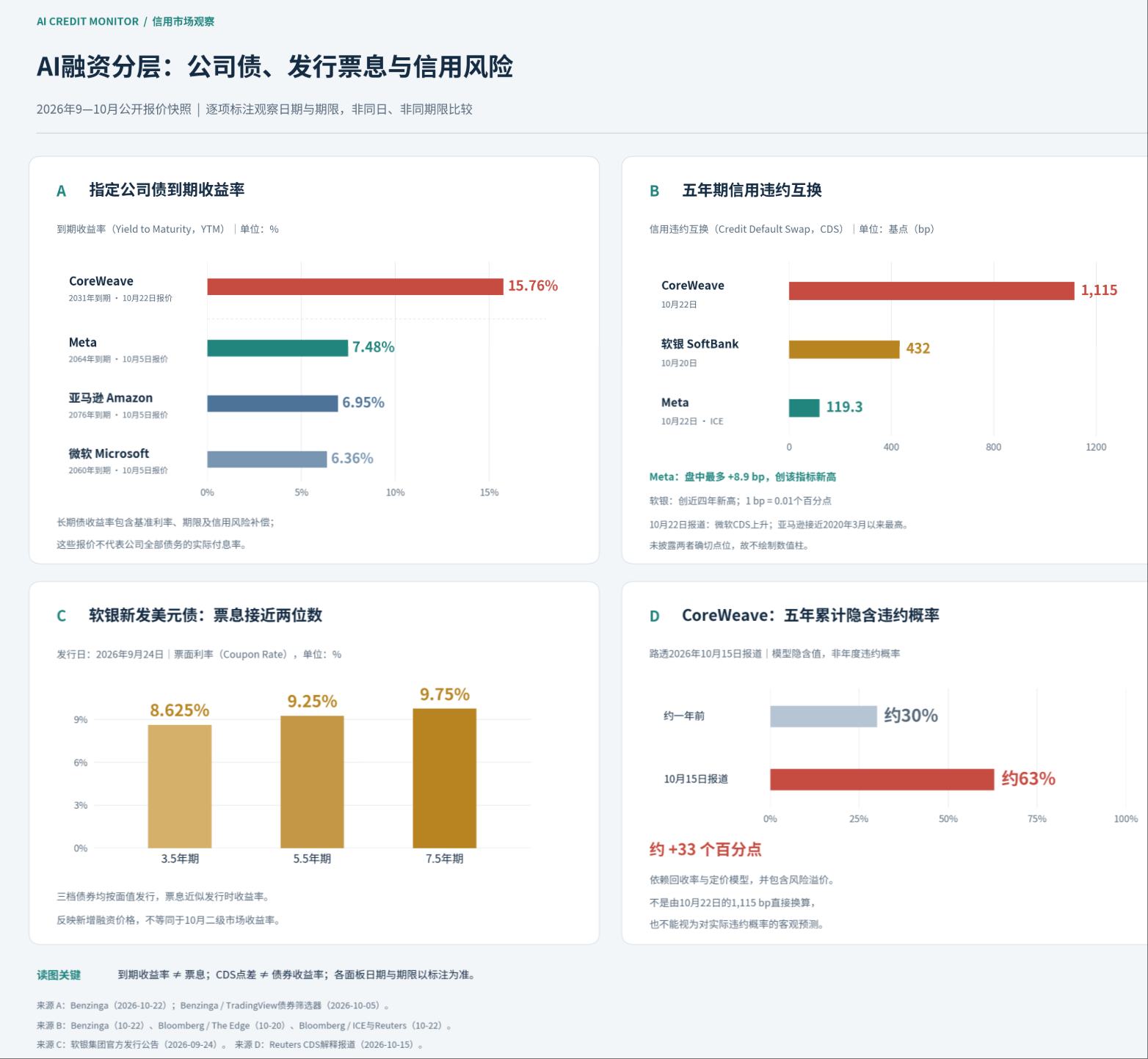
CoreWeave (CRWV.US), which is at the core of the “AI computing power sell-off storm” and the “AI bubble bursting argument,” has continued to be under the double pressure of company-level credit risk and continued financing needs recently. According to media reports on October 22, the yield on its 2031 bond is about 15.76%, and the five-year credit default swap (CDS) is about 1,115 basis points, which means that the relevant pricing corresponds to a 5-year cumulative implied default probability of about 63%, compared to about 30% a year ago. This probability includes recovery rate assumptions and risk premiums, and cannot be directly understood as actual default predictions.
The AI financing pressure on Japanese investment giant SoftBank, which has almost ALL-IN betting on the AI wave in recent years, is also specific — the three-tier US dollar bonds issued in September reached 8.625%, 9.25%, and 9.75%, respectively; the five-year CDS rose to 432 basis points on October 20, the highest in nearly four years; the former shows that additional capital is already expensive, while the latter reflects the market's demand for higher credit compensation.
Even those high-rated tech giants have been severely impacted by rising AI financing costs. On October 22, ICE data showed that Meta's five-year CDS rose to about 119.3 basis points in the intraday period, expanding by up to 8.9 basis points. Its bonds weakened simultaneously compared to US debt; Microsoft CDS also rose, and Amazon-related indicators were close to the highest level since March 2020. In terms of cash bonds, the clear quote on October 5 shows that the maturing yields of Microsoft's 2060 maturing bonds, Amazon's 2076 maturing bonds, and Meta 2064 maturing bonds are about 6.36%, 6.95%, and 7.48%, respectively. It should be noted that these are secondary market quotes for long-term bonds with different maturities. They reflect the combined effects of the sharp rise in 10-year US bond yields and credit premiums, and do not represent the actual interest rate of the company's entire debt.
For high-rated tech giants such as Amazon, Microsoft, and Google, the financing pressure associated with AI infrastructure is mainly reflected in the need to issue additional bonds to generate more revenue, long-term promises to squeeze future cash flow, and credit support that may be converted into actual expenses.
Earlier, in the July AI sell-off, Goldman Sachs analysts had discovered that Amazon's $25 billion issuance boosted the spread on one of its existing 30-year bonds by about 20 basis points. At the same time, US bond yields have not always risen: on October 23, Brent crude oil rose to about $114, but safe-haven purchases have pushed US bond yields below 5%. Declining US bond yields of 10 years or more can occur simultaneously with widening credit spreads for technology companies. Therefore, whether the AI financing environment can be improved requires both to have a positive impact.
Blackstone opens the door to AI chip financing, and Wall Street bets on computing power as an asset
“What is a GPU?” Blackstone Group executives asked CoreWeave management at the time. They also asked, “Is AI real?”
At a time when the AI boom is just beginning and CoreWeave is still a little-known AI cloud company looking for core purchase capital, these questions make perfect sense. Convinced by the answers, Blackstone's Tactical Opportunities team spearheaded a $2.3 billion private equity loan in 2023.
It was the first major transaction of this type of financing and became a model for chip-backed debt financing. Today, three years later, this market is growing to a trillion dollars, and will even exceed the amount of loans to build data centers to house these chips.
This shows how closely the global AI expansion has become linked to the credit market in such a short period of time. Just this week, Blackstone President Jon Gray described AI demand as growing almost “parabolic”. But CoreWeave also reflects market anxiety over the huge amount of money pouring into the sector — in recent weeks, its stocks and corporate bonds have plummeted, and investors are questioning whether AI revenue can actually justify such an astonishing investment.
Expected growth in this market has attracted the participation of almost all major US banks and alternative asset managers, and has also received back-up support from AI chip makers Broadcom and Nvidia. The combined market value of the two companies is about 7 trillion US dollars.
Broadcom is collaborating with Wall Street agencies to plan a $60 billion debt financing deal for a special entity that will buy a chip called a Tensor Processing Unit (TPU) and rent it to Anthropic. Meanwhile, SpaceX is in talks to raise $40 billion to buy Nvidia chips. Earlier, Nvidia announced a $500 billion partnership with six major lenders to help customers buy their graphics processing units (GPUs).
Such a large scale of expenditure may make the debt market dependent on the profitability of AI. In the context of rising interest rates, technology companies compete for limited capital, and this financing torrent may also drive up borrowing costs in AI and other industries. J.P. Morgan analysts expect chip spending by 2030 could exceed $3 trillion, most of which could be raised through borrowing.
Jason Pompey, senior director of Fitch Ratings, said: “Supplier financing is being carried out on an unprecedented scale and in a way that concentrates risk. This only increases the possibility that if AI ultimately disappoints, the impact will affect the entire supply chain.”
This strategy is based on the belief that demand for computing power will continue to exceed supply for many years to come.
Rich Myers, head of global structured products and private equity capital markets at Morgan Stanley, said, “This financing relies on the most valuable thing in the market, that is, the computing power provided by chips. There is plenty of evidence that demand for computing power will continue to grow, and the growth rate is outpacing the supply of computing power.”
However, there are still risks as to whether infrastructure construction can maintain this trend.
Opposition from local residents prompted Texas to suspend new data center projects; at the same time, Oracle has taken steps to delay payment for a New Mexico project that has been hampered by regulations. Following a series of incidents, OpenAI and Anthropic are also discussing slowing down the pace of launch due to concerns about safety and survival risks.
However, large expenses are already locked in very large data centers under construction, and demand for chips will occur when these facilities go online. Since most of the supplier's production capacity has been sold out, and severe memory shortages are driving up costs, companies that produce servers equipped with Nvidia's AI chips informed customers in August that the prices of many products will rise by more than 15%.
John Watson, senior managing director of the Blackstone Tactical Opportunities team, said: “This is a new area in the economy that requires an orderly financing mechanism.”
According to Watson, this is similar to the uncertain stage in the early days of the automobile industry and the situation where Ford introduced the T-model to the mass market.
In a recent interview, he said, “If you were financing the Ford Model T at the time, you would also ask, 'What am I really doing? Can people actually drive cars? ' Today, the auto finance market is mature, stable, widely understood, and large-scale. The car became the most purchased machine in the US. We have a similar vision of computing power.”
Chips, contracts, and credit support, how to allocate huge amounts of financing
The reality driving these capital requirements is that chips cost two to four times more than the data center that houses them, but the depreciation period is about five to six years.
For example, in the flagship project of AI cloud service provider nScale in West Virginia, the supporting power plant is estimated to cost 6.5 billion US dollars, and the data center and equipment will require an additional 18 billion US dollars. GPUs, on the other hand, cost $47 billion.
Cloud computing giants with investment-grade ratings — Google, Microsoft, Amazon, and Meta under Alphabet — mainly cover these hardware expenses through cash or low-cost debt financing included in the company's balance sheet. However, OpenAI and Anthropic, which are consuming billions of dollars, neither have such financial reserves nor the same debt market financing capabilities. The same goes for new cloud vendors that specialize in providing cloud computing services for AI.
Mike Liberato, head of business finance at OpenAI, said: “The scale of infrastructure construction is unprecedented. There are no ready-made models for how to go from zero to AGI and raise capital through traditional methods in such a capital-intensive business.” Here, AGI refers to Artificial General Intelligence (Artificial General Intelligence).
As a result, the industry has drawn on and adapted project financing and structured finance mechanisms. By establishing a special purpose vehicle (SPV) to isolate the assets, liabilities, and risks of each transaction, financiers can raise debts based on the terms of the transaction itself and the customer's credit quality, and often do not include them in the balance sheet of the relevant company.
The one that borrowed money to buy and hold the chip was SPV. The debt is supported by the cash flow generated by the target customer and the value of the chip itself; this cash flow is used to pay interest and gradually pay off the entire debt over time.
By matching the debt period with the chip's estimated depreciation schedule of five to six years, lenders can prevent the risk of hardware depreciation.
Currently, two main models have been formed: one is for customers to rent chips from SPVs and connect them to their own technology stack (Technology Stack); the other is for new cloud vendors to sell computing power to customers and use debt financing to buy chips to build the infrastructure required for this service.
Broadcom and Nvidia have gone one step further, providing underwriting arrangements for multi-billion dollar deals and promising to support lenders when issues arise. This matches the credit rating of the relevant debt with the chipmaker's investment-grade credit profile, thereby reducing the cost of SPV borrowing.
A representative from Broadcom declined to comment, and a representative from Nvidia did not comment either. Executives from the two companies said earlier that they believe the risks associated with these financing structures are limited.
To access the largest pool of funds, especially insurance funds, investment grade ratings are critical.
Chris Edson, head of global business development at Apollo Global Management, said that the scale of digital infrastructure financing has exceeded the funding that can be provided by the traditional open debt market, and requires market participation in project financing, private equity, insurance, and commercial real estate.
He said, “We have always focused on high credit quality investment opportunities to reduce risk through collateral guarantees, installment repayment of principal, minimal or non-existent residual value risk and contract renewal risk, diversification, and high credit rating offenders.”
CoreWeave, which has a junk rating and never conceals hope to upgrade to investment grade, was founded in 2017. It initially engaged in cryptocurrency mining, then quickly switched to selling AI computing power with GPU experience. As Microsoft sought more GPU resources to support partner OpenAI, the tech giant became CoreWeave's biggest customer.
To pay for chip purchases, the founders of CoreWeave drew on past experience in the commodities sector. They have transformed a model commonly found in markets such as liquefied natural gas (LNG): customers first sign contracts, then developers use these agreements to obtain debt financing needed to build facilities.
The first debt financing in 2023 was supported by a Microsoft contract, and CoreWeave undertook a high borrowing interest rate of about 10% to this end.
Branning McBee, co-founder of CoreWeave, recalled, “It was the most challenging due diligence I've ever experienced in my life.” He also described the questions Kuroishi raised with the company at the time.
As CoreWeave successively signed on to other clients, the company moved from private equity credit transactions to lower-cost bank financing. CoreWeave first experienced the sweetness of investment-grade funding in March, when it received a $8.5 billion round backed by a Meta contract. Wall Street assessed the risk of the deal based on Meta's high credit rating rather than CoreWeave's junk rating, which reduced borrowing costs to around 6%.
Other companies are starting to emulate CoreWeave. Last year, Elon Musk's xAI needed to buy Nvidia chips to equip its Colossus 2 data center, and raised capital through SPV, which included equity investments led by Valor Equity Partners. Apollo provided nearly $11 billion in debt financing for the deal.
Apollo and Blackstone recently closed a $35 billion debt deal called “Big Sky” to support Anthropic. This is the first deal for the AI XPV platform jointly established by Broadcom, Apollo and Blackstone. The platform is capable of supporting 20 gigawatts of computing power; Bank of America strategists estimate that this may require $235 billion in back-backed debt financing by mid-2029.
The deal established a special financing entity that would borrow money to buy the chips and then rent them out by Anthropic. Broadcom provides back-up support, meaning that if Anthropic defaults, the chip will be re-leased or sold to repay the remaining debt, while the chipmaker is responsible for making up the difference.
This support gave two priority Broadcom-supported grades of the financing vehicle an investment grade rating. Among them, the largest tier pays an interest rate of 5.75%, which is lower than the cost Anthropic can obtain from its own financing as an unrated private company; the lower tier, which is more risky and has a scale of 4.5 billion US dollars, is priced at an interest rate of 8.5%.
Ross McAdam, head of American alternative debt at L&G Asset Management, said: “There may be many risks in this industry, but some financing structures can mitigate these risks better than others.”
In August, Nvidia convened a strong coalition of Apollo, Blackstone, Blackstone, Brookfield Asset Management, KKR, and Goldman Sachs to raise financing for AI infrastructure; Nvidia will provide up to 25% underwriting support for individual financing projects.
Bloomberg reported this month that Broadcom has begun preliminary discussions to consider arranging financing to help OpenAI purchase customized chips jointly developed by the two parties.
However, to truly scale up, the industry needs to shift from a private equity market to a debt financing market where banks underwrite and distribute them to institutional investors; in this market, banks arrange bonds and loans and then sell them to institutional investors for them to trade. Earlier this year, CoreWeave pioneered the market through chip financing deals, and two leveraged loans garnered strong demand from investors.
But the ultimate goal is to allow these SPV structures to enter the much larger investment-grade bond market — one of the deepest and lowest-cost pools in the world.
This financing innovation lowered the funding threshold for some projects, and also made risk more concentrated on a small number of counterparties.
Broadcom's support mechanism is: after the customer defaults, the chip is first sold or re-leased to repay the debt, and then the agreed gap is filled. If industry demand, rent, and chip residual value weaken at the same time, customer solvency and collateral value may decline simultaneously, and the risk will be passed back to the guarantors. Matching the loan repayment schedule with a depreciation cycle of five to six years can reduce residual value exposure, but what really supports the debt is the continuous charge for computing power after it goes online. As a result, the value of the investment depends more on customer credit, project delivery, contract execution, and cash recovery rather than simply looking at the total contract amount.
The decline in bonds reveals credit risk, and AI computing power capitalization forces are still trying to expand financial rules
CoreWeave company-level junk bonds have recently been hit. Some bonds have fallen to about 80 cents per dollar face value, and yields have been pushed up to about 15%. Investors are worried that their debt will continue to expand. However, the market views its two chip-backed leveraged loans differently. The prices of both loans declined slightly, but were still close to face value.
Following the sell-off, CoreWeave CEO Mike Interrato issued a statement to Bloomberg saying that building a new technology company meant that the market sometimes needed to digest and clarify issues related to AI adoption.
He said, “This kind of review is important, but it's also important to recognize that each company's technology, customer commitments, financing structures, and execution records are different. We are confident in our business model, technology, quality of execution, and the continued strict discipline that underpins our financial system.”
As capital flows in, lenders are also facing risks. Since most chip financing is a private equity transaction, it is difficult for investors to easily sell their claims, and these deals have tied a small number of chip makers, cloud computing giants, and new cloud companies. This leaves investors with a highly concentrated risk exposure to a small group of interconnected businesses.
Dave Snyderman, managing partner and global head of alternative credit and fixed income at Magnetar, said: “Big companies will get bigger. Existing leaders are likely to win because only they have access to capital.”
Another risk that lenders face is how strong customer contracts are. Protective clauses in contract documents may not be as indestructible in practice as one might think — this has already happened in riskier credit markets. If AI returns disappoint, tech companies may use their influence to force lenders and new cloud companies to renegotiate deals or leases.
Akil Bansal, head of asset-backed finance at Carlyle Group, said that everyone assumed these contracts were strict and unbreakable, but “I'm looking at the actual situation. If seven companies are essentially providing all the credit support needed for GPUs, who has the bargaining advantage?”
Complexity has left some investors choosing to wait and see. Laura Parrott, head of private fixed income at Nuveen, said: “It's a novel structure. We haven't seen how it works once there's some kind of disturbance.” She added that until the market develops further, she will not be providing loans to these large chip deals that have received investment grade ratings for the time being.
As the chip market develops and the underlying chip architecture technology is updated and iterated, the mechanisms used for hardware financing will also evolve. Early research and actual usage to date suggest that chips can be used for longer than current accounting treatment suggests, which will make it easier for them to obtain financing.
Fang Fang, head of global infrastructure and sustainable finance at Bank of America and co-head of the Global Capital Solutions team, said that the semiconductor market may develop a system similar to the “Kelly Blue Book” for valuations of new and used cars, thus promoting the development of the chip trading and hedging market.
“Once we have accumulated enough chip history data and usage records, we will begin to see a more mature rental market,” she said.
Once OpenAI and Anthropic go public, it may also become easier to raise chip debt financing, especially if they can get investment-grade ratings and organize their own financing deals.
Blackstone's Watson said that the ultimate goal of Nvidia, Blackstone, and their Wall Street peers is to turn a unit of computing power into an asset class so that people around the world can “finance computing power because we understand the economic value of computing power.”