
Monogatari (TSE:3097) Posts Stronger Restaurant Sales, Is The Upside Already Priced In?
Monogatari (TSE:3097) released unaudited sales figures for September 2026 and the first quarter, showing net sales from all restaurants at 110.3% for the month and 112.0% for the quarter compared with a year earlier.
Recent trading reflects that sales update. Monogatari’s share price is now ¥6,020, with a 30-day share price return of 12.95% and a year-to-date share price gain of 39.35%. The 1-year total shareholder return of 54.62% points to strong longer term momentum.
Scan how Monogatari’s recent momentum compares with other consumer-focused stocks that currently screen as 72 high quality undiscovered gems in this corner of the market.
After a 39.35% gain this year and with fresh sales data in hand, Monogatari is no longer an overlooked small cap. Do current levels still leave enough upside to justify the risk?
Price-to-Earnings of 26.4x: Is it justified?
On recent prices, Monogatari trades on a P/E of 26.4x, which puts a clear premium on the shares compared with the JP Hospitality industry and the stock’s own estimated fair P/E level.
The P/E ratio compares the current share price to earnings per share. For a restaurant chain like Monogatari, it effectively tells you how much investors are paying for each unit of current profit, which is often linked to expectations around growth, brand strength and the stability of future cash generation.
Recent fundamentals give some context for that premium. Earnings grew 42% over the past year and have compounded at 21.8% per year over five years, while net profit margins improved from 5.0% to 5.8% and earnings are forecast to grow around 9.9% per year. Those figures, along with high quality earnings and a return on equity of 18.4% that is below a 20% benchmark, suggest the market is willing to pay up for a business that has grown quickly but is now expected to expand at a more moderate pace. At the same time, the estimated fair P/E of 23.4x implies investors are paying more than the level that regression analysis suggests the market could gravitate toward over time.
Compared with peers, the picture is mixed. The current 26.4x multiple is higher than the JP Hospitality sector average of 21.9x, which means Monogatari is valued more richly than the broader industry, yet it is lower than a 67.5x peer average, indicating that within a narrower comparison set the stock is not the most aggressively priced. The tension between a P/E above both the industry and a fair value estimate, and below a much higher peer group multiple, leaves investors weighing how much confidence to place in continued earnings growth versus the risk of that premium compressing if expectations cool.
Explore the SWS fair ratio for Monogatari.
Result: Price-to-Earnings of 26.4x (OVERVALUED)
Still, the story can change quickly if Monogatari’s premium P/E meets weaker earnings delivery, or if Japan’s consumer spending backdrop softens from here.
Find out about the key risks to this Monogatari narrative.
Another View: What Monogatari’s Cash Flows Say
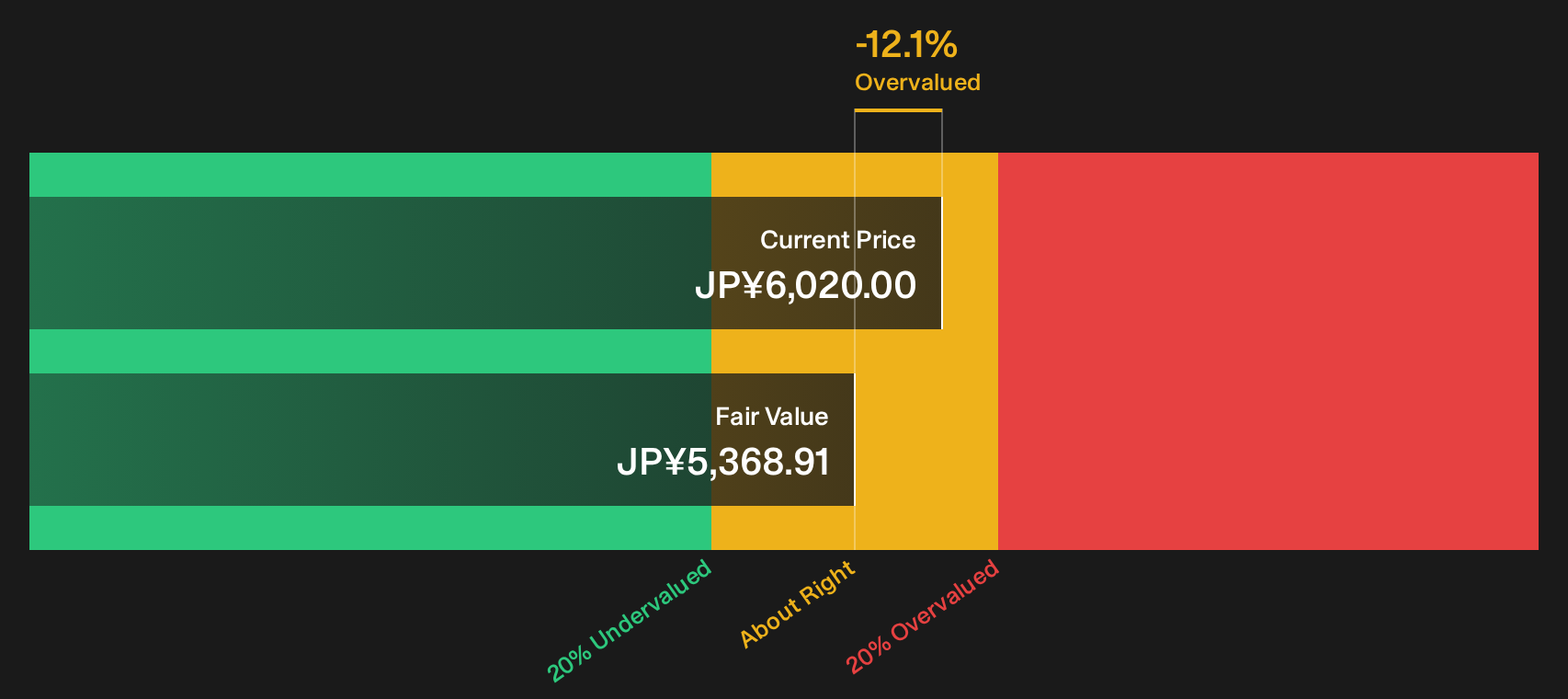
A second lens on Monogatari comes from our DCF model, which estimates future cash flow value at ¥5,368.91 per share against a market price of ¥6,020. On that basis the stock screens as expensive, so the question is whether current enthusiasm is running ahead of the cash flows.
For investors who want to see how this plays out across the full valuation framework, including the detailed cash flow assumptions, Look into how the SWS DCF model arrives at its fair value.
Simply Wall St performs a discounted cash flow (DCF) on every stock in the world every day (check out Monogatari for example). We show the entire calculation in full. You can track the result in your watchlist or portfolio and be alerted when this changes, or use our stock screener to discover 15 high quality undervalued stocks. If you save a screener we even alert you when new companies match - so you never miss a potential opportunity.
Next Steps
Sentiment around Monogatari is punchy right now. If you want to move quickly, stress test the upside story and then weigh the 2 key rewards
Looking for more investment ideas beyond Monogatari?
Do not stop with a single stock when the rest of the market is full of opportunities that match different risk levels, income needs and balance sheet preferences.
- Target consistency by hunting for resilient businesses that come through with fewer shocks using the 22 resilient stocks with low risk scores.
- Chase quality at a reasonable price by scanning for companies that combine strong fundamentals with attractive valuations through the 15 high quality undervalued stocks.
- Build a sturdier portfolio foundation by focusing on financially sound enterprises using the list of solid balance sheet and fundamentals (23 results).
Have feedback on this article? Concerned about the content? Get in touch with us directly. Alternatively, email editorial-team@simplywallst.com