
Is Packaged Contractor Coverage Altering The Investment Case For Markel Group (MKL)?
- Markel Insurance, part of Markel Group, has launched a Contractors & Trades sector that bundles casualty, property and specialist liability cover with access to ARAG legal and risk management support for construction related businesses.
- The focus on packaged coverage for multi line contractors and trades signals Markel Group’s push to deepen specialty insurance offerings as it reshapes its underwriting portfolio after exiting loss making global reinsurance activities.
- The next area of attention will be how Markel Group’s investment narrative is influenced by this bundled contractors offering and the added legal support.
Markel Group Investment Narrative Recap
To own Markel Group, you need to believe its three engine model of specialty insurance, public equities and operating businesses can keep compounding value even as earnings are forecast to decline 3.3% a year over the next three years. The short term swing factor is whether the refocused insurance franchise can keep underwriting discipline tight while premium volumes reset.
The biggest risk remains legacy and runoff exposure in discontinued or challenged lines, where further reserve strengthening could hit combined ratios and net income. The Contractors and Trades launch looks directionally aligned with the specialty pivot but does not, on its own, materially shift near term earnings risks.
The most relevant fresh datapoint for this Contractors and Trades move is the upcoming Markel Group earnings call on 29 October 2026. That discussion should give you clearer colour on how management sees the new sector fitting into the 14 business unit structure and whether it is already influencing underwriting mix or expense trends.
Listen for practical markers: how quickly this packaged offering is scaling, how loss experience compares with legacy books, and what it implies for capital freed from global reinsurance runoff. Those details tie directly into the key catalysts analysts watch, from combined ratio stability to the capacity for ongoing share repurchases and non insurance reinvestment.
Markel Group Forecasts Behind the Contractors Push
Markel Group's new Contractors and Trades package drops into an earnings backdrop that already bakes in slower profit and modest top line expansion. Analysts are working off revenue growth assumptions of 2.7% a year and lower profit margins, so this sector launch is being judged on whether it can support quality of earnings rather than chase raw volume.
Consensus numbers today point to earnings of US$2.3b and an expected outcome of US$2.1b by 2029. That is a projected decline of US$0.2b in profit over the forecast window, even as the business mix tilts further toward specialty underwriting such as the Contractors and Trades offering and fee based legal support partnerships.
Markel Group's narrative projects US$18.0b revenue and US$2.1b earnings by 2029. This assumes 2.7% yearly revenue growth and an earnings decline of US$0.2b from US$2.3b today.
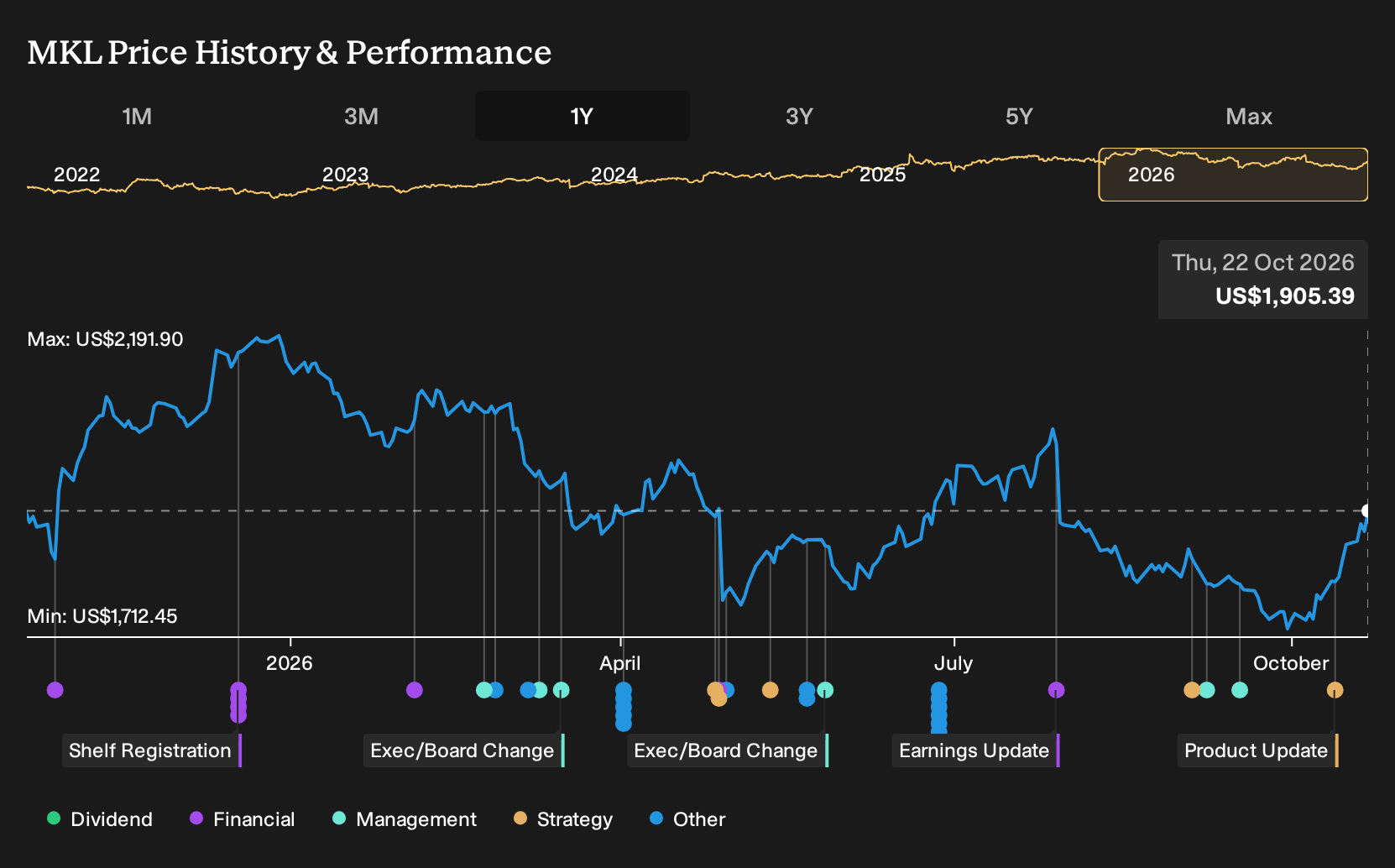
Uncover why Markel Group's fair value indicates a 3% potential upside to its current price that could narrow quickly.
Exploring Other Perspectives
The Simply Wall St Community only has two fair value views on Markel Group so far, with estimates spread between about US$1,332 and US$1,956 per share. That thin but wide range underlines how far opinions can stretch. Consider legacy reserve risks and the October 29 earnings call catalyst, then explore more community viewpoints before leaning on any single number.
Explore another Markel Group fair value estimate, including one that suggests it could be worth as much as $1,956.
Reach Your Own Conclusion
Don't just follow the ticker; dig into the data and build a conviction that's truly your own.
- A great starting point for your Markel Group research is our analysis highlighting 2 key rewards and 1 important warning sign that could impact your investment decision.
- See our latest analysis for Markel Group. The report includes a comprehensive fundamental analysis summarized in a single visual, the Snowflake, making it easy to evaluate Markel Group's overall financial health at a glance.
Looking For More Investment Ideas Beyond Markel Group?
Markel Group may suit a certain type of portfolio, but your watchlist will usually be stronger when it blends different income profiles, balance sheet strengths and risk levels. Put the Markel thesis in context by lining it up against a broader universe of stocks using the Simply Wall St Screener.
- If capital preservation is front of mind, start with companies that pair financial resilience with measured upside through a 30 resilient stocks with low risk scores.
- For investors hunting for quality at a reasonable price, compare Markel Group with a 29 high quality undervalued stocks that share solid fundamentals and potential mispricing.
- Income focused portfolios might benefit from adding reliable payers alongside Markel Group, so scan a 6 dividend fortresses that combine higher yields with more robust coverage metrics.
Have feedback on this article? Concerned about the content? Get in touch with us directly. Alternatively, email editorial-team@simplywallst.com