
S&P rewrites stock classification rules! The capital of 375 billion US dollars may be forced to adjust positions in growth stocks and value stocks to welcome a “major reshuffle”
The Zhitong Finance App learned that after S&P Dow Jones Indices adopts new stock classification rules, growth stocks and value stocks will usher in a reshuffle. According to a statement issued by the index provider on Friday, S&P will include intangible assets, expected profits, and free cash flow in an index system to determine whether a company is cheap compared to its stock price. Meanwhile, the 12-month price momentum, a measure of a company's growth potential, will be eliminated. These new rules were introduced after a recent consultation process and will officially take effect during the annual index restructuring before the market opens on December 21.
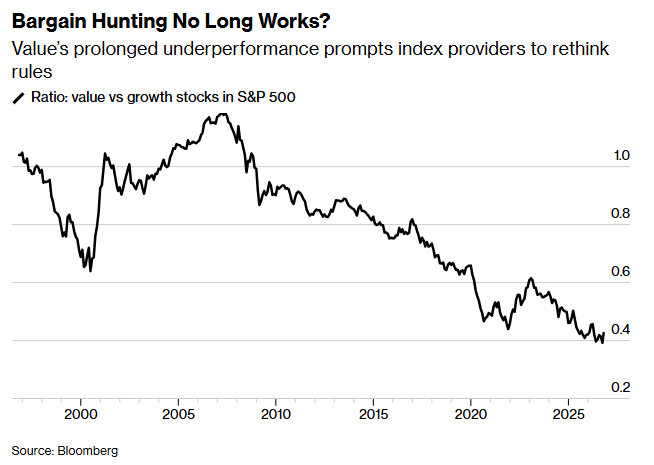
Long-term poor performance of value stocks has prompted index providers to rethink relevant rules
This adjustment may force funds tracking the relevant index to adjust their positions to match the new index constituents. Bloomberg Intelligence analyst James Seyffart estimates that at least $375 billion in passive funds are linked to affected indices.
S&P's decision stemmed from an ongoing debate over whether traditional measures of value stocks are still valid. Researchers and fund managers believe that part of the long-term downturn in value stocks is due to flaws in relevant metrics, particularly price-to-book (price-to-book).
The purpose of this adjustment is to take into account the company's expenses on R&D and other internal development assets, and according to normal accounting rules, these expenses are often included as expenses rather than assets on the balance sheet. Critics say this will make IP-intensive companies look expensive to value, which may prevent these companies from being included in the value stock index.
S&P isn't the only index provider considering adjusting the rules. FTSE Russell is also reconsidering how growth stocks and value stocks each account for 50% in its benchmark index due to the increasing dominance of tech giants in the market. The call for comments will end on December 11.