
AT&T Stock and 2 Wireless Rivals Facing the Starlink Threat
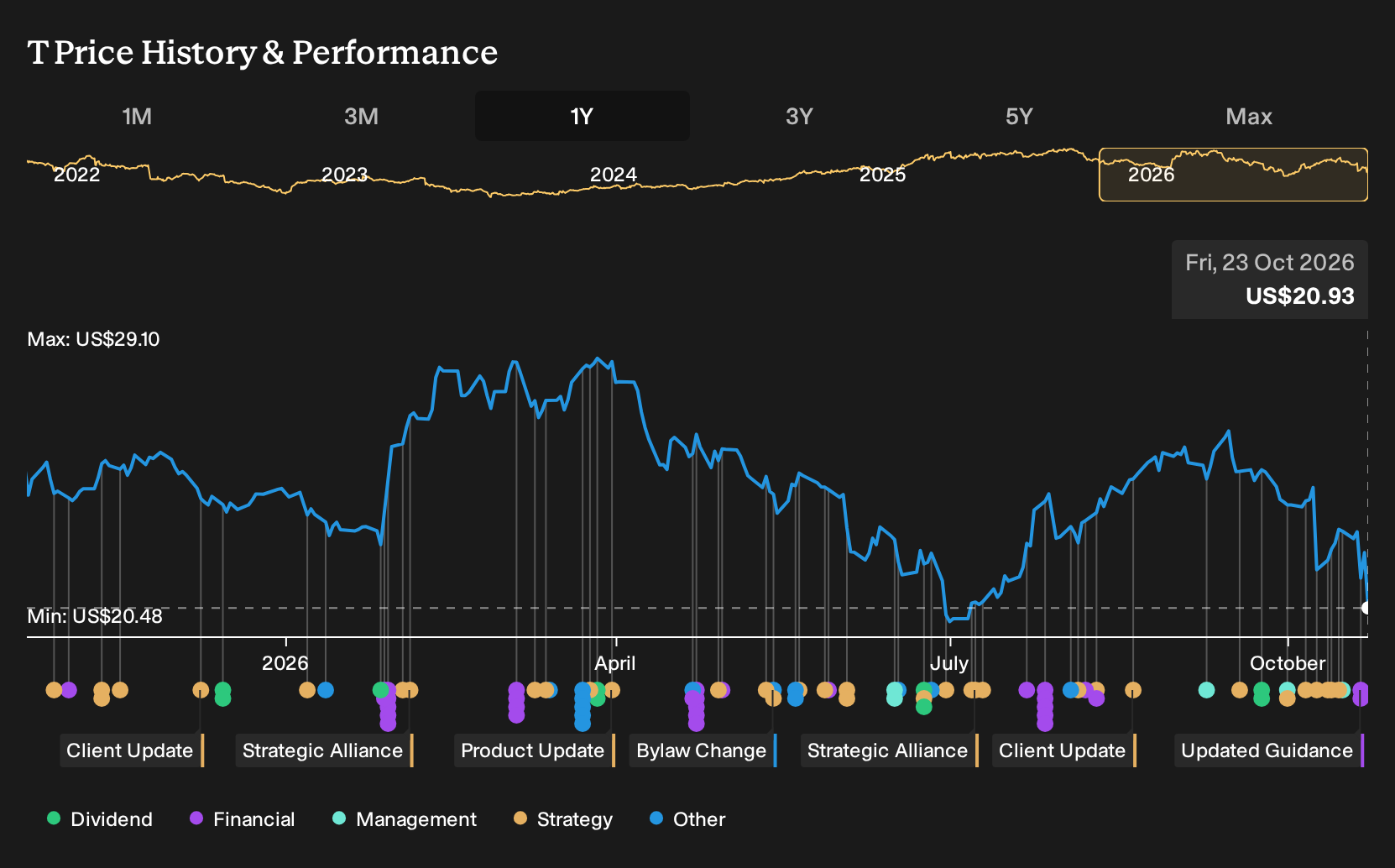
Starlink’s push into mobile and the sharp 8% slide in AT&T stock have turned a sleepy corner of telecom into a live stress test for old guard networks. Disruption risk is rising, but so is the chance to reassess where durable cash generation and pricing power might still sit. This article breaks down how that tension plays out in three U.S. incumbents directly exposed to the Starlink news.
The companies discussed below are only a first slice of the opportunity set, and the broader screen surfaced 14 more large U.S. wireless and network infrastructure businesses with equally compelling but very different stories that are not covered here.
If you want to identify your own potential winners in this corner of telecom, head straight into the U.S. Incumbent Wireless Carriers and Network Infrastructure screener to filter, analyze, and focus on the highest-conviction plays.
T-Mobile US (TMUS)
Overview: T-Mobile US is a large wireless carrier providing mobile connectivity, broadband and devices across the United States, Puerto Rico and the U.S. Virgin Islands.
Operations: T-Mobile US generates all of its US$92.2b wireless revenue in the United States, reflecting a pure play on domestic connectivity demand.
Market Cap: US$170.3b
For this screener, T-Mobile US matters because it blends a nationwide 5G footprint with spectrum depth that can plug directly into emerging satellite tie ups and future connectivity models.
"Continued expansion of T-Mobile US 5G broadband and fiber offerings, with higher 2030 broadband targets and early fiber joint venture penetration around 20% in year one, indicates potential for additional service revenue as the broadband base scales."
What really shifts the story is how one unresolved competitive threat eventually feeds through into pricing power and long term margin resilience.
That long term pricing question is exactly what the full narrative for T-Mobile US tackles, spotlighting where T-Mobile US economics could decouple from legacy wireless peers.

AT&T (T)
Overview: AT&T is a large U.S. telecom group providing mobile, broadband, fiber, and enterprise connectivity that anchors traditional networks against emerging satellite competition.
Operations: AT&T generates about US$124.0b in adjusted segment revenue and US$4.9b from Latin America, reflecting a primarily communications focused model.
Market Cap: US$153.2b
AT&T sits right in the crosshairs of this screener theme, because its wireless network and fiber build are exactly what investors are reassessing as Starlink pushes harder into U.S. connectivity and forces a clearer view on which cash flows look most durable.
"Accelerated investments in 5G and fiber infrastructure, now supported by a multi year fiber supply agreement worth over US$3b and part of more than US$250b of planned U.S. network spending over the next five years, continue to expand AT&T's reach and are aimed at supporting recurring service revenue growth and future earnings power."
What happens to that reach and earnings power depends heavily on how one unseen pressure shapes the balance between pricing, churn, and margins.
That pressure point is exactly what the full narrative for AT&T unpacks, showing how AT&T’s heavy fiber spend could either accelerate pricing power or mask deeper churn risks.
Liberty Capital (GLIB.A)
Overview: Liberty Capital provides broadband, wireless, video, voice, and managed connectivity services across Alaska through its GCI brand for households and institutions.
Operations: Liberty Capital generates all of its US$1.0b communications services revenue in the United States, giving investors focused Alaska telecom exposure.
Market Cap: US$856 million
Liberty Capital brings the screener theme down to a single, concentrated region, giving you pure Alaska wireless and broadband exposure in a market where terrestrial networks and satellite partnerships are starting to blur together.
"Expansion of high speed broadband and DOCSIS 4.0 capable HFC upgrades in Anchorage and other markets increases available capacity and speeds, which can support higher broadband adoption, stronger customer retention and potential improvements in revenue per user, feeding into top line revenue and adjusted OIBDA."
The key question now is how one shift in customer behavior across that upgraded footprint ultimately feeds through into pricing power and long term margins.
As that behavior shift plays out, the full narrative for Liberty Capital lays out how Liberty Capital’s upgraded footprint could accelerate cash flow, pressure returns, or quietly reshape Alaska telecom economics.

Seeking Alternatives Before The Crowd
Fresh ideas often move first. Breakout stories can build momentum while prices are still under the radar for now. Consider acting before any potential edge is reduced, rather than waiting.
- Explore early-stage momentum with 7 elite penny stocks with strong financials that focus on smaller companies with solid financials, before larger investors pay closer attention.
- Track real-world AI adoption through 39 profitable AI stocks that aren't just burning cash where cash-generative businesses align machine learning spending with measurable results instead of emphasizing distant projections.
- Consider structural demand using 42 power grid technology and infrastructure stocks which filters for businesses involved in long-term grid upgrades while any pricing power implications may still be gradually reflected in the market.
Have feedback on this article? Concerned about the content? Get in touch with us directly. Alternatively, email editorial-team@simplywallst.com