
Does Sales Reset Change The Bull Case For Nike Stock (NKE)?
- Nike is confronting weaker sales and a softer profit outlook, with management intentionally shrinking some product lines and restructuring direct digital operations, particularly in Greater China.
- The business is trying to protect brand strength and long term efficiency through cost programs, AI driven quality control in factories, and a renewed focus on higher quality demand rather than discount driven volume.
- This article examines how Nike's investment narrative holds up as management leans on restructuring and cost savings to reset expectations.
NIKE Investment Narrative Recap
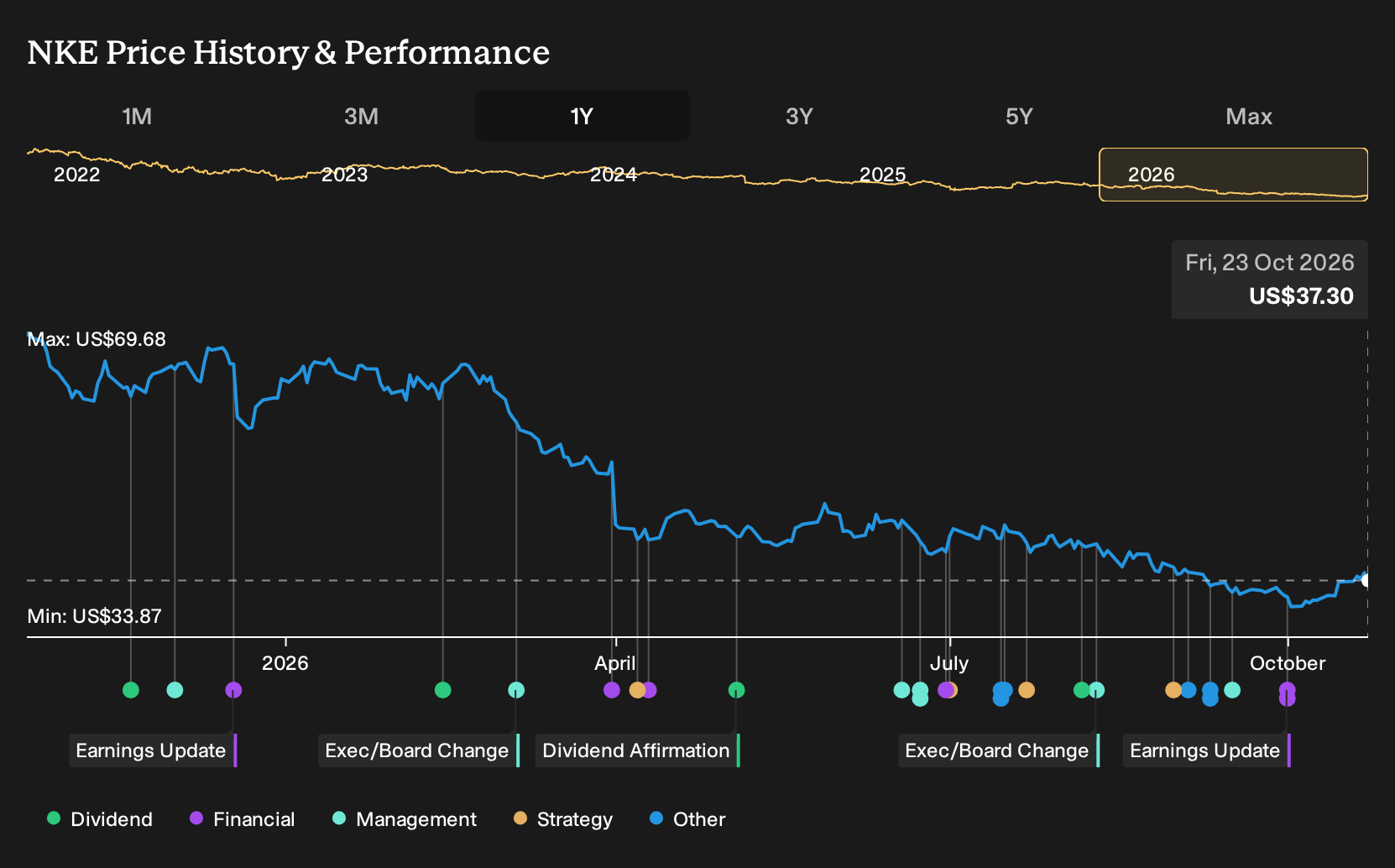
Nike’s reset asks you to back a business that is willingly shrinking lower quality revenue to protect its brand and margins, while near term sales and EBIT are expected to fall into fiscal 2027. The near term catalyst is clear: evidence that the Performance portfolio and premium channels can offset weakness in Sportswear, Jordan, and Greater China.
The biggest risk is that digital softness and lifestyle fatigue deepen in key regions, turning a reset into a longer earnings contraction while the dividend strains free cash flow. Recent guidance and restructuring updates already lean into this risk, so the impact of new headlines mainly reinforces, rather than changes, that core debate.
The most relevant recent development is Nike’s approval of Genon’s AI system to detect outsole defects, with an initial rollout in Indonesian factories from 2027. This ties directly into the Pace cost program and reflects how management is trying to tighten quality control while trimming less profitable demand and discount heavy channels.
If execution goes to plan, automated inspection can support fewer defects, lower rework, and more consistent product for full price channels. The operational catalyst to watch is not the technology on its own, but whether it contributes to the broader goal of cleaner inventories and better gross margins while sales are under pressure and investors scrutinise dividend coverage.
NIKE's current analyst narrative points to revenues of US$46.0b and earnings of US$3.5b by 2029, built on a flat top line over the next three years, profit margins rising from 6.7% today to 7.6%, and an earnings increase of about US$0.4b from US$3.1b now.
Uncover why NIKE's fair value aligns with its current price.
Exploring Other Perspectives
One alternate angle you might consider focuses on how far Nike’s earnings could fall if the reset drags. The most cautious analysts were modelling revenue slipping to about US$40.6b and earnings near US$1.9b by 2029, well below consensus. Those views came before this AI quality push, so expectations on both sides could still shift.
Explore 10 other NIKE fair value estimates, including one that suggests it could be worth just $36.50.
Form Your Own Verdict
Don't just follow the ticker. Dig into the data and build a conviction that's truly your own.
- A great starting point for your NIKE research is our analysis highlighting 1 key reward and 1 important warning sign that could impact your investment decision.
- See our latest analysis for NIKE. The report includes a comprehensive fundamental analysis summarized in a single visual, the Snowflake, making it easy to evaluate NIKE's overall financial health at a glance.
Looking for more NIKE-sized investment ideas?
Once you have a view on NIKE, it can help to set it alongside other companies with different strengths so you can judge risk and reward on your own terms.
- If you want businesses that combine strong fundamentals with a valuation that screens as attractive, start with our hand picked 27 high quality undervalued stocks that share a mix of quality and disciplined pricing.
- If capital preservation sits higher on your list than rapid gains, focus on a 30 resilient stocks with low risk scores that score well on resilience and balance sheet strength.
- If you prefer steady income on top of potential price moves, filter for companies in our 5 dividend fortresses that aim to pair higher yields with durable payout profiles.
Have feedback on this article? Concerned about the content? Get in touch with us directly. Alternatively, email editorial-team@simplywallst.com