
Labor Deal Could Change The Bull Case For Sysco (SYY)
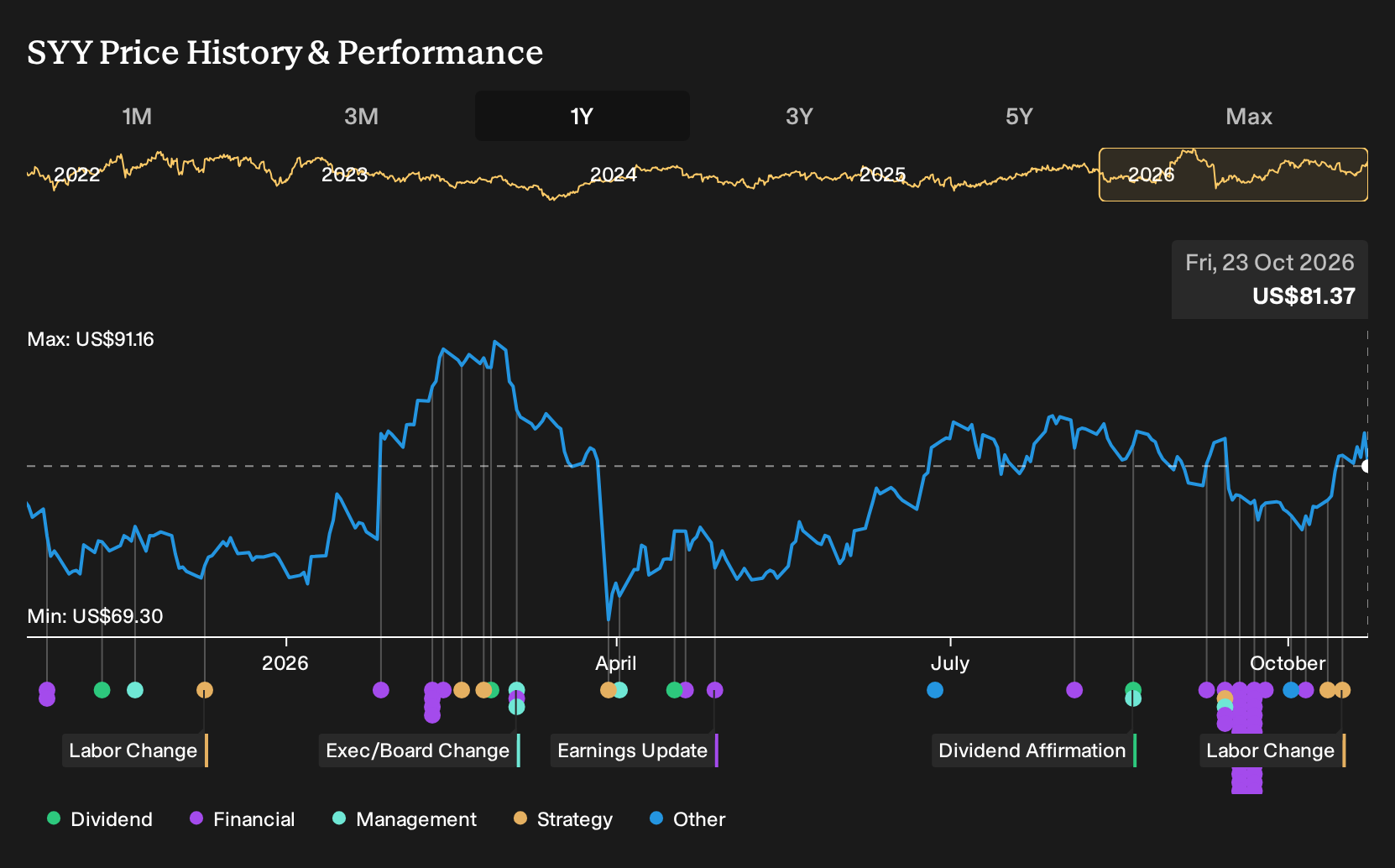
- Sysco reached a historic labor agreement with Teamsters Locals 630 and 848 in Los Angeles, ending a disruptive strike and confirming terms around wages, benefits and working conditions for warehouse and delivery workers.
- The resolution of this dispute reduces operational uncertainty at a key distribution hub, which is important for Sysco’s service reliability, cost planning and labor relations approach across other regions.
- The next step is to assess how Sysco’s investment narrative could be influenced by the restored labor stability at its Los Angeles operations.
Scan how labor sensitive distributors like Sysco compare by focusing on companies screened for 30 resilient stocks with low risk scores with more resilient risk profiles and steadier operating setups.
Sysco Investment Narrative Recap
To own Sysco, you need to believe the food distribution engine can translate its scale, AI projects and the planned Restaurant Depot deal into steadier earnings and cash generation, despite higher leverage and relatively modest expected revenue growth. The Los Angeles agreement removes a local disruption, but it does not materially change the near term focus on integration, technology delivery and capital discipline.
Right now, the key short term swing factor is execution on AI and cost efficiency programs that feed into margin and cash flow. The biggest risk is that higher debt and equity issuance strain sentiment if operating cash does not keep pace. Labor stability in Los Angeles helps operational reliability at the margin, rather than redefining that risk reward balance.
The October 16 agreement with Teamsters Locals 630 and 848 matters because it protects Sysco’s ability to keep trucks moving in a major market while it tackles bigger projects, such as AI rollouts and the Restaurant Depot acquisition. Food distribution is a high fixed cost activity, so avoiding stop start disruption can be important for service levels and cost planning.
Management previously highlighted concerns about contract language that could open the door to frequent strikes. With a deal now in place, attention shifts back to Sysco’s execution on its technology savings target of US$500 million by fiscal 2029 and the planned uplift from Restaurant Depot, against the backdrop of debt that is flagged as not well covered by operating cash flow.
What The Sysco Analyst Case Is Really Asking You To Believe
Sysco's consensus story is fairly clear once the numbers are stripped back to their basics. Analysts are building in 4.7% yearly revenue growth over the next three years, profit margins stepping up from 2.1% today to 3.0%, and earnings moving from US$1.8b to US$2.9b by 2029 while the share count stays flat. That combination points to a bigger profit pool built on roughly the same ownership base, which is why the P/E input matters so much in the model.
On the earnings side, the shift from US$1.8b today to US$2.9b by the 2029 forecast implies roughly a 1.1x increase in profit on the current base. For an investor looking at Sysco, that gap between present and projected earnings is where execution risk sits. AI projects, Restaurant Depot integration and mix changes toward higher margin customers all have to feed into that higher earnings number for the thesis to hold together.
Valuation assumptions then stack on top of those operating inputs. The consensus framework uses a P/E of 18.7x on 2029 earnings, down from 22.1x today and slightly higher than the 18.0x cited for the broader US Consumer Retailing group. That lower multiple relative to today's level means the model is not only asking you to underwrite higher profits, it is also asking you to accept a future scenario where Sysco trades closer to the sector average multiple than it does now.
Sysco's narrative projects US$96.9b revenue and US$2.9b earnings by 2029. This requires 4.7% yearly revenue growth and roughly a 1.1x earnings increase from US$1.8b today.
Uncover why Sysco's fair value indicates an 11% potential upside to its current price that could narrow quickly.
Exploring Other Perspectives
Three fair value views from the Simply Wall St Community cluster between about US$90 and US$145 per share, so you are seeing sharply different takes on Sysco’s worth. That spread meets fresh catalysts such as the Restaurant Depot deal, higher leverage and the new Los Angeles labor peace, which could all reshape how you and other investors frame Sysco’s future performance.
Explore 2 other Sysco fair value estimates, including one that suggests it could be worth just $90.31.
Reach Your Own Conclusion
Don't just follow the ticker. Dig into the data and build a conviction that's truly your own.
- A great starting point for your Sysco research is our analysis highlighting 3 key rewards and 1 important warning sign that could impact your investment decision.
- See our latest analysis for Sysco. The report includes a comprehensive fundamental analysis summarized in a single visual, the Snowflake, making it easy to evaluate Sysco's overall financial health at a glance.
Looking For More Ideas Beyond Sysco?
If Sysco is only one piece of your watchlist, it can help to line it up against other businesses that fit clear, filterable criteria. Use the Simply Wall St Screener to compare different angles and pressure test your thesis from multiple directions.
- For investors who care most about stability, start with companies flagged as 30 resilient stocks with low risk scores and see which businesses pair resilience with lower overall risk profiles.
- If income is your priority, scan a universe of payouts through 5 dividend fortresses that focus on higher yields backed by underlying fundamentals.
- When you want potential upside paired with solid financial footing, review the 21 high quality undiscovered gems that combine quality metrics with less crowded ownership.
Have feedback on this article? Concerned about the content? Get in touch with us directly. Alternatively, email editorial-team@simplywallst.com