
How Investors Are Reacting To Hubbell (HUBB) Dividend Increase
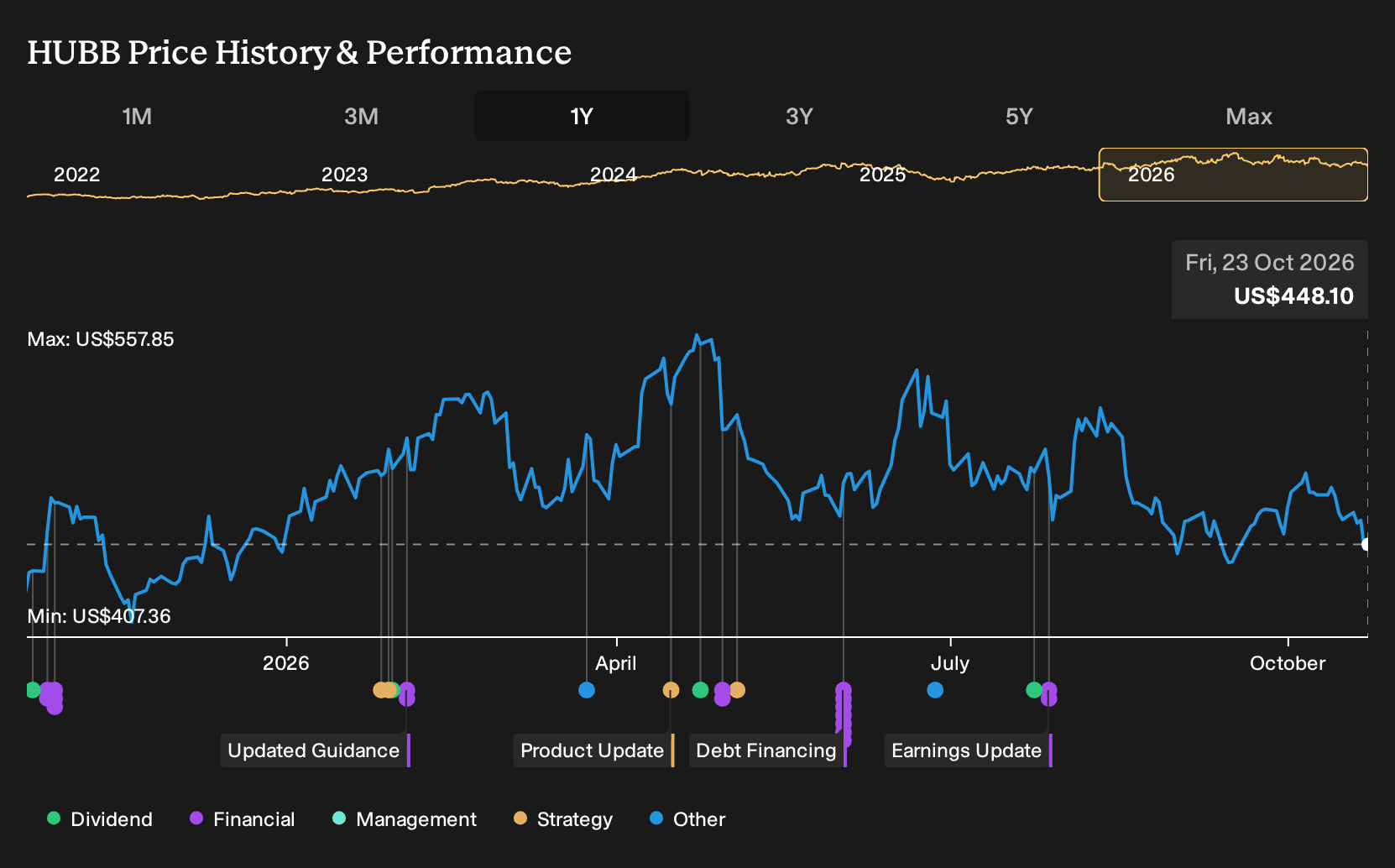
- Hubbell raised its common stock dividend rate by 7%, with the annual payout moving to $6.08 per share, or $1.52 quarterly, for investors on record as of November 30, 2026, with payment made on December 15, 2026.
- This higher cash return links Hubbell’s utility and electrical solutions earnings base more closely with shareholder income, which can matter for investors assessing how dependable the company’s grid, data center and acquisition driven cash flows feel over time.
- We will now look at how Hubbell's higher $6.08 annual dividend might reshape the investment narrative around cash generation and resilience.
Scan how Hubbell's dividend move compares with peers by reviewing 5 dividend fortresses, which may offer similar income potential with different risk profiles.
Hubbell Investment Narrative Recap
Owning Hubbell means believing its utility and electrical platforms can keep turning grid, data center and NSI related demand into steady cash. The 7% dividend lift to US$6.08 a year signals confidence in that cash generation, but by itself it does not change the near term story. The main upside still rests on grid hardening, high voltage projects and data center orders converting into sustained earnings.
The biggest swing factor remains execution on NSI integration and margin stability in Electrical Solutions, especially after the recent margin pressure in that segment. Higher leverage and roughly US$170 million of extra 2026 interest expense keep balance sheet risk on the table. The dividend increase looks incremental to that risk reward equation rather than a new catalyst.
The NSI acquisition, at about US$3.0b, is the key backdrop for this higher dividend. Management has outlined revenue and cost synergy ambitions over three years, which puts real weight on integration discipline, product cross selling and cost control. For a shareholder, the raised payout now sits against those operational goals and the higher interest burden.
Dividend growth can feel reassuring. However, the more important question is whether NSI and the broader Hubbell portfolio can support that cash commitment while funding grid, transmission and data center opportunities. Execution on pricing power, especially the broad increases introduced in April and July 2026, and on Utility Solutions backlog conversion will likely matter more to the medium term outcome than this single dividend step.
Hubbell's analyst narrative points to US$8.6b in revenue and US$1.3b in earnings by 2029, based on an assumed 11.5% yearly revenue growth rate and an earnings increase of about US$399.4m from US$900.6m today.
Uncover how Hubbell's fair value indicates a 26% potential upside to its current price, a gap that may not last much longer.
Exploring Other Perspectives
Some of the most optimistic analysts focus on Hubbell’s capacity investments as the real swing factor, rather than the higher dividend. Before this dividend news, they were modeling about US$9.0b in revenue and US$1.3b in earnings by 2029, with a P/E of 32.9x. You can compare that upbeat view with more cautious forecasts and decide which story fits your expectations.
Explore 3 other Hubbell fair value estimates, including one that suggests up to 41% upside from the current price.
Decide For Yourself
Don't just follow the ticker. Dig into the data and build a conviction that's truly your own.
- A great starting point for your Hubbell research is our analysis highlighting 4 key rewards and 1 important warning sign that could impact your investment decision.
- See our latest analysis for Hubbell. The report includes a comprehensive fundamental analysis summarized in a single visual, the Snowflake, making it easy to evaluate Hubbell's overall financial health at a glance.
Looking For More Investment Ideas Beyond Hubbell?
Hubbell may sit at the center of your research right now, but your portfolio decisions usually benefit from comparing it with other potential opportunities that fit different risk and income preferences.
- If capital preservation is your priority, check out a curated 30 resilient stocks with low risk scores that may offer steadier profiles for more cautious investors.
- For investors hunting for quality at a sensible price, scan a focused 27 high quality undervalued stocks that screens for stronger fundamentals with support from cash flow and balance sheets.
- Income focused portfolios can tap into a hand picked 5 dividend fortresses that highlights stocks where yield and stability work together.
Have feedback on this article? Concerned about the content? Get in touch with us directly. Alternatively, email editorial-team@simplywallst.com