
Is Mastercard (MA) Still Cheap As Its Stablecoin And AI Push Gains Traction?
Mastercard (MA) just rolled out its Global Money Platform with BVNK, tying its card network to stablecoin rails through a single API. Investors now have fresh information on how the business is leaning into digital assets.
Recent price action has been constructive for Mastercard, with a 30 day share price return of 11.37% and a 90 day gain of 15.55% as investors react to a steady stream of product launches in stablecoins, AI driven tools and fraud prevention ahead of upcoming earnings.
Scan Mastercard’s digital-payments peers on our curated list of 39 profitable AI stocks that aren't just burning cash, which are also leaning into AI, blockchain and new transaction rails.
After a 15.55% move in 90 days and fresh digital-asset launches, Mastercard is already pricing in plenty of optimism. The real puzzle now is whether most of the upside is behind the stock or still in front of it.
Most Popular Narrative: 16.9% Undervalued
According to the most widely followed narrative on Mastercard, a fair value of $750 sits well above the recent close near $623. This frames the current debate around whether the market is properly weighing the payment network's durability and cash generation.
What it offers instead: a business that compounds safely, a payout growing at double-digit rates from a tiny base, and a price that doesn''t currently reflect either of those things. Setups like that don''t come around often, and the current pullback looks more like an entry point than a warning sign.
See why 148 investors see Mastercard as 17% undervalued.
Putting numbers around that story, the narrative from Investingwilly pegs Mastercard's fair value at $750 per share. This implies the stock trades at roughly a 16.9% discount to that estimate based on the last close of $623.60. The analysis applies a discount rate of 7.25%, which reflects the return investors might reasonably ask for when they price the stream of future cash flows tied to Mastercard's payment rails and services.
The same narrative leans heavily on earnings power. Mastercard reported revenue of $35.08b and net income of $16.26b, which implies net margins around 46%. That level of profitability gives the business room to fund new products like the Global Money Platform while still returning capital to shareholders through dividends and buybacks.
Recent fundamentals line up with that story. Revenue growth is reported at 10.8% year on year, net income growth at 11.3%, and earnings growth over the past 5 years at 13.8% annually. Over just the last year, earnings growth of 19.7% is ahead of the 5-year pace and also ahead of the 9.6% figure cited for the wider Diversified Financial industry. This helps explain why some long term holders focus more on compounding than on quarter-to-quarter sentiment shifts.
Market performance tells a more muted story than the narrative. The 1-year total return of 9.4% roughly matches the 9.1% return for the broader US market and comes in ahead of the 6% return for the Diversified Financial peer group. Over 3 and 5 years, total returns of 74.4% and 91.5% respectively point to compounding for investors who have held the stock over longer stretches, even if the last twelve months have felt choppy.
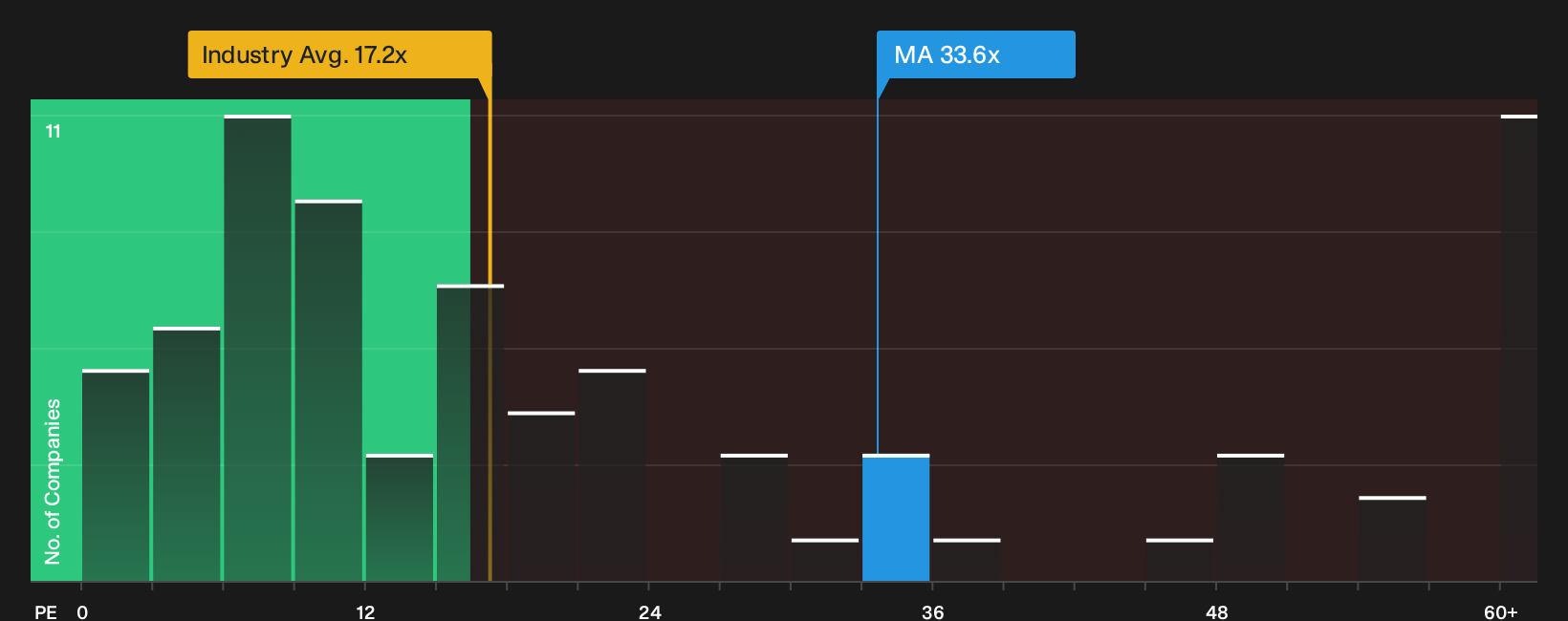
On valuation, the internal SWS checks are mixed. One statement flags Mastercard as trading at 30.8% below an estimated fair value based on future cash flows of $901.49 per share. This would frame the shares as cheap against that specific discounted cash flow benchmark. At the same time, the stock is described as expensive on a P/E basis when compared with both the US Diversified Financial industry average P/E of 17.2x and an estimated fair P/E of 19.5x, even though it screens as better value than a peer average P/E of 49.1x. Those opposing signals help explain why reasonable investors land on different sides of the valuation debate.
The quality checks lean constructive. Earnings are described as high quality, net profit margins of 46.3% are above last year's 44.9%, and return on equity is flagged as outstanding, even if that figure is influenced by leverage. Earnings are also forecast to keep growing at 11.3% per year, with revenue expected to expand around 10.8% annually. Those growth rates are slower than the 17% earnings and 13.3% revenue growth figures cited for the US market, but they still describe a business that is not standing still.
Governance and capital structure risk round out the picture. The board is described as experienced with an average tenure of 7.8 years and 91% independent directors, yet there have been no new director appointments in the last 3 years, which may limit fresh perspectives. Management tenure averages 2.1 years, which is flagged as experienced by the methodology used, and CEO compensation is called out as above the typical $14.84m paid at similar sized US companies, even though it is said to be in line with company performance. On the balance sheet, Mastercard is marked as having a high level of debt and relying entirely on higher risk external borrowing rather than customer deposits, and there has been significant insider selling over the past 3 months, which some readers may view as a yellow flag worth tracking against future results.
All in, the current narrative frames Mastercard as a highly profitable payment platform with robust earnings quality and steady growth. Discounted cash flow work and user narratives point to undervaluation, while headline P/E checks against the sector argue the opposite. For investors weighing the fresh digital asset rollout against these fundamentals, the tension sits less in the operating metrics and more in what kind of valuation profile suits this kind of compounding business over the long haul. Result: Fair Value of $750 (UNDERVALUED)
Still, Mastercard’s story can get knocked off course if regulators squeeze interchange economics or if new payment rails sidestep its network more quickly than expected.
Find out about the key risks to this Mastercard narrative.
Another View On Mastercard’s Valuation
On the flip side of the user narrative and SWS DCF work pointing to value, the simple P/E check tells a tougher story. Mastercard trades at 33.6x earnings, almost double the US Diversified Financial industry on 17.2x and well above a fair ratio of 19.5x. That gap suggests real multiple risk if sentiment cools.
For investors who prefer to anchor on earnings multiples rather than cash flow models, our valuation breakdown sets out how this richer P/E stacks up against peers and that fair ratio benchmark in more detail, and where that leaves Mastercard if growth or enthusiasm fade from here. See what the numbers say about this price — find out in our valuation breakdown.
Next Steps
If this Mastercard story feels finely balanced, move fast and pull up the data yourself so you can weigh the red flags against the upside. A good starting point is to review the 3 key rewards and 2 important warning signs.
Looking For More Investment Ideas Beyond Mastercard?
If Mastercard feels fully priced to you right now, you may want to widen the lens and let a few data driven shortlists surface fresh opportunities before the crowd.
- Target steady appreciation and fewer negative surprises by scanning a 30 resilient stocks with low risk scores that already screen well on resilience and downside protection.
- Hunt for mispriced quality by reviewing a 27 high quality undervalued stocks that combine solid fundamentals with share prices that lag their underlying strength.
- Spot tomorrow’s potential leaders early by combing through a 21 high quality undiscovered gems that pair strong financials with relatively low market attention.
Have feedback on this article? Concerned about the content? Get in touch with us directly. Alternatively, email editorial-team@simplywallst.com