
Biohaven (BHVN) As FDA Review And Ono Deal Revive The Buying Opportunity Question
Regulatory momentum and new licensing deal reshape the Biohaven story
Biohaven (BHVN) has been back in focus after the FDA agreed to review its resubmitted application for Vyglxia in spinocerebellar ataxia and scheduled an advisory committee meeting, while a new Ono Pharmaceutical licensing deal added fresh attention to its pipeline.
That FDA decision and the Ono deal arrived alongside sharp trading swings, with Biohaven’s share price dropping 5.5% on the day to US$13.88 after a recent 7 day share price return of 28.8%. However, the 1 year total shareholder return declined 16.4% and the 3 year total shareholder return fell 48.3%, so recent momentum contrasts with a much tougher longer term track record in the stock.
Compare Biohaven’s regulatory story with other late stage healthcare opportunities by scanning our hand picked 34 healthcare AI stocks that are moving on clinical and data catalysts.
Biohaven now looks like a busy drug developer with regulatory momentum and a new licensing partner. After such a sharp swing in the share price, the key question is whether that pipeline strength is already fully reflected in the US$13.88 share price.
Most Popular Narrative: 67% Undervalued
Against Biohaven’s last close at $13.88, the most followed narrative anchors on a Fair Value of $42.29 and frames the recent FDA and licensing news inside a much larger long term pipeline story built on epilepsy and autoimmune programs.
The up to US$795m global licensing agreement for the Kv7 ion channel platform with SK Biopharmaceuticals, which includes tiered U.S. sales royalties, introduces an external commercialization route that can add milestone income and capital efficient revenue without fully burdening Biohaven’s own operating costs.
The pivotal Phase 3 trial of BHV-1300 in Graves’ disease, as a first MoDE extracellular protein degrader targeting pathogenic IgG1 TSH receptor autoantibodies, creates a potential new autoimmune revenue stream that is largely separate from epilepsy and could improve earnings diversification if successful.
See why 0 investors see Biohaven as 67% undervalued.
Result: Fair Value of $42.29 (UNDERVALUED)
Still, if opakalim’s partial FDA hold expands or key trials disappoint, or if fresh equity funding proves heavier than expected, the bullish Biohaven narrative could unravel quickly.
Find out about the key risks to this Biohaven narrative.
Another view on Biohaven’s valuation
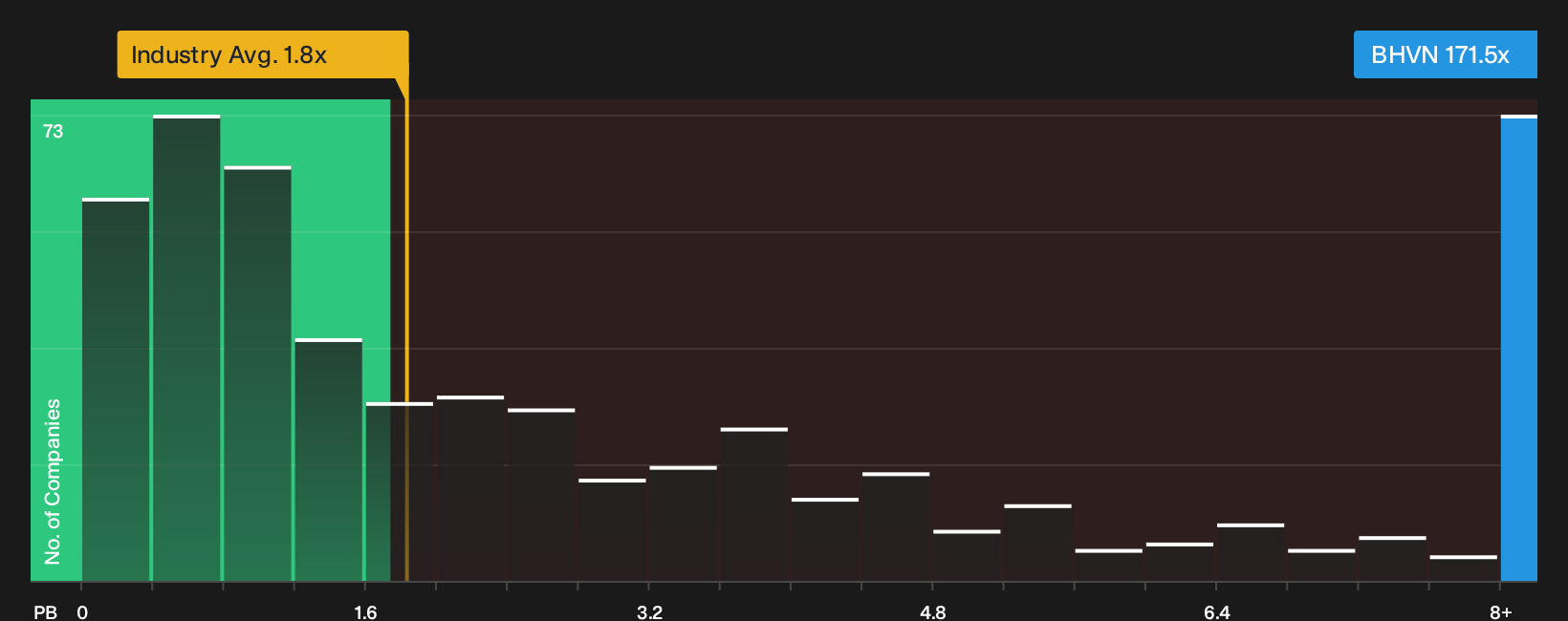
The story looks very different once you switch from the SWS DCF model to a simple P/B check. On that measure, Biohaven trades on a 171.5x P/B ratio, compared with 1.9x for the US Biotechs industry and 4.4x for its peer group. This points to a heavy valuation premium. The open question is whether that kind of gap reflects future pipeline potential or instead increases the risk side of the equation for new buyers.
See what the numbers say about this price — find out in our valuation breakdown.
Next Steps
Conflicted by Biohaven’s combination of pipeline optimism and valuation questions? Act quickly and dig into the details yourself, starting with the 2 key rewards and 5 important warning signs.
Looking for more investment ideas beyond Biohaven?
If Biohaven has sharpened your thinking, broaden your opportunity set now with a few focused screens that surface companies matching very different risk and return profiles.
- Target resilient balance sheets and steady fundamentals by running a list of solid balance sheet and fundamentals (25 results) that filters for financial strength first.
- Hunt for potential mispricing by checking a 27 high quality undervalued stocks that highlights quality businesses trading below their estimated worth.
- Spot dependable income ideas through a 5 dividend fortresses that focuses on higher yield payouts with staying power.
Have feedback on this article? Concerned about the content? Get in touch with us directly. Alternatively, email editorial-team@simplywallst.com