
Visa (V), What Is Drawing Fresh Attention Now?
Visa (V) has become a talking point after a roughly 10% move over the past month as investors weigh its AI driven commercial payments rollout, its expanding digital asset partnerships, and the approaching fiscal fourth quarter earnings update.
For context, Visa’s share price is up 11.03% over the past 30 days and 17.73% year to date. Its 1-year total shareholder return of 18.37% and 5-year total shareholder return around 2x suggest momentum building alongside the recent AI, stablecoin and earnings narrative.
Spot fast movers riding similar AI and payments momentum by scanning our hand picked 39 profitable AI stocks that aren't just burning cash, which already pair real earnings with applied AI products.Visa now trades only a few percent below both analyst targets and one estimate of intrinsic value after that sharp run. Is this a fair premium, or is the market overpaying for AI and digital asset excitement as earnings approach?
Most Popular Narrative: 67% Overvalued
Visa closed at $407.92, while the widely followed narrative fair value from Esteban pins it at $243.70, which implies a steep premium and puts the recent AI and payments enthusiasm under a tougher spotlight.
Visa executes steadily on its three-pillar strategy: Consumer Payments volume growing 8-9% in constant dollars driven by secular cash-to-card conversion and cross-border recovery, CMS at ~20% initially decelerating to ~12% by FY30, VAS sustaining 20-25% growth before decelerating to ~15% by FY32 as the business matures. The DOJ antitrust case resolves with a monetary settlement and limited routing adjustments, painful but not structurally disruptive to the debit network economics. A2A rails remain fragmented outside Brazil and India, Visa monetizes the trend indirectly via Visa Direct. Non-GAAP operating margins expand from ~67.7% (FY2025) to ~71% by FY2030 as VAS scales and operating leverage is captured. Revenue grows in low-double-digits in FY2026-FY2027 (consistent with management guidance of "low-double-digit adjusted net revenue growth"), decelerating to 7-8% by FY2033-FY2035 as the base grows and secular conversion matures in developed markets.
See why 10 investors see Visa as 67% overvalued.
Result: Fair Value of $243.70 (OVERVALUED)
Still, this upbeat Visa narrative could be knocked off course if the DOJ case leads to tougher debit economics or if account to account rails gain traction more quickly than expected.
Find out about the key risks to this Visa narrative.
Another View On Visa’s Valuation
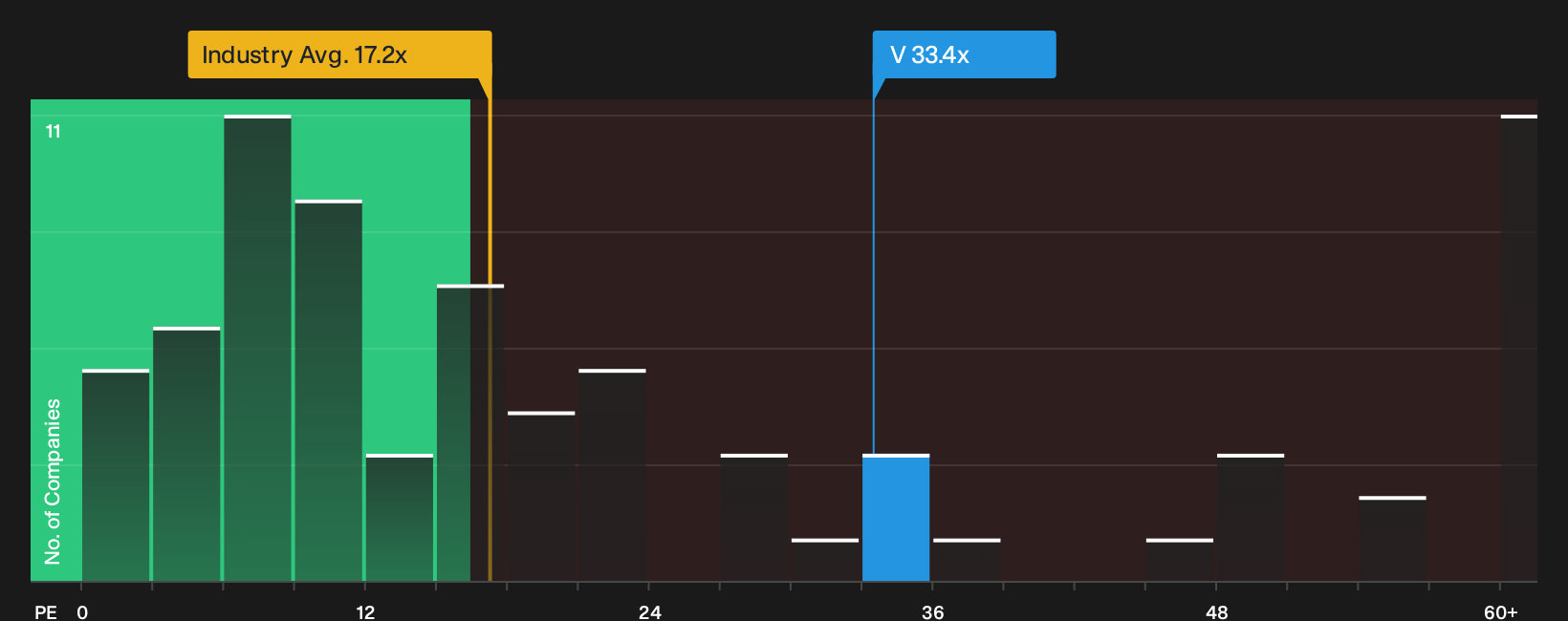
Esteban’s narrative points to Visa looking 67% overvalued at $407.92, yet the market is not treating it as an outlier. On a P/E of 33.4x, the stock trades well above the US Diversified Financial industry at 17.2x, and also above a fair ratio of 20.3x that the market could move toward over time.
This richer P/E is still lower than the 49.2x peer average. That softens the idea that Visa is in extreme territory but keeps valuation risk in play if investors ever decide to pay closer to that 20.3x fair ratio instead. Is this a durable quality premium, or a point where expectations start working against holders?
See what the numbers say about this price — find out in our valuation breakdown.
Next Steps
Mixed messages on Visa’s valuation and growth story. If you want to move past the headlines and form your own view quickly, start with the 3 key rewards and 1 important warning sign.
Looking for more investment ideas beyond Visa?
Visa sets a high bar, but your portfolio deserves more than a single story. Use data driven stock lists to surface fresh opportunities before they become crowded trades.
- Target potential mispricing by scanning companies that line up on quality and valuation using the 29 high quality undervalued stocks.
- Strengthen your income stream by reviewing the 5 dividend fortresses that focus on higher yields with robust profiles.
- Dial down portfolio risk by filtering for businesses in the 30 resilient stocks with low risk scores that combine resilience with more measured volatility.
Have feedback on this article? Concerned about the content? Get in touch with us directly. Alternatively, email editorial-team@simplywallst.com