
US Large Cap Dividend Stocks Paying Investors To Wait On Lower Rates
Interest rates are stuck in a holding pattern, inflation is still above the Fed’s target, and energy costs are being shaken by fresh geopolitical shocks. That mix keeps pressure on borrowing costs and future returns, but it also pushes attention toward large US dividend stocks that already pay investors to wait. This article walks through three US Large-Cap Dividend Stocks exposed to these macro crosswinds and explains why each might deserve a closer look right now.
The stocks covered in this piece are just a first pass, and the full screen surfaced 47 more large-cap dividend payers with similarly detailed stories that are not included here. To identify and analyze the highest-conviction ideas that fit your own risk and income goals, head straight to the US Large-Cap Dividend Stocks screener.
Packaging Corporation of America (PKG)
Packaging Corporation of America fits the US Large-Cap Dividend Stocks theme as a cash-generative, dividend-paying industrial that leans on relatively steady demand for everyday packaging rather than aggressive growth bets.
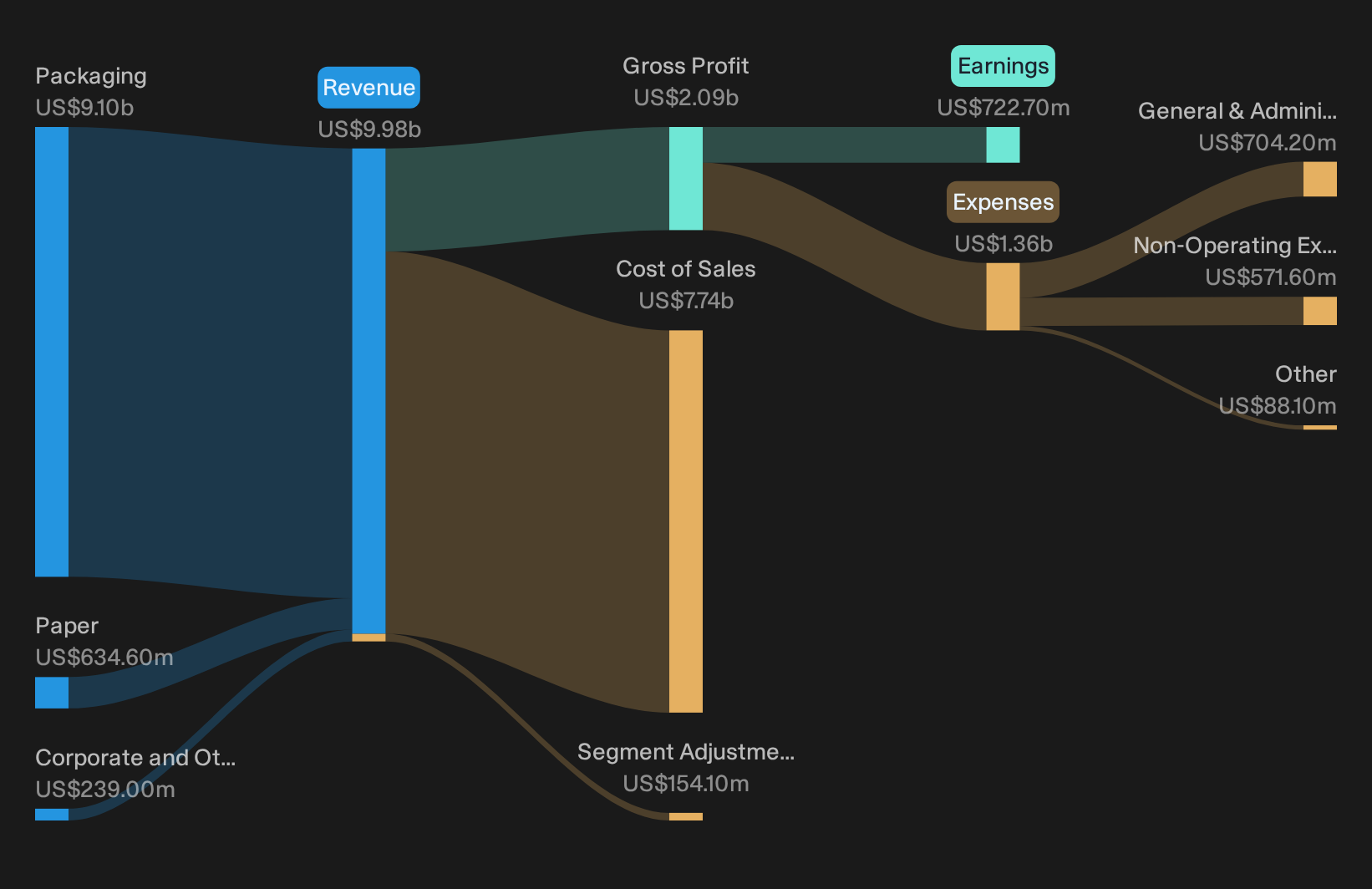
Packaging Corporation of America runs a large North American containerboard and paper operation, with about US$9.1b of sales from packaging and US$600 million from paper, giving it a roughly US$21.9b equity value in the market.
Packaging Corporation of America is operating in a containerboard market that management describes as very tight, with mills expected to run full through 2026 and limited ability for customers to source extra tons. This can support pricing power and revenue resilience.
The outcome for income investors may hinge on how one stubborn cost pressure interacts with that pricing power over the next few years.
To see how that cost squeeze could either stall or accelerate Packaging Corporation of America’s cash story, read the full narrative for Packaging Corporation of America for what might be coming next.
H.B. Fuller (FUL)
H.B. Fuller fits this US Large-Cap Dividend Stocks theme as a long-established adhesives specialist that leans on recurring demand from everyday industrial and construction uses to keep cash flowing for a steady income profile.
H.B. Fuller is a US$2.7b adhesives and specialty chemicals producer. Its largest unit, Hygiene, Health and Consumable Adhesives, brings in about US$1.6b of sales, followed by Engineering Adhesives at roughly US$1.1b and Building Adhesive Solutions at about US$900 million.
Income-focused investors tend to watch H.B. Fuller closely when rates stay higher for longer. The business leans on essential adhesives rather than discretionary projects, which can make its dividend stream feel more predictable when other cash flows look shakier.
H.B. Fuller is focused on maintaining pricing discipline and securing additional pricing gains, particularly in the HHC segment, which is expected to improve EBITDA margins as raw material cost pressures subside. If end market demand in areas like packaging and construction remains soft and pricing can no longer compensate, revenue growth and earnings could fall short of expectations.
What really decides how attractive that dividend looks a few years from now is whether one emerging cost pressure quietly erodes the margin progress management is working so hard to protect.
If that pressure keeps building, read the full narrative for H.B. Fuller to see how H.B. Fuller could still turn pricing discipline into accelerating long term income potential.

Cabot (CBT)
Cabot fits the US Large-Cap Dividend Stocks theme as a mature US specialty chemicals business that pays investors a regular dividend while leaning on diversified industrial demand for specialty carbons, reinforcement materials and performance chemicals.
Cabot generates about US$2.2b of sales from Reinforcement Materials and roughly US$1.3b from Performance Chemicals, with smaller contributions in Unallocated and Other, and the stock carries a market value of around US$3.8b.
Cabot gives income-focused investors exposure to rubber, plastics and battery materials used in everything from tires and industrial parts to electric vehicles. This can feel reassuring when rate-sensitive growth stories are swinging around more aggressively.
The rapid build-out of global battery capacity and data center related battery energy storage systems is heavily concentrated in China and other highly competitive regions, which could pressure pricing for Cabot's conductive additives and reduce future revenue growth and EBITDA contribution from Battery Materials.
What really matters is how one less obvious cost and pricing pressure shapes Cabot’s margin profile just as investors are counting on steadier earnings.
To see how that margin risk could turn into an earnings tailwind for Cabot, read the full narrative for Cabot for the full story on what might be accelerating beneath the surface.

Seeking Fresh Alternatives Before They Fly
Fresh ideas often move first. Screens fill with momentum, then the window tightens and the most attractive entry points are captured by faster traders. Scan these under-the-radar lists to explore opportunities early.
- Target resilient payers that could keep income flowing even when headlines turn noisy by scanning this curated group of 5 dividend fortresses.
- Hunt for lesser-known operators with strong fundamentals that larger funds may still be ignoring through this focused set of 21 high quality undiscovered gems.
- Review companies linked to energy security and electrification by exploring this concentrated pocket of 16 nuclear energy infrastructure stocks.
Have feedback on this article? Concerned about the content? Get in touch with us directly. Alternatively, email editorial-team@simplywallst.com