
Did AI Tax Launch Just Shift Intuit Stock Investment Narrative?
- Intuit has rolled out AI driven Credit Karma Tax with flat pricing, extended Intuit Intelligence globally across QuickBooks and Accountant Suite, and deepened its AI focused partnership with Aprio to build sector specific advisory tools.
- By coupling zero fee federal filing and low cost state returns with AI agents that automate tax prep and cash flow planning, Intuit is using price as a funnel into a broader financial platform anchored on its data and automation capabilities.
- We will now look at how Intuit’s AI driven Credit Karma Tax launch could reshape the broader investment narrative for the business.
Intuit Investment Narrative Recap
To own Intuit, you need to believe its AI driven financial system and lower priced entry points can keep pulling in more tax, small business, and mid market customers, then deepen their usage across the platform. The Credit Karma Tax launch leans into that thesis by using a flat fee offer and automation to rebuild the DIY funnel.
The near term swing factor is whether these lower priced products offset missed customer targets and recent DIY tax share loss where price pushed churn. The biggest risk remains that aggressive pricing and product complexity, including at Mailchimp, weigh on revenue mix and margins more than AI driven efficiency can support.
The Credit Karma Tax rollout looks tightly linked to one of the clearest catalysts, Intuit’s focus on lower priced acquisition channels such as QuickBooks Free, QuickBooks Lite and earlier versions of Credit Karma Tax. A simple US$0 federal and US$15 state offer with embedded AI support is a direct test of that playbook during tax season.
If execution goes well, this product could widen the top of the funnel for Intuit’s consumer and money ecosystems and create more users for its AI agents around refunds, debt and paycheck management. If uptake is weak or monetization of add ons stalls, pressure on DIY tax economics and growth expectations would stay front and center.
What The Intuit Consensus Is Pricing In
Analysts are effectively tying the Intuit story to a specific earnings path and multiple. The current consensus assumes revenue increases by 8.9% a year over the next few years, current earnings sit at US$4.6b, and forecasts point to US$6.9b by 2029, which is about a US$2.3b uplift. On those numbers, the same group is looking for Intuit to generate US$27.7b of revenue and US$6.9b of earnings in 2029.
To align with that view, you would need to be comfortable that an 8.9% annual top line expansion is achievable, that profit margins move from 21.3% today to 24.8% in three years, and that a P/E of 18x on 2029 earnings is reasonable when compared with 16.1x today and 29.7x for the wider US software peer group. The forecast also incorporates a 4.01% annual reduction in share count over the next three years, which supports earnings per share even if revenue tracks closer to the low end of expectations.
Intuit's narrative projects US$27.7b revenue and US$6.9b earnings by 2029. That profile assumes 8.9% yearly revenue growth and an earnings increase of about US$2.3b from US$4.6b today.
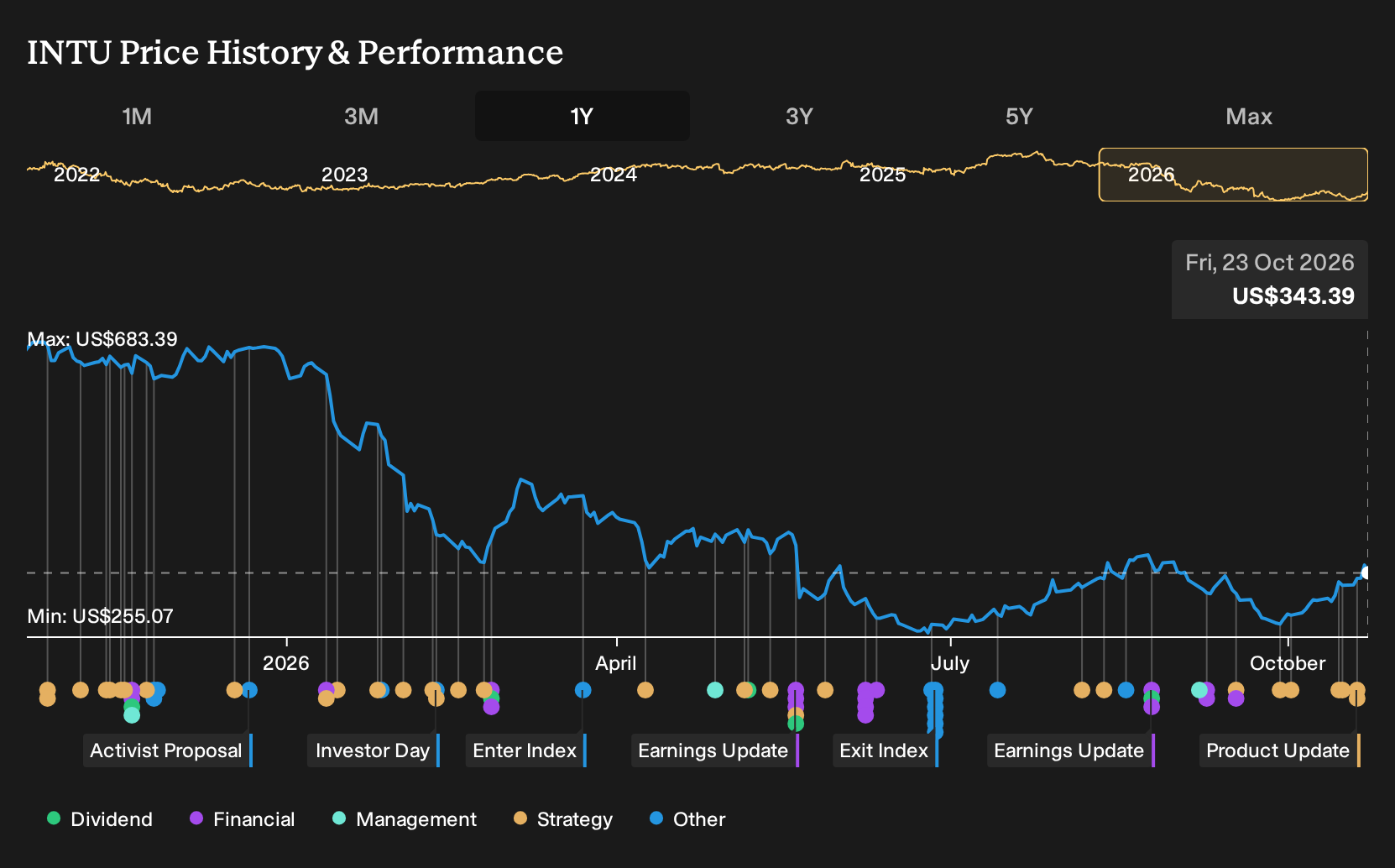
Uncover why Intuit's fair value indicates an 18% potential upside to its current price that could narrow faster than many investors expect.
Exploring Other Perspectives
The most pessimistic analysts focus on a different risk for Intuit. They worry that heavier exposure to money products and credit could cap earnings, even before this Credit Karma Tax launch. Their pre news models were closer to US$27.3b revenue and US$6.5b earnings by 2029. That is a cooler story than consensus and it shows how far views can spread. Use this new AI driven tax move as a prompt to explore both sets of assumptions and decide which camp sounds closer to your own expectations.
Explore 14 other Intuit fair value estimates, including one that suggests it could be worth just $390.00.
Reach Your Own Conclusion
Disagree with existing narratives? Extraordinary investment returns rarely come from following the herd, so go with your instincts.
- A great starting point for your Intuit research is our analysis highlighting 5 key rewards that could impact your investment decision.
- See our latest analysis for Intuit. The report includes a comprehensive fundamental analysis summarized in a single visual, the Snowflake, making it easy to evaluate Intuit's overall financial health at a glance.
Looking For More Investment Ideas Beyond Intuit?
If the Intuit story has sharpened how you think about pricing power, product funnels, and AI driven automation, it can be useful to line that up against companies with very different risk and balance sheet profiles. The Simply Wall St Screener can help you quickly surface a mix of opportunities that match your own tolerance for volatility and income needs.
- For investors who care most about stability and capital preservation, review a curated 30 resilient stocks with low risk scores that pairs lower risk scores with solid balance sheet strength.
- If you are hunting for mispriced quality, scan a focused 29 high quality undervalued stocks that blends stronger cash flows with balance sheets that can support long term compounding.
- For readers who want income on top of potential capital gains, shortlist a 5 dividend fortresses that screens for higher yields backed by underlying financial resilience.
Have feedback on this article? Concerned about the content? Get in touch with us directly. Alternatively, email editorial-team@simplywallst.com