
AI Job Cuts Could Lift Genpact Stock And Other White Collar Automation Shares
AI is starting to do the work that used to fall to junior office staff, and that shift is reshaping who gets hired, what companies spend on salaries, and where future profits might pool. Investors watching this change risk missing it while arguing about headlines. This article walks through three stocks that appear closely exposed to the latest AI job disruption news and explains how that exposure could influence portfolios over time.
The stocks highlighted below are just a starting sample of this theme. The full screen surfaced 96 more U.S. listed businesses with similarly interesting AI-linked storylines that are not covered in the article. To see the wider field and quickly identify which candidates best match your own criteria, head straight into the AI-Driven Productivity Winners in White-Collar Industries screener
Genpact (G)
Genpact is one of the clearest examples in this screener of AI being used to reshape white collar workflows, with its tools aimed at replacing repetitive junior tasks rather than just trimming costs around the edges.
Genpact runs outsourced finance, operations and customer service for large enterprises, using AI and analytics to automate many of those white collar routines. It generates about US$1.39b from Financial Services, US$1.79b from Consumer and Healthcare, and US$2.07b from High Tech and Manufacturing, and is valued at roughly US$6.9b.
"Although non FTE, outcome based and consumption models already represent a significant share of revenue and generally support margin improvement, these models also shift more delivery and performance risk to Genpact. This could pressure earnings if implementations underperform client expectations or volumes fluctuate."
What happens to Genpact’s earnings power if one unseen pressure quietly reshapes how much clients are willing to pay for that automation?
That quiet shift in pricing power is exactly why it helps to read the full narrative for Genpact, where the full story on risk and opportunity comes into focus.

Accenture (ACN)
Accenture aligns directly with this screener’s theme by helping big employers replace repetitive white collar work with AI driven workflows. This is a key reason its US$22.45b Products, US$13.96b Financial Services and other segments matter at a US$147.31b market cap.
Accenture’s AI strategy is to be the enterprise AI implementation partner, not the foundation-model owner. It is trying to own the layer where AI becomes useful inside large organizations: workflow redesign, data pipelines, security, governance, integration, compliance, agent deployment and managed operations.
The key question is what happens to Accenture’s earning power if a single assumption about how clients share the gains from that productivity shift breaks down.
If that sharing model is your hinge risk, read the full narrative for Accenture to see how Accenture’s AI push could accelerate or decouple from client budgets.

ExlService Holdings (EXLS)
ExlService Holdings pitches itself as a data and AI partner for white collar work, wiring automation directly into insurance, healthcare and finance workflows. That pitch matters more as employers look to AI to replace entry level tasks rather than just trim overtime.
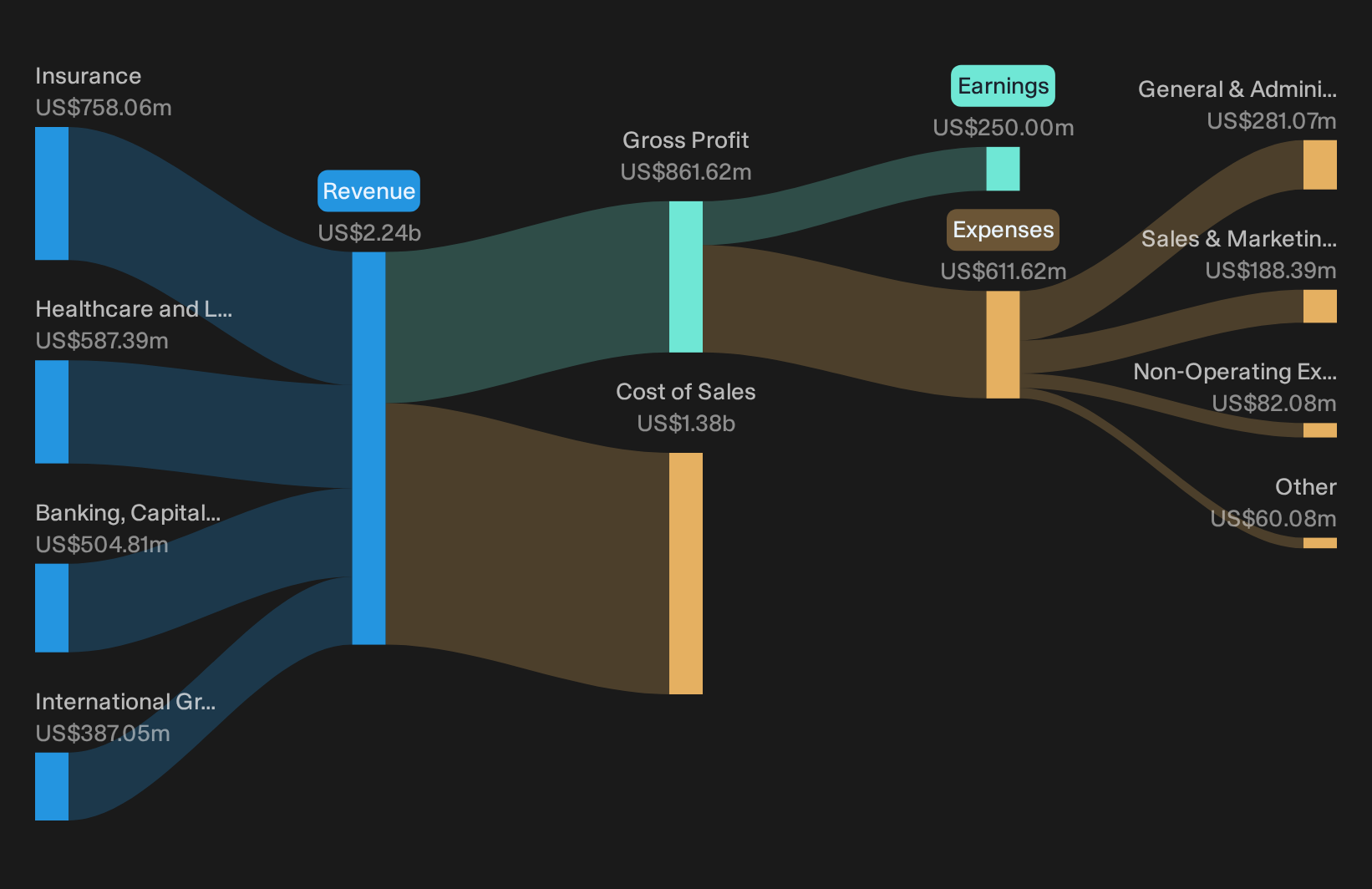
ExlService Holdings runs AI enabled digital operations across insurance, healthcare and finance. Insurance brings in about US$758 million, Healthcare and Life Sciences US$587 million, Banking, Capital Markets and Diversified Industries US$505 million, and International Growth Markets US$387 million, at a roughly US$6.4b market value.
"Five years of mix shift into AI-led work has produced no gross margin expansion, and contracts are terminable without cause."
The key question is what happens if a quiet shift in how clients pay for AI driven workflows finally shows up in ExlService Holdings’ margins and growth trajectory.
That margin puzzle is exactly why it helps to read the full narrative for ExlService Holdings, which lays out how ExlService Holdings could turn AI contract risk into accelerating earnings power.
Seeking Alternatives Before The Crowd?
Fresh themes often move first, then the breakout momentum fades as more money piles in and pricing moves away from attractive entry points. Review these under the radar ideas while they may still be relevant and consider them carefully.
- Target potential income streams by focusing on a curated 5 dividend fortresses that is designed to keep cash flowing even when sentiment cools.
- Look for potential category leaders among a focused 21 high quality undiscovered gems that many investors may not yet be following, allowing more room to evaluate opportunities at an earlier stage.
- Evaluate the next infrastructure phase of AI by reviewing a concentrated 55 AI infrastructure stocks before momentum changes the landscape for the most capable developers and operators.
Have feedback on this article? Concerned about the content? Get in touch with us directly. Alternatively, email editorial-team@simplywallst.com