
Wall Street is hoping for a rebound after the election. BTIG throws cold water: the midterm elections may be a “starting point of decline” rather than a “starting point of rebound”
The Zhitong Finance App notes that Wall Street investors who are expecting the stock market to rise after the November midterm elections may be disappointed. BTIG strategist Jonathan Klinsky believes that as credit conditions deteriorate and multiple sectors show fatigue, the risk of a stock market decline is rising.
Klinsky said in a research report on Sunday that the S&P 500 could fall back to around 7,300 points, close to its 200-day EMA and summer low. This is equivalent to a 4.3% drop from the index's recent level of 7631 points. If it falls below this technical support level, the benchmark index may decline further.
This warning challenges the general expectation that “the stock market will rise after uncertainty about the November 3 election subsides”. Judging from history, midterm elections are often a turning point for the stock market, but Klinsky believes that this year's unusually strong market performance makes it less likely that this scene will be repeated.
According to BTIG data, since 1962, the average maximum retracement of the S&P 500 index between June and December of the midterm election year was 13.76%. This year, the biggest decline since June 1 was only 4.5%, the second smallest retracement in the period.
Klinsky wrote, “The reason the stock market often performs well in November of the midterm elections is that the S&P 500 usually weakens before the elections. The opposite was true this year.”
The strategist said that the S&P 500 also deviated from its historical seasonal pattern at other points this year, indicating that investors should not take for granted that elections will provide a catalyst for further growth.
“Although the market consensus is that there will be a rebound after the midterm elections, we think the opposite is actually more likely to happen,” he wrote.
The credit market lights up warning signals
One of Klinsky's biggest concerns is the widening yield gap for low-rated corporate bonds — this change often indicates an increase in financial pressure before stock prices reflect it.
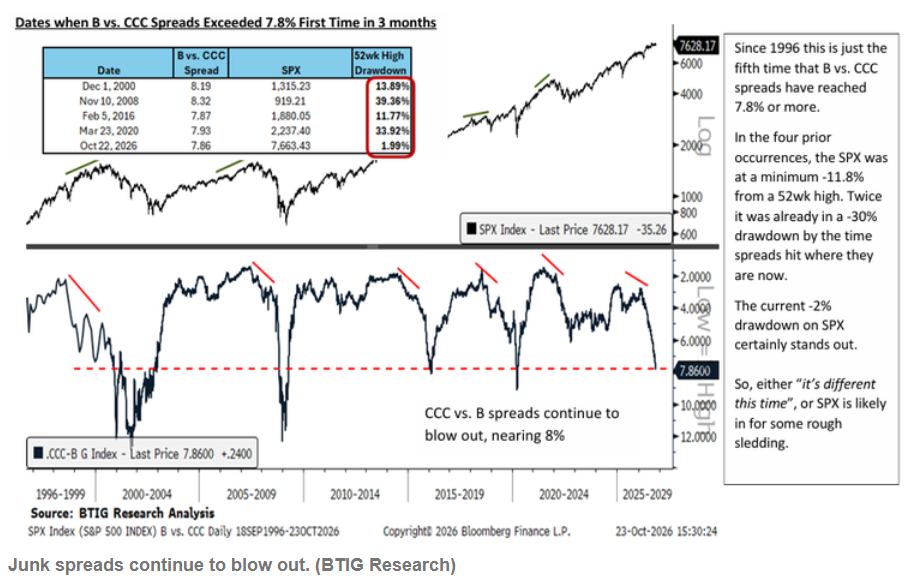
According to BTIG statistics, the spread between B-grade and CCC-grade bonds has reached about 7.8 percentage points. This level has only occurred four times since 1996.
In every case before this, the S&P 500 index has fallen at least 11.8% from its 52-week high. On two of these occasions, when credit spreads reached similar levels, the benchmark index had fallen by about 30%.
The reason why the current divergence is notable is that the S&P 500 is still only about 2% below its recent high. “So either 'this time is different, 'or the S&P 500 may be about to face a difficult downturn,” Klinsky wrote.
For investors, this disconnect raises questions about whether stock valuations adequately reflect deteriorating credit conditions. Widening interest spreads may indicate increased concerns about corporate borrowers' ability to repay their debts, which in turn may indicate tightening financing conditions and weakening economic activity.
Klinsky also pointed to increased pressure on the technology credit market. Credit default swap spreads of large hyperscale computing companies have continued to widen, while interest spreads on investment-grade technology bonds have risen to the highest level since 2022.
This deterioration occurred against the backdrop that the S&P 500 technology sector was still only a few percentage points below its all-time high.
The private equity market also showed similar fatigue. Business Development Companies (BDCs) — institutions that finance businesses outside of traditional bank lending channels — have fallen to multi-year lows and are struggling to maintain a rebound.
The weakening of semiconductors contrasts with the strengthening of software
After a recent failed attempt to rebound from technical support, Klinsky continued to be bearish on semiconductor stocks.
Although iShares Semiconductor ETF and Vaneck Semiconductor ETF are still above the 200-day EMA, the SPDR S&P Semiconductor ETF, which uses an equal weight preparation method, has fallen below this level.
“We still believe semiconductor stocks will continue to decline in the coming weeks and months,” Klinsky wrote.
However, software stocks are a potential bright spot. An equal-weight software index has broken through the two-year trading range, and its strength relative to the general market has reached the highest level this year.
The ratio between equal-weighted software stocks and equal-weighted semiconductor stocks has also broken through a year-long trading bottom, suggesting that the leading forces within the technology sector may shift.
When talking about software stocks, Klinsky wrote, “If you want to find momentum, this is the entry point.”
This divergence suggests that investors may need to be more selective within the technology sector rather than treating the entire sector as a single transaction.
Lack of investors heightens fears
Klinsky also questioned whether the market experienced enough selling pressure to build a lasting bottom.
The bearish/bullish ratio in the options market is still far below the level during the market pressure in March and July, indicating that investors have not actively bought protection to hedge against the risk of further declines.
“In the absence of hedging, it's hard to think we've seen a meaningful low,” he wrote.
The breadth of the market provides another warning. For about 33% of this year's trading days, the direction of the S&P 500 index deviated from the direction of market breadth — that is, more individual stocks fell while the index rose, or vice versa.
BTIG's historical analysis shows that this continuing divergence is unlikely to continue indefinitely.
A number of economically sensitive industries also appear vulnerable. Klinsky pointed out that sectors such as industry, healthcare, catering, aviation, and gaming are showing technical fatigue.
The report focuses on the Mexican-style fast food brand Chipotle Mexican Grill (CMG.US), whose stock price has fallen back to the level since 2022. BTIG separately maintains the restaurant chain's “buy” rating and a target price of $45.
Taken together, weakening credit indicators, worsening market breadth, and technical breakdowns in various sectors all indicate that investors may have underestimated the risk of a wider pullback.
Not only will the midterm elections not end market uncertainty, but they may well be accompanied by a new round of selling pressure — especially as the S&P 500 follows other major market sectors and tests its 200-day EMA.