
What Comes Next For WIN Semiconductors After A 396% Gain
WIN Semiconductors spent the past year moving from talk to execution, with fresh Q2 2026 figures showing higher revenue and a swing from a loss to profit as net margin shifted from an 11.1% deficit to 18.6%. Investors who held WIN Semiconductors over the past year are up 396.0%, including dividends. If you had bought before that earnings reset, what would you have needed to believe about those smartphone, Wi-Fi, optical, and satellite projects already on the table?
If the move has made WIN Semiconductors harder to judge, start where the gap is still open and scan 194 high quality undervalued stocks.
The Argument You Would Have Been Weighing Up On WIN Semiconductors
The shares cost NT$100 at the start of the period, and investors in WIN Semiconductors were effectively choosing between two very different stories about the same wafer producer.
The bullish narrative pointed to a Fair Value of NT$119, a notional price implied by its assumptions, built on Wi-Fi 7 and smartphone PA demand helping revenue expand and net margins lifting from a loss to 20% by 2028.
The bearish case anchored on a Fair Value of NT$69 and focused on risks such as rising export controls, onshoring, and customer concentration, with only 5.9% annual revenue growth and margins reaching 8.3% in its scenario.
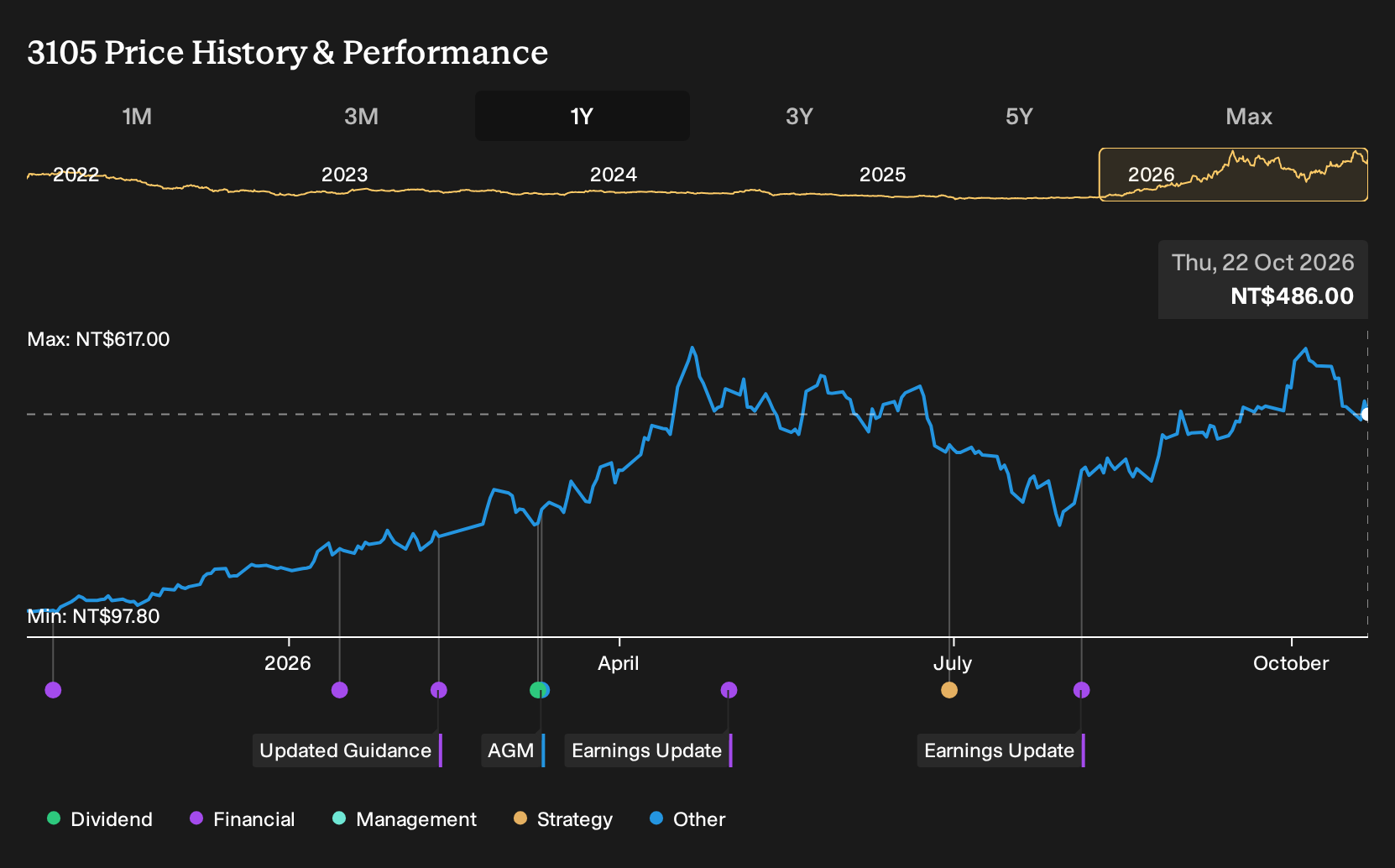
What The Results Changed For WIN Semiconductors
The clearest piece of evidence was WIN Semiconductors lifting total revenue from NT$3,780.398m in Q2 2025 to NT$5,257.268m in Q2 2026, while moving from a loss of NT$420.966m to a profit of NT$977.1m. Net margin shifted from an 11.1% deficit to 18.6%. That earnings swing leaned toward the optimistic case on profitability, although only over one quarter.
The lesson is simple. When a thesis leans on margin repair, track the reported net margin and absolute net income in each filing rather than just watching top-line recovery.
What WIN Semiconductors' Rally Already Prices In
WIN Semiconductors now trades at NT$486, after a roughly 396.0% gain over the past year. The selected Narrative’s Fair Value sits below the current price, which frames today’s level as already baking in a robust earnings recovery.
That view hinges on WIN Semiconductors steadily shifting toward higher margin infrastructure, aerospace, Wi-Fi and AI related optical work, while 60% utilization and pricing pressure still weigh on gross margin. A buyer at today’s price would need to assume that the mix upgrade succeeds quickly enough to offset weaker cellular power amplifiers.
"The main thing that has to go right is WIN Semiconductors successfully shifting its revenue mix toward higher margin infrastructure, aerospace, Wi-Fi and AI related optical applications, while keeping CapEx and depreciation tightly controlled so that improving mix translates into durable margin recovery."
That disagreement has a full argument behind it. → Uncover the lower Fair Value this Narrative argues for
WIN Semiconductors And AI’s Next Layer
WIN Semiconductors points you toward radio chips and optical links. The same AI buildout also leans heavily on something less visible.
Every high-end accelerator still needs fast working memory and reliable storage. Another specialist concentrates on that task, supplying the bits that keep models active.
This business focuses on advanced memory technologies tailored to data-heavy AI servers. It also pushes dense storage that helps data centers handle training and inference workloads.
As more projects look like WIN Semiconductors’ customers, that memory layer could matter more. The open question is how differently this once-commoditized segment now behaves.
It is written up in full, assumptions and all. → Explore the Narrative that puts this company 42% above its price
Have feedback on this article? Concerned about the content? Get in touch with us directly. Alternatively, email editorial-team@simplywallst.com